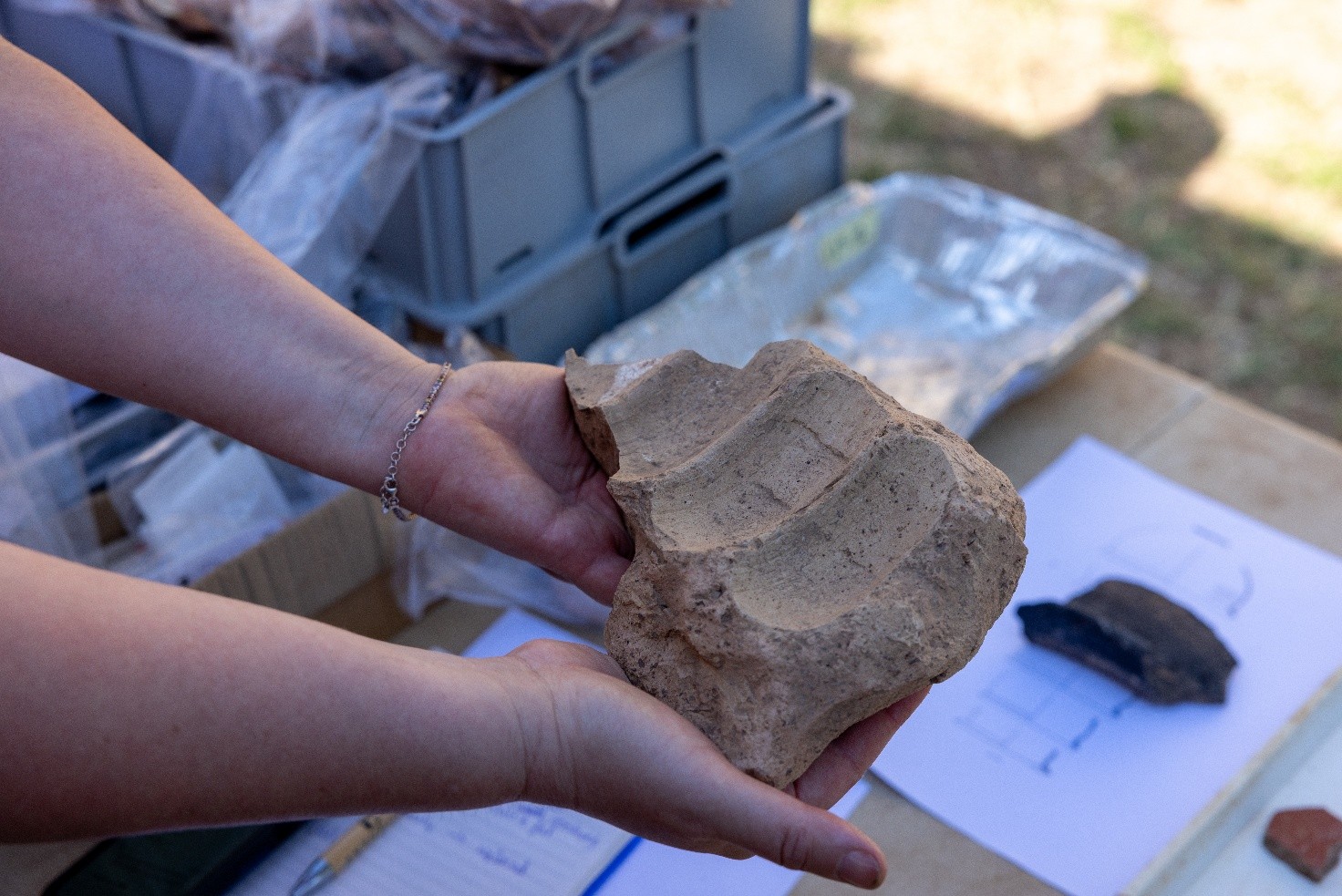
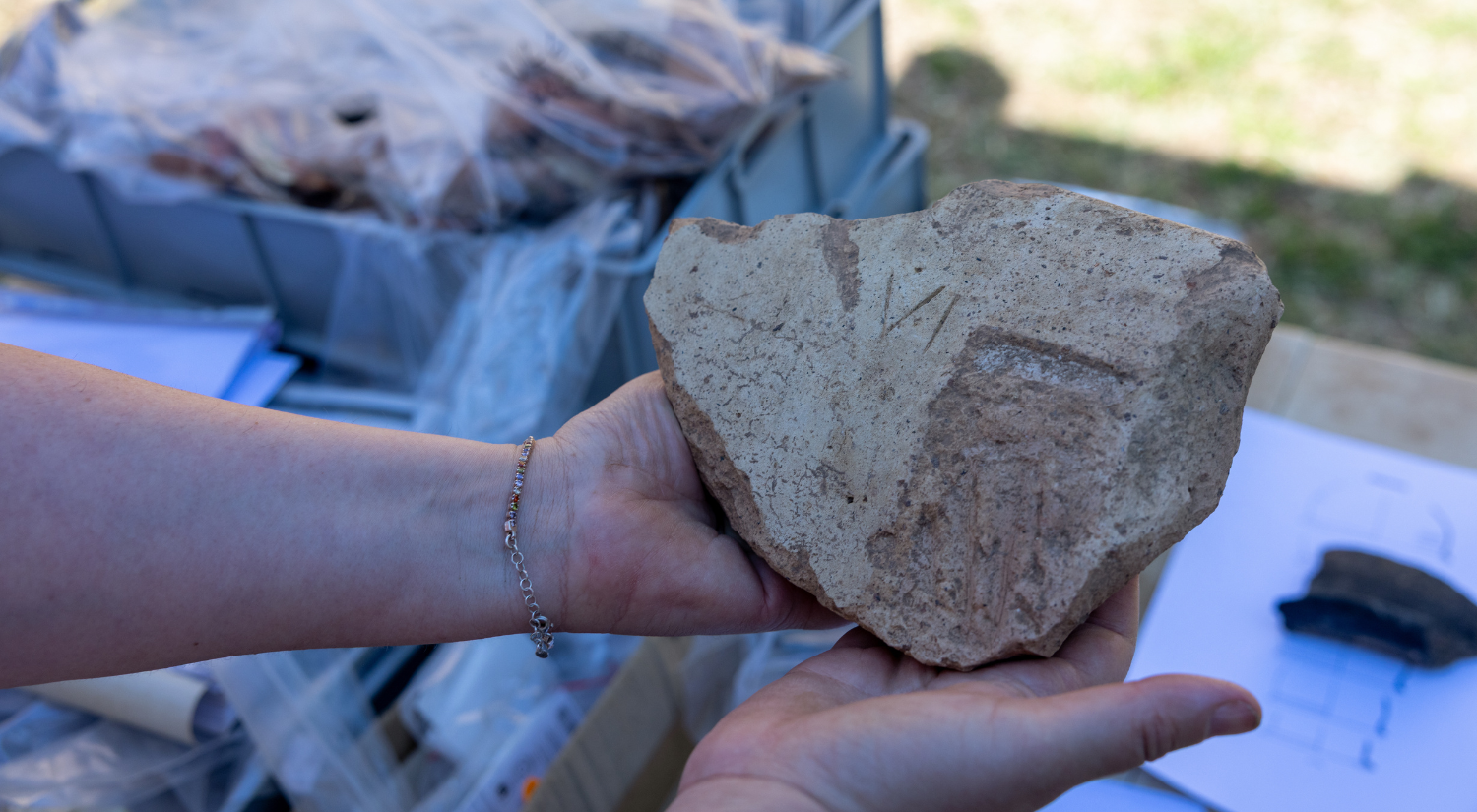
Among the most remarkable finds from the excavation at Falerii Novi is a fragment of architectural terracotta dating to the second century BCE, a reminder that the site’s history stretches far beyond the imperial and late antique layers that dominate much of the assemblage.
Architectural terracottas were the decorative and protective elements of Roman temple roofs. Given its considerable thickness, this fragment almost certainly belonged to a temple rather than a domestic building. Its function was both structural and protective: Roman temples of this period were built primarily in mud brick and timber, with very little use of stone, meaning the roof was designed with large beams to protect walls in perishable material. Terracotta slabs were fixed along the edges of the roof to shield the heavy wooden beams from the elements, while lighter elements such as antefixes decorated the smaller lateral rafters.
An architectural terracotta, photo by Nicholas Berardo, 2026
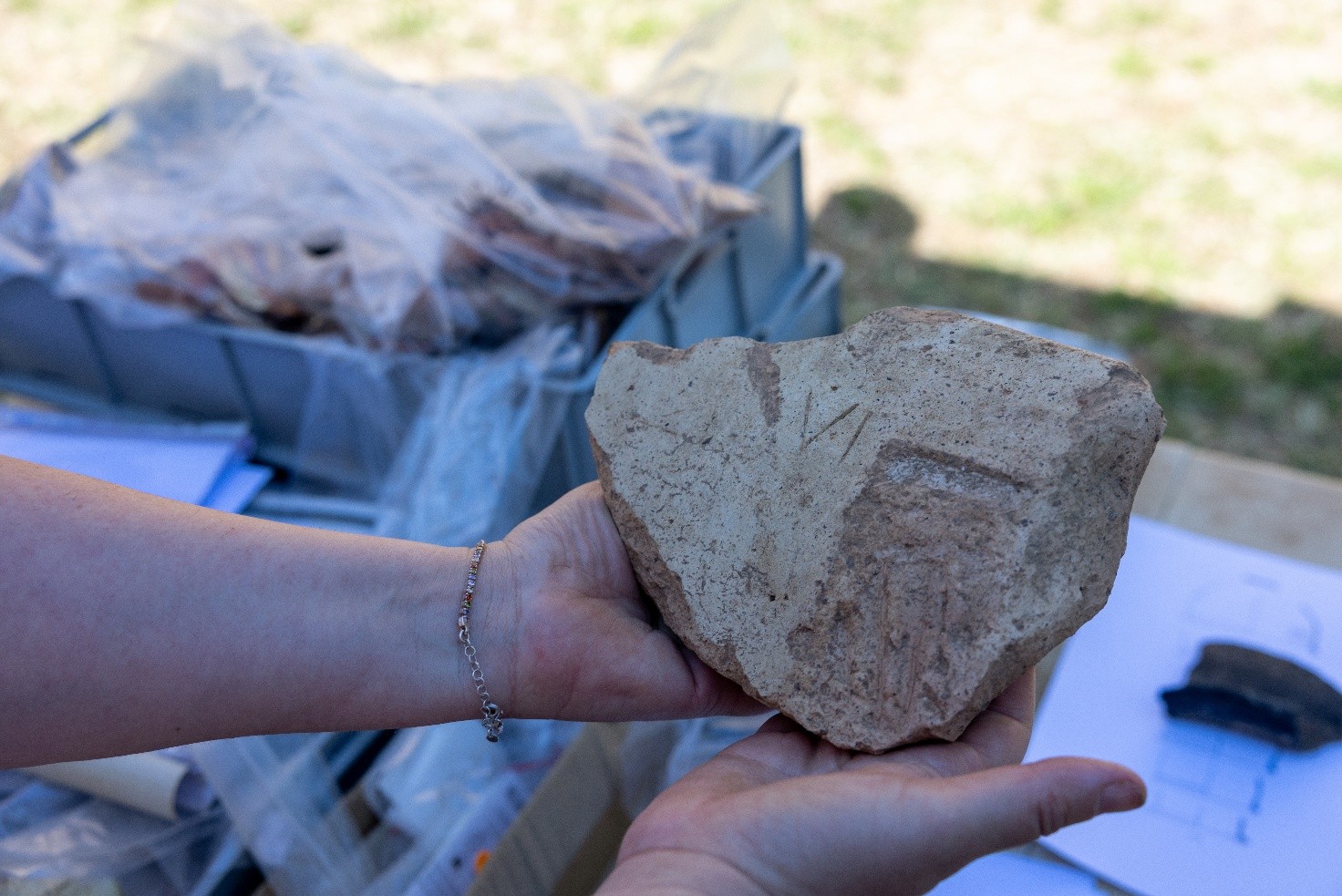
What makes this particular fragment especially fascinating is a detail incised into the clay before firing: the number six. This simple mark reveals an entire operational sequence. Before the terracottas were fired, the craftsmen already knew exactly where each piece would be positioned on the roof and in what order it would be installed. The ceramist producing these elements was therefore working directly for the temple – part of an organised workshop, likely located not far from the building itself, producing made-to-measure components for a specific architectural project: a kind of ancient IKEA assembly system.
The number six visible on the back of the terracotta, photo by Nicholas Berardo, 2026
The fragment was found in a third-century CE layer, making it what archaeologists call residual material, an object significantly older than the context in which it was discovered, having survived for centuries before ending up in later deposits as the city was transformed around it.
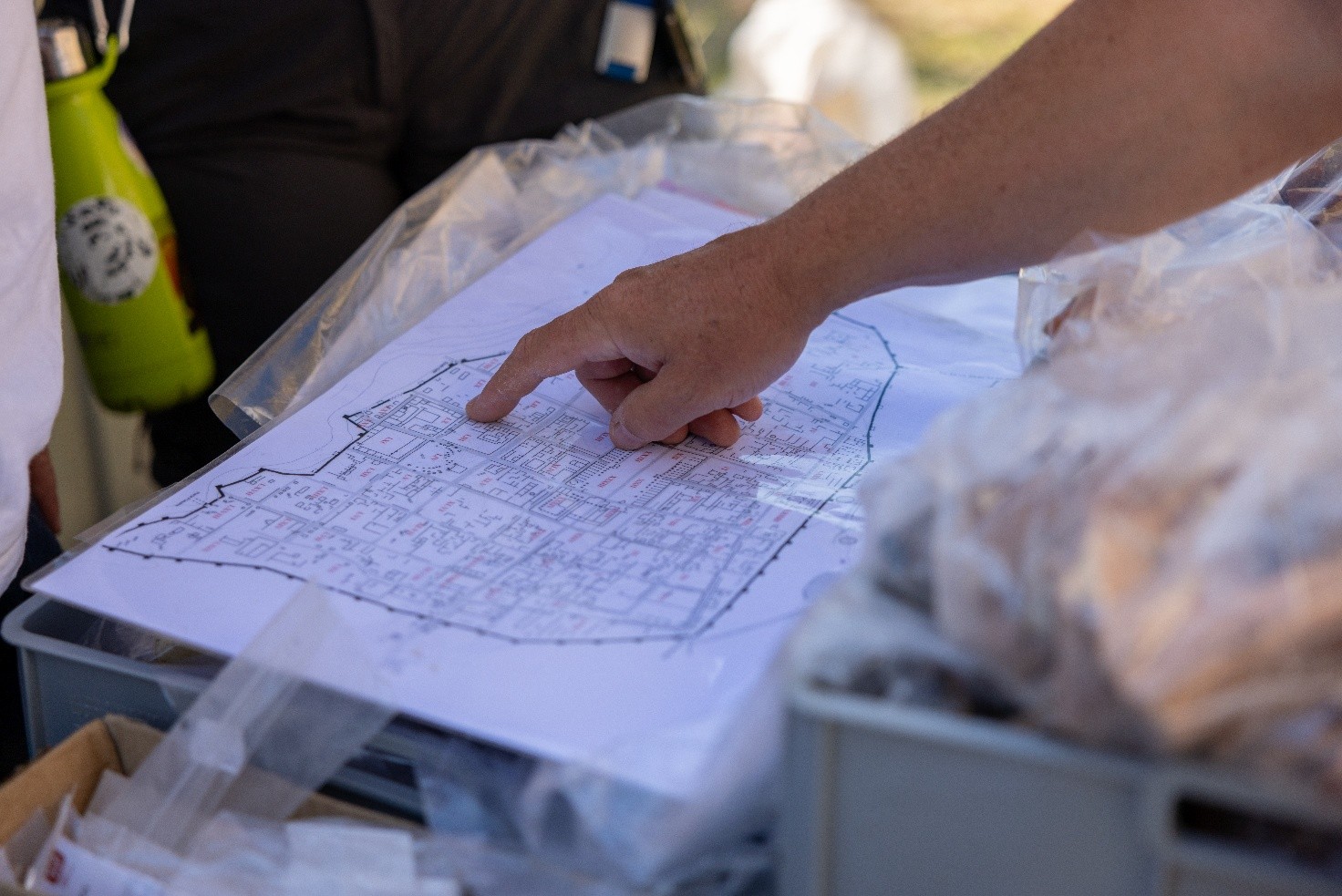
By the time Falerii Novi developed its later tufo, brick and mortar architecture, large protective terracotta slabs were no longer needed. Decorative terracottas continued to be used, but the architectural language had fundamentally changed. The city’s sacred topography, however, endured: geophysical survey has revealed traces of several monumental temple structures, including one near the forum whose foundations remain visible today. How many temples once stood at Falerii Novi, and when they fell out of use, remains one of the many questions that only further excavation can answer.
Geophysical interpretation producing a plan of the town, photo by Nicholas Berardo, 2026
Ethan Scanlon, Leverhulme Study Abroad Student at the British School at Rome from October 2025 to July 2026, shares insights into the development of his
Valeria Tettamanti, Ecole française de Rome (résidence scientifique jeunes chercheurs UNIONE –November 2025-July 2026) Awardee, discuss her project “Popular science in Italian feminine press at
Ethan Scanlon, Leverhulme Study Abroad Student at the British School at Rome from October 2025 to July 2026, shares insights into the development of his
Valeria Tettamanti, Ecole française de Rome (résidence scientifique jeunes chercheurs UNIONE –November 2025-July 2026) Awardee, discuss her project “Popular science in Italian feminine press at
Emlyn Dodd is former Assistant Director of the British School at Rome, an Associate Fellow of the Institute of Classical Studies at the University of
We use cookies on our website to give you the most relevant experience by remembering your preferences and repeat visits. By clicking “Accept All”, you consent to the use of ALL the cookies. However, you may visit "Cookie Settings" to provide a controlled consent.
This website uses cookies to improve your experience while you navigate through the website. Out of these, the cookies that are categorized as necessary are stored on your browser as they are essential for the working of basic functionalities of the website. We also use third-party cookies that help us analyze and understand how you use this website. These cookies will be stored in your browser only with your consent. You also have the option to opt-out of these cookies. But opting out of some of these cookies may affect your browsing experience.
Necessary cookies are absolutely essential for the website to function properly. These cookies ensure basic functionalities and security features of the website, anonymously.
Cookie
Duration
Description
cookielawinfo-checkbox-advertisement
1 year
Set by the GDPR Cookie Consent plugin, this cookie records the user consent for the cookies in the "Advertisement" category.
cookielawinfo-checkbox-analytics
11 months
This cookie is set by GDPR Cookie Consent plugin. The cookie is used to store the user consent for the cookies in the category "Analytics".
cookielawinfo-checkbox-functional
11 months
The cookie is set by GDPR cookie consent to record the user consent for the cookies in the category "Functional".
cookielawinfo-checkbox-necessary
11 months
This cookie is set by GDPR Cookie Consent plugin. The cookies is used to store the user consent for the cookies in the category "Necessary".
cookielawinfo-checkbox-others
11 months
This cookie is set by GDPR Cookie Consent plugin. The cookie is used to store the user consent for the cookies in the category "Other.
cookielawinfo-checkbox-performance
11 months
This cookie is set by GDPR Cookie Consent plugin. The cookie is used to store the user consent for the cookies in the category "Performance".
CookieLawInfoConsent
1 year
CookieYes sets this cookie to record the default button state of the corresponding category and the status of CCPA. It works only in coordination with the primary cookie.
elementor
never
The website's WordPress theme uses this cookie. It allows the website owner to implement or change the website's content in real-time.
viewed_cookie_policy
11 months
The cookie is set by the GDPR Cookie Consent plugin and is used to store whether or not user has consented to the use of cookies. It does not store any personal data.
Functional cookies help to perform certain functionalities like sharing the content of the website on social media platforms, collect feedbacks, and other third-party features.
Performance cookies are used to understand and analyze the key performance indexes of the website which helps in delivering a better user experience for the visitors.
Analytical cookies are used to understand how visitors interact with the website. These cookies help provide information on metrics the number of visitors, bounce rate, traffic source, etc.
Cookie
Duration
Description
_ga
1 year 1 month 4 days
Google Analytics sets this cookie to calculate visitor, session and campaign data and track site usage for the site's analytics report. The cookie stores information anonymously and assigns a randomly generated number to recognise unique visitors.
_ga_*
1 year 1 month 4 days
Google Analytics sets this cookie to store and count page views.
_gat_gtag_UA_*
1 minute
Google Analytics sets this cookie to store a unique user ID.
_gid
1 day
Google Analytics sets this cookie to store information on how visitors use a website while also creating an analytics report of the website's performance. Some of the collected data includes the number of visitors, their source, and the pages they visit anonymously.
CONSENT
2 years
YouTube sets this cookie via embedded YouTube videos and registers anonymous statistical data.
Advertisement cookies are used to provide visitors with relevant ads and marketing campaigns. These cookies track visitors across websites and collect information to provide customized ads.
Cookie
Duration
Description
VISITOR_INFO1_LIVE
5 months 27 days
YouTube sets this cookie to measure bandwidth, determining whether the user gets the new or old player interface.
YSC
session
Youtube sets this cookie to track the views of embedded videos on Youtube pages.