

From its earliest years, the BSR has placed great importance on its relationships with cultural institutions in Italy and abroad. In this new blog post, Claudia Pratillo, Librarian of the BSR Research Collections, explores how the book exchange, established by 1909–1910, helped build the Library and a wide network of partners.
Drawing on letters from the BSR Institutional Archive, the post traces the roles of Directors such as Thomas Ashby and John Ward-Perkins, and shows how the Library came to shape the School’s vision and policy.
The blog is published as part of the celebrations for the 125th anniversary of the founding of the BSR.
Since its early years, the British School at Rome has placed great importance on its relationships with other cultural institutions in Italy and abroad, so much so that these connections have become a core element of its overarching vision. This extensive network formed the backdrop against which the British School at Rome Library was established as a key resource for scholars and research in Rome and throughout Italy, alongside other leading institutions.
Before the role of Librarian was formally established within the British School at Rome’s administrative structure, management of the BSR Library was entrusted to the Director in office, with the help of the Assistant Director who was acting as Librarian, or individuals associated with the School. The collection expanded not only through book purchases and the generosity of supporters, but also through a powerful tool for cultural exchange: the book exchange.
According to the Annual Reports, the book exchange appears to have been an established practice from 1909–1910 onwards. Institutions were recorded on a list that was periodically reviewed and approved by the Managing Committee and, subsequently, by the Faculty of Archaeology, History and Letters (FAHL). This practice went hand in hand with the publication of the Papers of the British School at Rome, which was supplied to subscribers, to listed institutions, and, where appropriate, to potential exchange partners.
Throughout the long history of the British School at Rome, successive directors distinguished themselves through their efforts to enhance the School’s reputation as it took on an increasingly influential role, both institutionally and strategically. In this context, both formal and informal relationships developed between BSR Directors, members, scholars, publishers, authors, and Directors of other cultural institutions.
During their tenure at the BSR the Director Thomas Ashby (1906-1925) and his Assistant Director and Librarian Eugénie Strong (1909-1925), for example, periodically proposed names for the Faculty’s consideration. Arthur Hamilton Smith, a member of the Faculty, strongly advocated the cultural value of such appointments, as is evident from the correspondence held in the BSR’s institutional archive. Financial and cultural considerations weighed heavily on decisions regarding how many copies of the Papers to send, while the primary aim remained expanding the collection through relationships with institutions deemed ‘useful to the cause’.
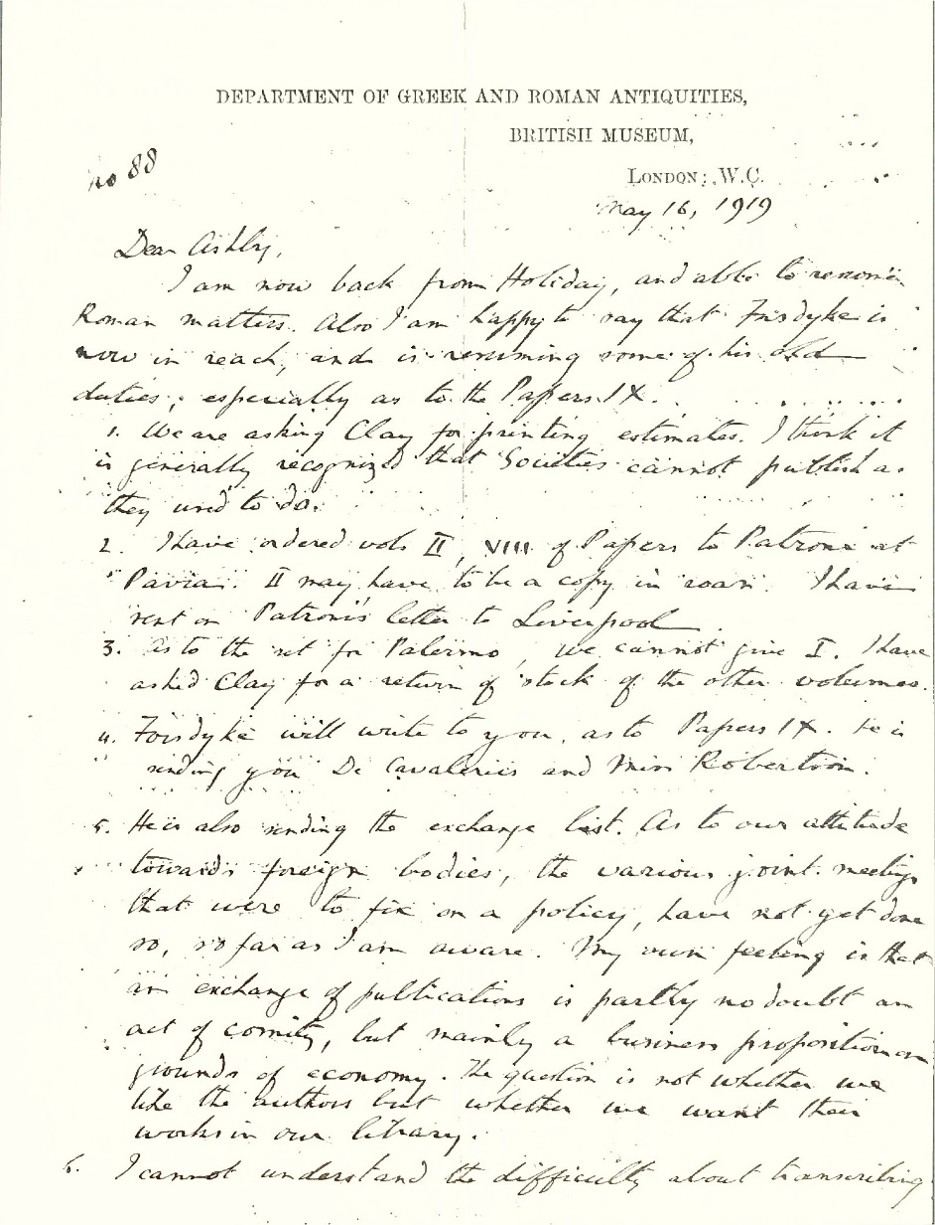

In such cases, it was necessary to strike a balance between an institution’s potential cultural significance and its direct impact on the School, while maintaining ties driven purely by scholarly interest. The same applied to the Director John Bryan Ward-Perkins (1945-1974) who, like his predecessors, conducted extensive research beyond the Academy, directly influencing the number and calibre of institutions seeking collaboration during his tenure, as well as giving rise to one of the most significant institutional forms of partnership between foreign libraries: the Unione Internazionale degli Istituti di Archeologia, Storia e Storia dell’Arte in Roma.
During the two world wars, it became crucial to separate the wartime climate from the value of cultural exchange, as excluding certain institutions for political reasons risked undermining their development and, by extension, broader cultural heritage. In a 1947 letter to the Secretary of the South African Society for Cultural Relations with Italy—who had sought advice on establishing a potential South African Institute in Rome—Ward-Perkins highlighted that forging links with existing libraries must go hand in hand with building a new library collection.

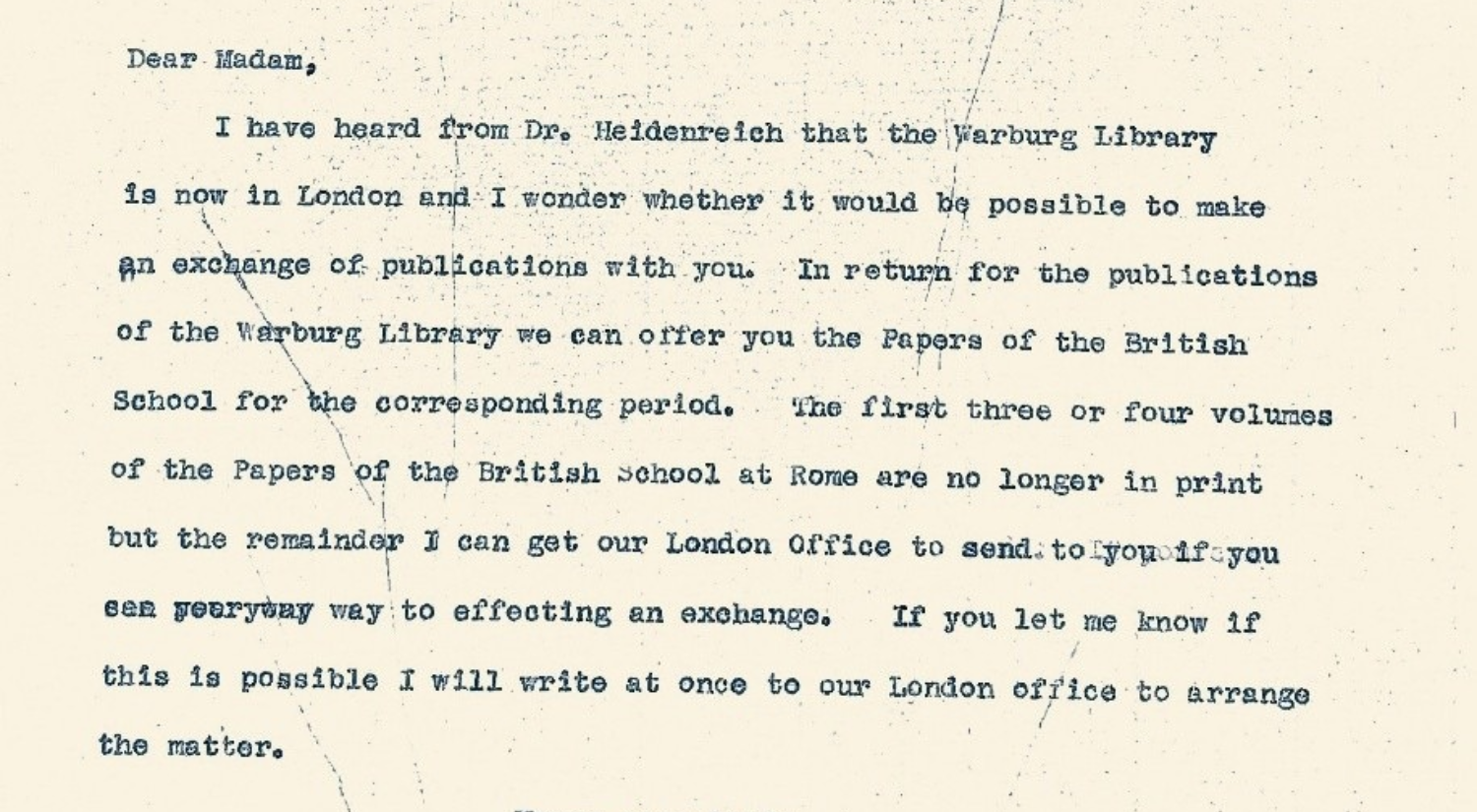
A practical example of an exchange proposal is shown above; correspondence typically occurred between the Librarian or Director and the partner institute. These proposals ranged from brief to elaborate, depending on the institution and the nature of the relationship.
Overall, a strong synergy existed across the British School at Rome’s various departments: the Faculty, responsible for policy decisions; the Directors, who guided the Institute’s overall trajectory; and the Library, which, far from being a mere backdrop, would over time assume a crucial role in shaping the vision and policy of one of Italy’s most prominent research institutes.