Meet the fellows: Ethan Scanlon

Meet the fellows: Ethan Scanlon

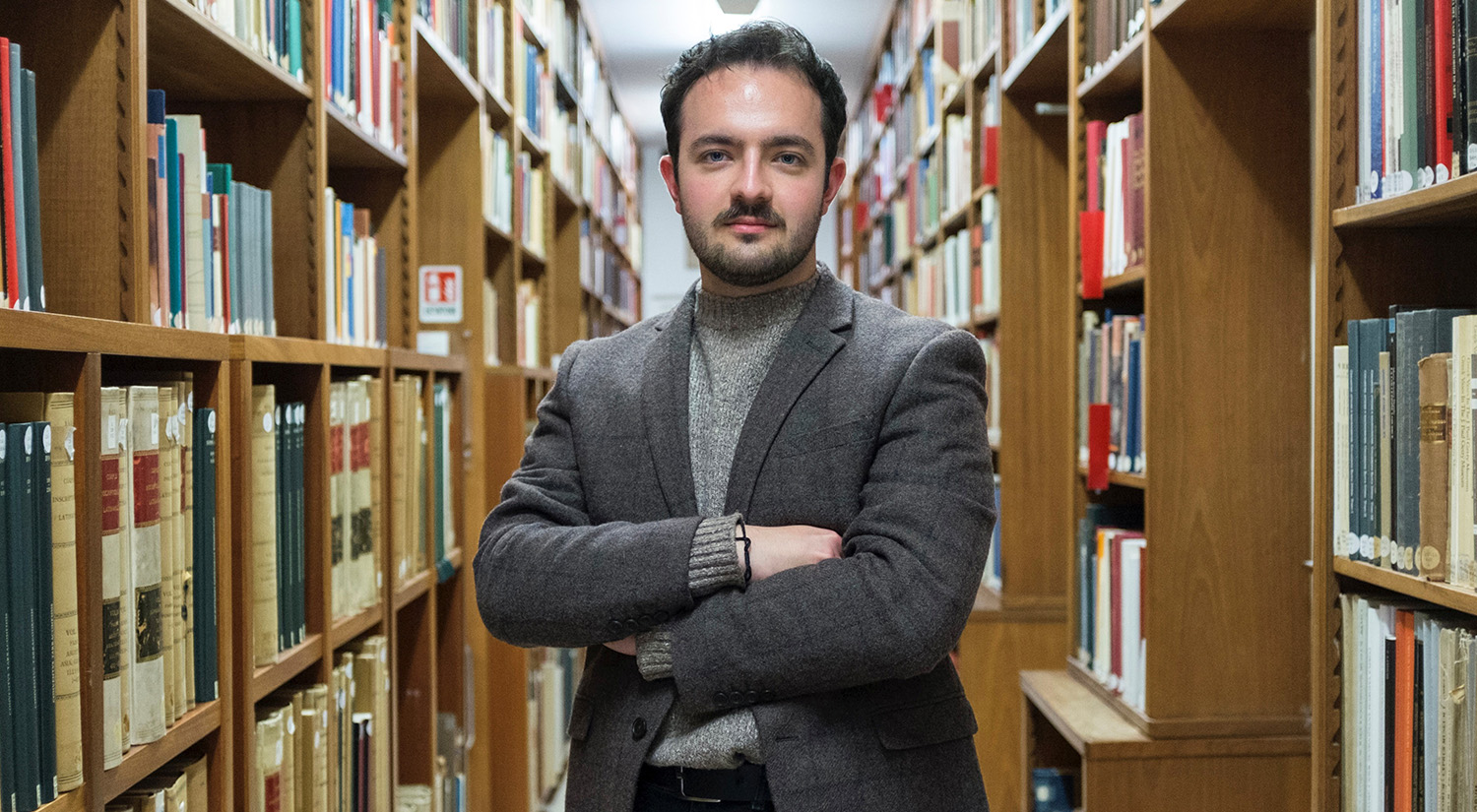
Ethan Scanlon, 2026, photo by Luana Rigolli
Ethan Scanlon, Leverhulme Study Abroad Student at the British School at Rome from October 2025 to July 2026, shares insights into the development of his research project, “What’s past is present: A critical multimodal analysis into the use of Classics in the Iconography of the Italian Far-Right”.

Se vogliamo che tutto rimanga com’è, bisogna che tutto cambi

‘If we want everything to stay as it is, everything must change’

(Il Gattopardo – Giuseppe Tomasi di Lampedusa)


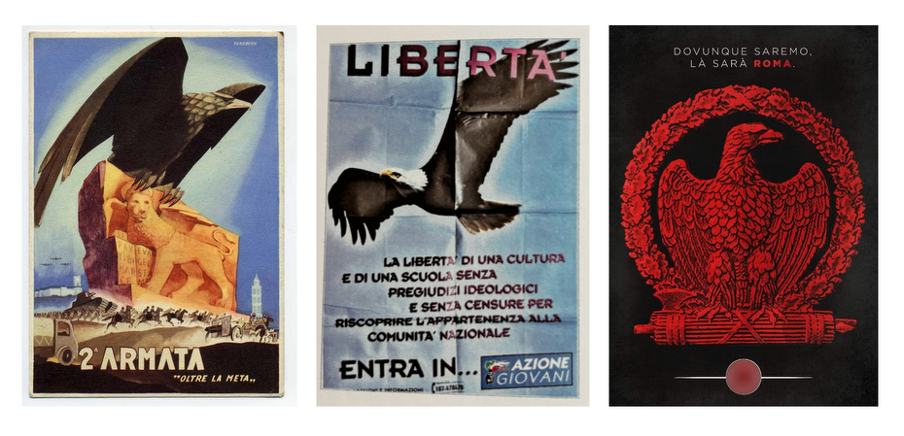
Even when things change, it is often surprising how little is different. My project looks at the use and abuse of Roman (and sometimes Greek) Ancient History in the visual culture and iconography of the Italian Far Right. It attempts to understand the developments of this history and make sense of how these differences between the Fascist and Contemporary uses of such symbols and ideas, may in fact be similar to one another.

Selection of posters incorporating the Roman Aquila from the Fascist Period (1942), Azione Giovani (1990), Acca Larenzia (2025) Image 1 - Museo Civico del Risorgimento di Bologna; Image 2 - Luciano Cheles; Image 3 – Acca Larenzia

Ancient History is embedded into the political narrative and culture of Italy, that can often draw upon the peninsula’s rich ancient past in political discourse and iconography, but in the wrong hands threatens both our understanding of this past and the socio-political discourse of the present.  Focusing on the history of classical iconography within the Italian Far-Right, I trace the use of Classics through posters, manifestos, newspapers, cards, and more recent forms of communication such as online posts and videos. I focus on the Fascist Regime, then move onto developments of the Movimento Sociale Italian and Alleanza Nazionale, and finish with the contemporary Italian Far-Right, such as Acca Larenzia. Most of my time is spent in archives, libraries and the street – the three main places where I engage with the visual manifestation of political discourse through image and text. Each of them offers a different perspective of understanding Far-Right discourse, and whilst the material I view within these locations are inherently different, due to their distinctions both spatially and temporally, they often draw from the same texts and iconographies.

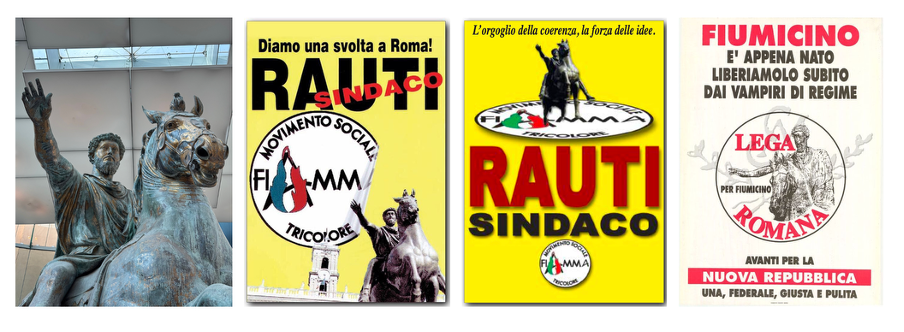
Image of equestrian statue of Marcus Aurelius and selection of posters incorporating this statue from Fiamma Tricolore and Lega Nord Image 1 – Author (2026); Image 2 – Fiamma Tricolore (1994); Image 3 – Fiamma Tricolore (1996); Image 4 – Fondazione Gramsci (1990)

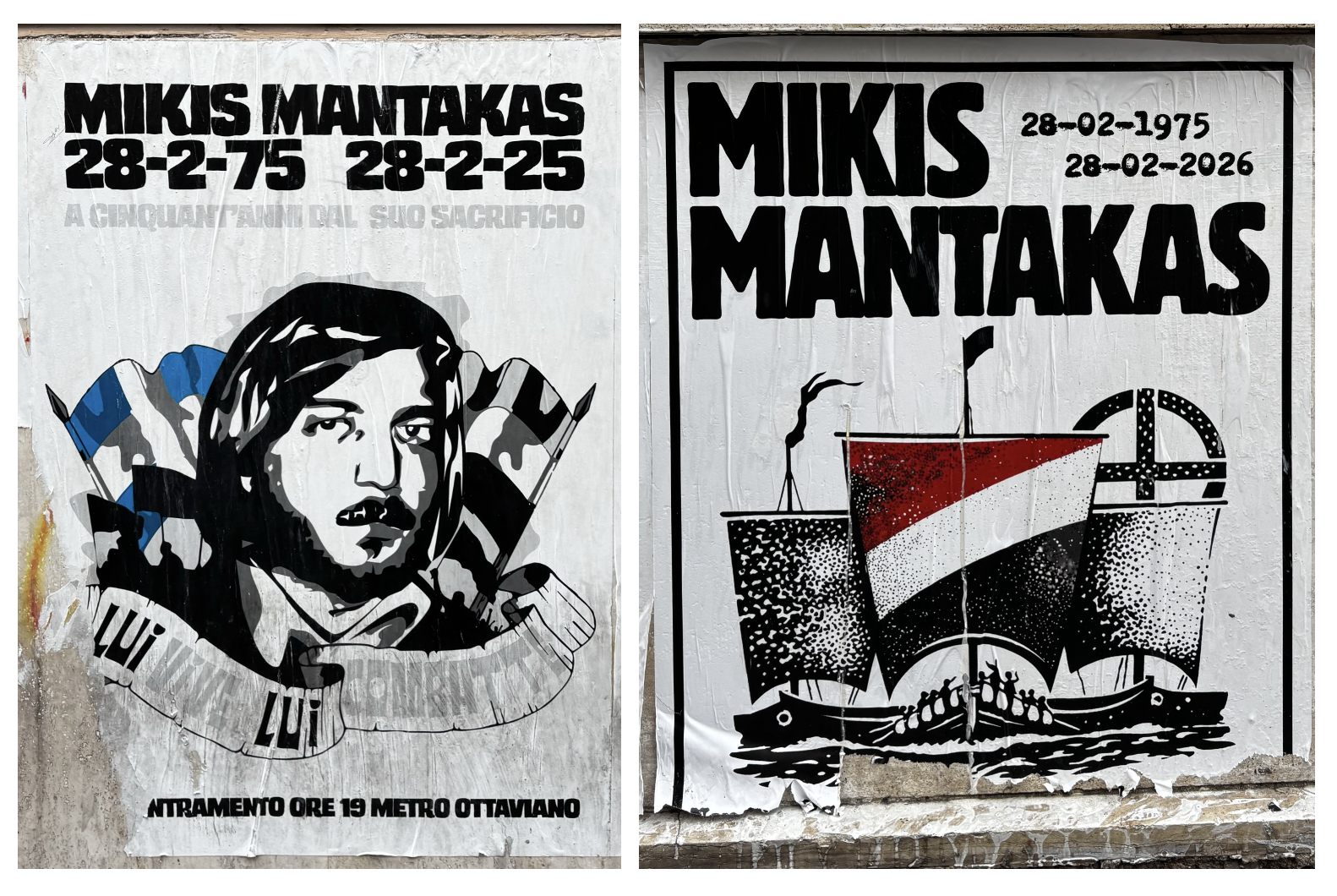
Away from my PhD, I have also become interested in the works of Henri Lefebvre, who often talks of the ‘Rhythmanalysis of Mediterranean Cities’ and lived social space. Engaging with its contemporary materiality, I have begun to research how Far-Right posters and symbols manifest physically within the built environment of Rome. In turn, I have set about walking the streets of Rome, capturing the Far-Right material that I have seen: graffiti, posters, stickers – which for ephemeral material, have a rather permanent nature to them. Places of contestation were revealed, a constant battle between different groups, their spray cans and stickers. The demarcation of ‘zone’ made clear what political dispositions were more active in each area, and often too where these boundaries were blurred. Many of these areas I have visited multiple times, the posters were often different and the graffiti edited, yet through these developments the visual culture of Rome often felt recognisable and unchanged.

Posters commemorating the anniversary of MSI member Mikis Mantakas 2025 and 2026 (Image by the Author)

These myths, as a crucial element of social and political discourse in ancient societies, were constantly reinvented according to the needs of the day. But in Italy, Gaul and Iberia alike, Hercules bridges cultures and mythologies.  For the Greeks who settled there, his mythical journey functioned as a charter-myth, explaining how they came to be there, while the Italic (and Italiot) Herakles is partly based on Greek traditional models, but has many unique characteristics of his own. A protector of herds (transhumant stockraising dominated the economy of southern and central Italy down to the Roman conquest), he is also associated with hot springs, healing, oracles and with natural sources of water and salt, as well (like in Greece) as with warfare and warrior masculinity. In early Latium as well as Umbria and the Sabellic regions to the south, Hercules was an immensely popular deity in his own right, as is confirmed by the countless small bronzes found across the zone that lay between the cities of Magna Graecia to the south, and expanding Rome to the northwest. Nor should one ignore the strong Phoenician strand in this Italic Hercules. 

Italic Hercules is not a Greek cultural import, but rather a creative and constantly – evolving personality with myriad local forms rooted in many cultural traditions, none of which are detached from the others. Much of this story is accessible only through archaeology and iconography, which frequently allow us to go where the texts (for whatever reason) don’t take us.

My BSR project aims to tell the story of this complex divine and heroic figure not so much in its origins as in its development over the period from the earliest Greek settlements in Iron Age Italy down to the Roman conquest, in a series of studies of local contexts and locales, one of which is certainly Hercules’ cult at the Forum Boarium in Rome, and especially in his capacity as a bridge or transmitter of knowledge and cultural forms between the peoples of the peninsula.  The main focus of is on iconography and material culture, making use of the literary record where it raises questions or helps to provide some context to the archaeological finds.  I am grateful to the BSR for the time and support it gave me in beginning this fascinating project. 

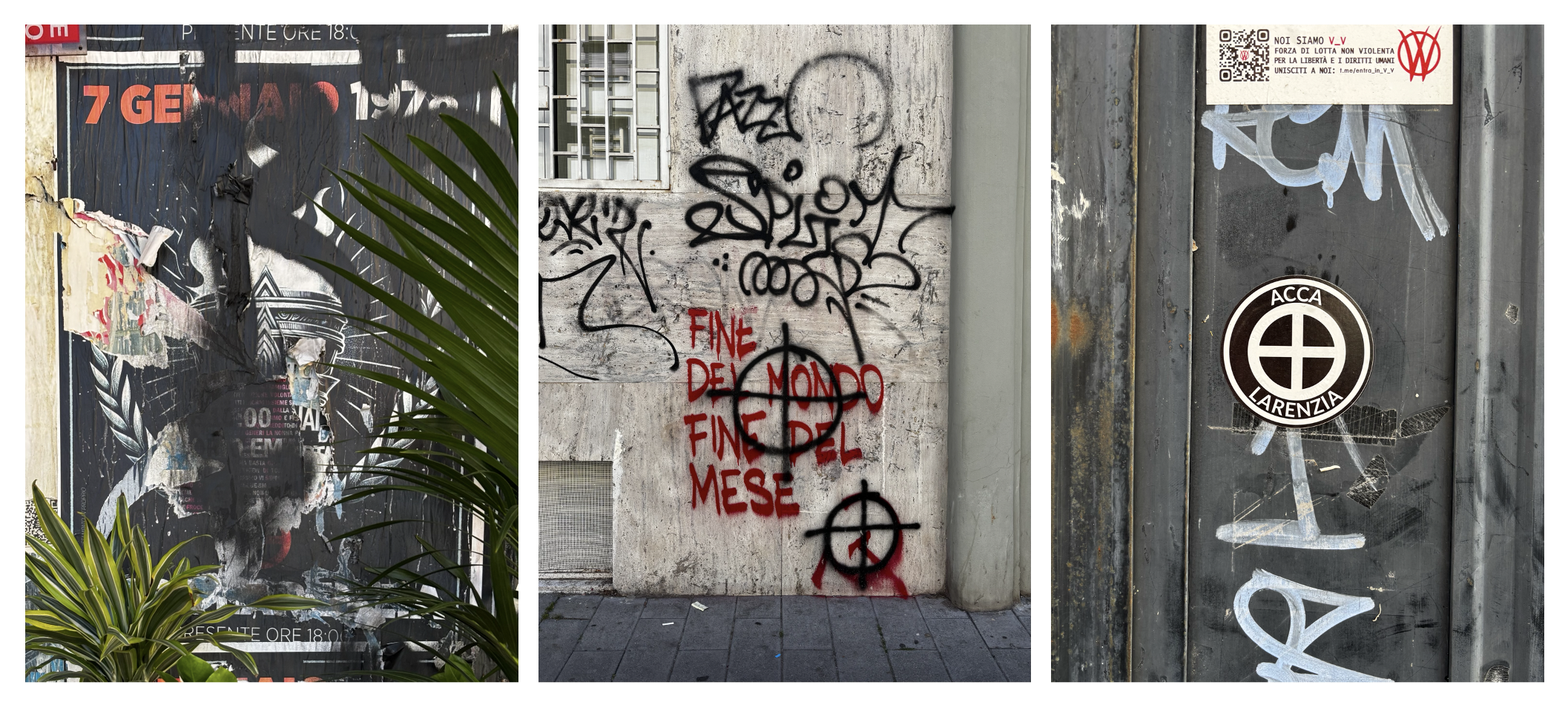
Poster, graffiti and sticker from Far-Right group Acca Larenzia 2025 - 2026 (Image by the Author)

Their semi-permanent existence may not have been realised in the rhythms described by Lefebvre, though it illustrated the fluid movement of dangerous Far-Right discourses that remained at the forefront of the physical social space of Rome. The permanent feature of such semi-permanent material made clear how malleable the socio-political architecture of Rome is, and often how much it changes within the seen space. In turn, since then, I have developed this work into a paper and website in collaboration with the BSR and King’s College London, to map out the contestations of discourse, understand the fluid movements of political space, and illustrate to a wider audience how public space continues to be shaped by tangible forms of communication. 


As I reflect at my time at the BSR, and Rome more widely, I think back to how I started this year, how much has changed and yet how similar it still feels. Maybe its inherent of the rhythm of the Mediterranean city discussed by Lefebvre, but may also speak of something more embedded about the pertinence of Fascist discourse and iconography with the Italian Far-Right over last 80 years.

Latest Posts

Latest Posts

HUMANITIES
Meet the fellows: Frances Myatt
Frances Myatt, Rome Awardee at the British School at Rome from April to June 2026, shares insights into the development of her research project, “Lady
FINE ARTS
Meet the artists: Josh Juett
In this blog, Josh Juett, Helpmann Academy Resident (April–June 2026), presents "The Symbolic Object and the Formation of Self," a project developed during his residency.
FINE ARTS
Meet the artists: Mark Farid
In this blog, Mark Farid, Rome Research Fellow from April to June 2026, reflects on his residency experience and the research he presented at the

Search