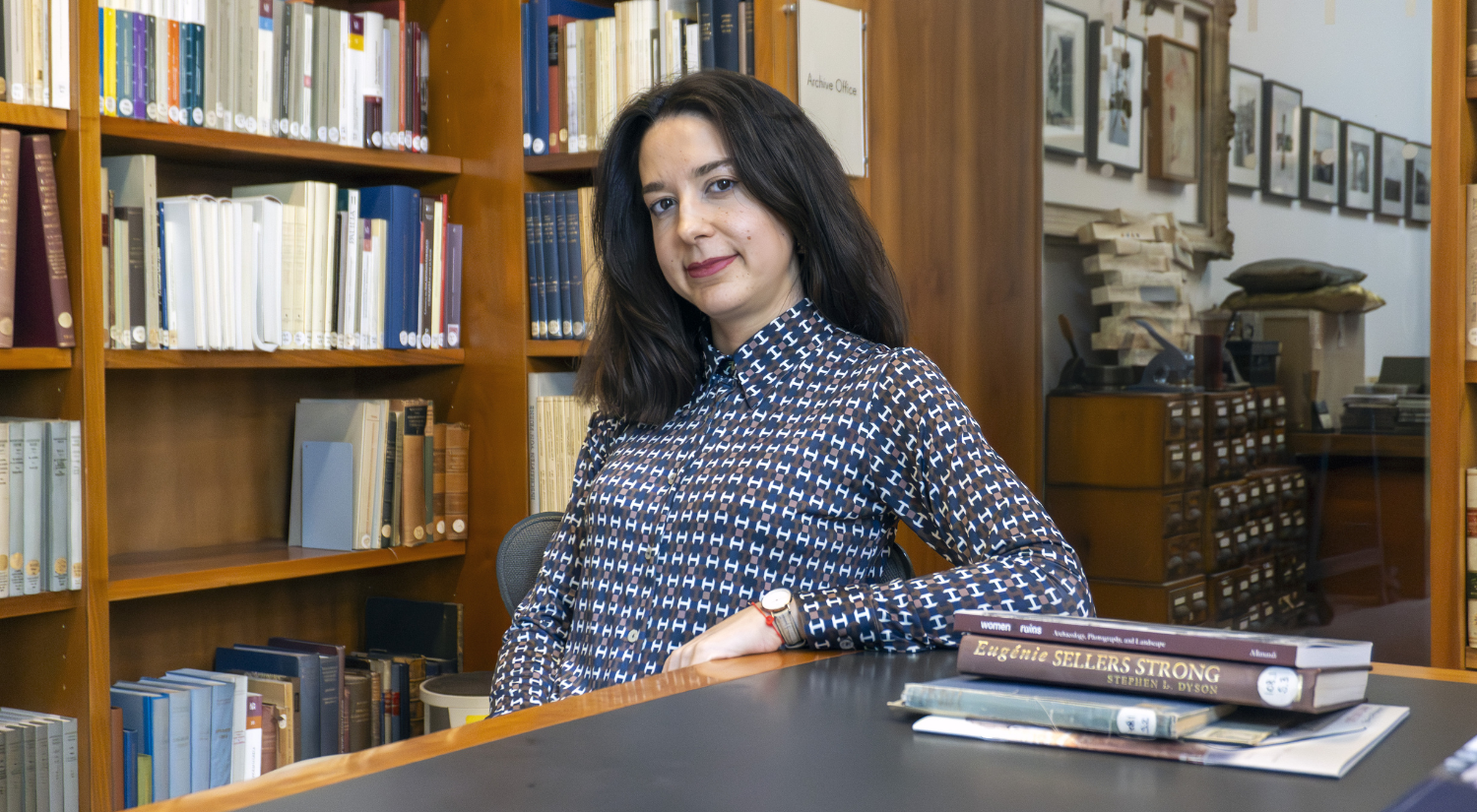
Valeria Tettamanti, 2026, photo by Silvia Calderoni
Valeria Tettamanti, 2026, photo by Silvia Calderoni
Valeria Tettamanti, Ecole française de Rome (résidence scientifique jeunes chercheurs UNIONE –November 2025-July 2026) Awardee, discuss her project “Popular science in Italian feminine press at the turn of 20th century”.
“Making science accessible” by “giv[ing] examples of women”: this is how UNESCO, in March 2026, frames its support for girls’ access to quality STEM learning. At the heart of this statement lies a paradox: the idea of science as a universal mode of knowing sits uneasily alongside the biographical exemplum as a gendered practice of scientific “translation”. My current research project investigates this paradox though a rarely credited source about science and feminine imagery: science popularization in the Italian feminine press at the turn of 20th century.
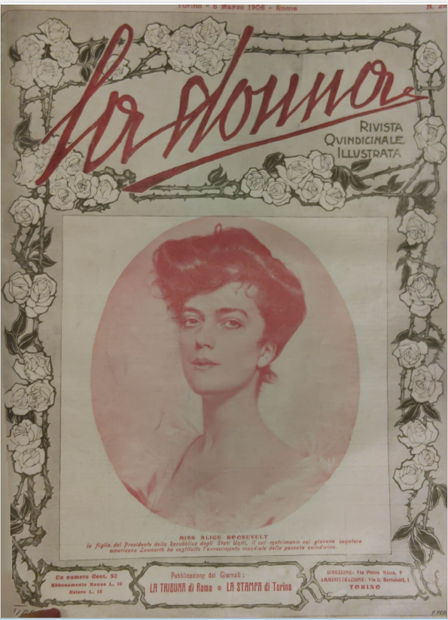
Front page La donna. Rivista quindicinale illustrata, n. 25, March 5th 1906, La Tribuna (Roma), La Stampa (Torino). Museo Civico del Risorgimento di Bologna. Image: author.
The tension is not new. On the one hand, the universalist credo of the “Republic of sciences” (praised by popularizers like Angelo Secchi, Antonio Stoppani and Paolo Mantegazza), presupposing an accessible, shared, and cultivated knowledge by all, collides with expressions of women’s subjectivation, gendered specializations, and structural barriers to professionalisation. On the other hand, women tend to constitute the privileged relay of a “scientific communication” that separates the production of knowledge from its transmission, the medium from its message.
From the history of science, where women’s scientific popularization has largely been approached through paradigmatic cases, to the bestselling biographies such as Women in Science: 50 Fearless Pioneers Who Changed the World (2016), the dominant mode of making women visible in science reproduces rather than interrogates the “top-down model” of scientific communication. Understanding the historical roots of this paradox — and the diversified, scattered and largely unacknowledged popularization that emerged in the Italian feminine press at the turn of the 20th century — is a necessary condition for rethinking the relationship between gender, science, and public knowledge today.
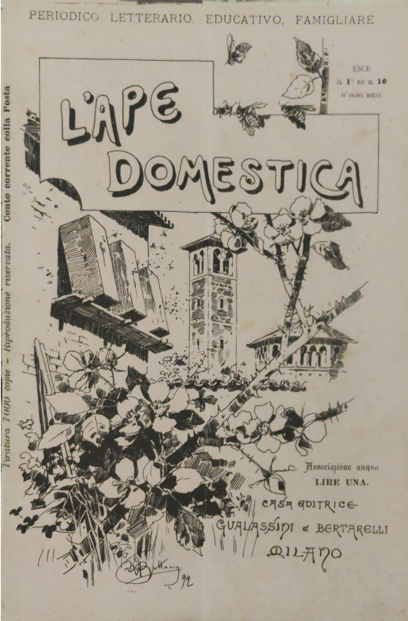
Front page L’ape domestica. Periodico letterario, educativo, famigliare, vol. 1, n. 1, January 1st 1893 (Milano, Gualassini Bertarelli). Biblioteca Italiana delle Donne, Bologna. Image: author.
Most of these writers, not degree-holding scientists, adopt hybrid intellectual statuses, answering to divergent logics of legitimation: as amateurs, as novelists, as “wives of” or “daughters of”. Popularization is often one “station” within diversified writing careers and surfaces as metadiegetic inserts in various articles (from serialized novels to socialist reportages). Unlike popularization in the specialized press, these writings do not always stem from a complete expertise of the matter, nor do it often rely on leading scientific journals, as such “high” popular science or academic. How does feminine popularization differ from “masculine” popularization and from pedagogical “feminine” writing? My project traces this indeterminacy in a privileged place of negotiation: in feminine press, the interplay of knowledge transmission, social categorization, moral judgement and gender prejudice is concentrated on the page.
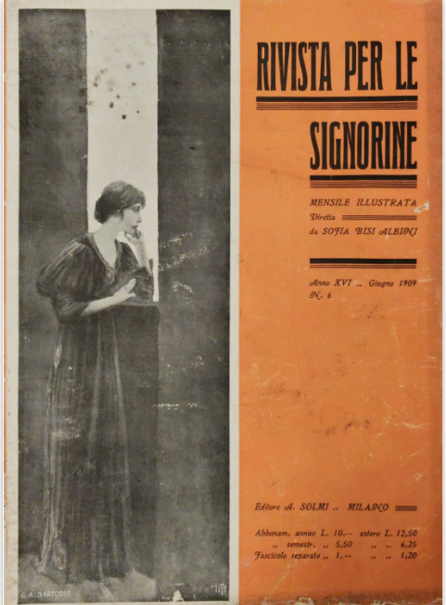
Front page Rivista per le signorine, XVI year, n. 6, Juin 1909 (Milano, Solmi). Biblioteca italiana delle donne, Bologna. Image: author.
At the BSR, I’ve been investigating how the genesis of these texts and the conditions of production, which can be identified in archival correspondences and official Roman documents (Archivio Centrale dello Stato, Biblioteca Nazionale Centrale di Roma, Fondazione Primoli), allows to trace an intertext of relations and circulations (reprinted articles, synopsis…). Reconstructing science popularization in the feminine press will offer a more comprehensive image of nineteenth-century science communication, of the periodical press culture, of women’s writing production and of history of science.
I am grateful to the BSR for the time and very warm support it gave me in beginning this fascinating project.
Ethan Scanlon, Leverhulme Study Abroad Student at the British School at Rome from October 2025 to July 2026, shares insights into the development of his
This year marks the first milestone for the excavations at Falerii Novi: after five years of excavation, work now begins on the publication. What began
Ethan Scanlon, Leverhulme Study Abroad Student at the British School at Rome from October 2025 to July 2026, shares insights into the development of his
This year marks the first milestone for the excavations at Falerii Novi: after five years of excavation, work now begins on the publication. What began
We use cookies on our website to give you the most relevant experience by remembering your preferences and repeat visits. By clicking “Accept All”, you consent to the use of ALL the cookies. However, you may visit "Cookie Settings" to provide a controlled consent.
This website uses cookies to improve your experience while you navigate through the website. Out of these, the cookies that are categorized as necessary are stored on your browser as they are essential for the working of basic functionalities of the website. We also use third-party cookies that help us analyze and understand how you use this website. These cookies will be stored in your browser only with your consent. You also have the option to opt-out of these cookies. But opting out of some of these cookies may affect your browsing experience.
Necessary cookies are absolutely essential for the website to function properly. These cookies ensure basic functionalities and security features of the website, anonymously.
Cookie
Duration
Description
cookielawinfo-checkbox-advertisement
1 year
Set by the GDPR Cookie Consent plugin, this cookie records the user consent for the cookies in the "Advertisement" category.
cookielawinfo-checkbox-analytics
11 months
This cookie is set by GDPR Cookie Consent plugin. The cookie is used to store the user consent for the cookies in the category "Analytics".
cookielawinfo-checkbox-functional
11 months
The cookie is set by GDPR cookie consent to record the user consent for the cookies in the category "Functional".
cookielawinfo-checkbox-necessary
11 months
This cookie is set by GDPR Cookie Consent plugin. The cookies is used to store the user consent for the cookies in the category "Necessary".
cookielawinfo-checkbox-others
11 months
This cookie is set by GDPR Cookie Consent plugin. The cookie is used to store the user consent for the cookies in the category "Other.
cookielawinfo-checkbox-performance
11 months
This cookie is set by GDPR Cookie Consent plugin. The cookie is used to store the user consent for the cookies in the category "Performance".
CookieLawInfoConsent
1 year
CookieYes sets this cookie to record the default button state of the corresponding category and the status of CCPA. It works only in coordination with the primary cookie.
elementor
never
The website's WordPress theme uses this cookie. It allows the website owner to implement or change the website's content in real-time.
viewed_cookie_policy
11 months
The cookie is set by the GDPR Cookie Consent plugin and is used to store whether or not user has consented to the use of cookies. It does not store any personal data.
Functional cookies help to perform certain functionalities like sharing the content of the website on social media platforms, collect feedbacks, and other third-party features.
Performance cookies are used to understand and analyze the key performance indexes of the website which helps in delivering a better user experience for the visitors.
Analytical cookies are used to understand how visitors interact with the website. These cookies help provide information on metrics the number of visitors, bounce rate, traffic source, etc.
Cookie
Duration
Description
_ga
1 year 1 month 4 days
Google Analytics sets this cookie to calculate visitor, session and campaign data and track site usage for the site's analytics report. The cookie stores information anonymously and assigns a randomly generated number to recognise unique visitors.
_ga_*
1 year 1 month 4 days
Google Analytics sets this cookie to store and count page views.
_gat_gtag_UA_*
1 minute
Google Analytics sets this cookie to store a unique user ID.
_gid
1 day
Google Analytics sets this cookie to store information on how visitors use a website while also creating an analytics report of the website's performance. Some of the collected data includes the number of visitors, their source, and the pages they visit anonymously.
CONSENT
2 years
YouTube sets this cookie via embedded YouTube videos and registers anonymous statistical data.
Advertisement cookies are used to provide visitors with relevant ads and marketing campaigns. These cookies track visitors across websites and collect information to provide customized ads.
Cookie
Duration
Description
VISITOR_INFO1_LIVE
5 months 27 days
YouTube sets this cookie to measure bandwidth, determining whether the user gets the new or old player interface.
YSC
session
Youtube sets this cookie to track the views of embedded videos on Youtube pages.