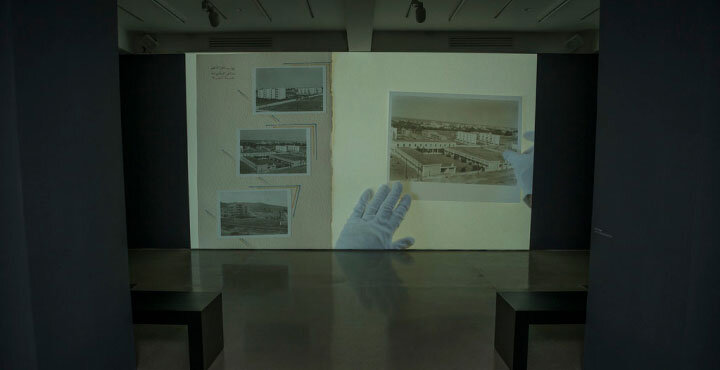
Genevieve Felix Reynolds, 2026. Photo by Luana Rigolli
Genevieve Felix Reynolds, 2026. Photo by Luana Rigolli
National Art School, Sydney Resident Genevieve Felix Reynolds (April – June 2026) reflects on her residency and her research at the BSR in a new blog.
A photograph is silent: its integral meaning is only what can be inferred by the viewer. Barthes describes this muteness as potentially tragic to some, and poetic to others. In books and museums, images are anchored by captions or catalogue entries, but I find these unable to fully account for the complexities they seek to contain, often revealing partial truths and unresolved residues.
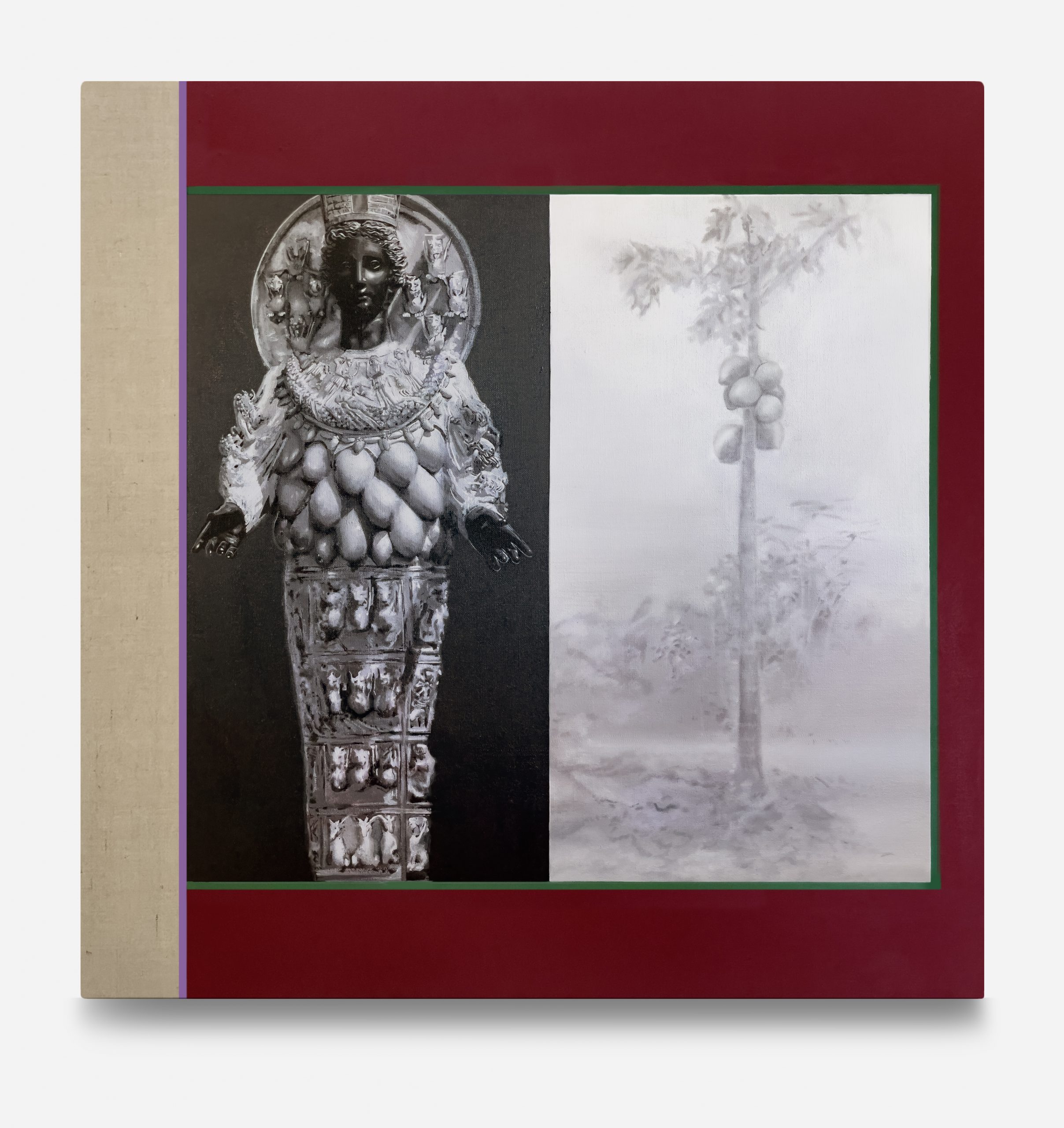
Composition in red and grey (reprieve), 2026, 150 x 150 cm, oil and polymer on hessian
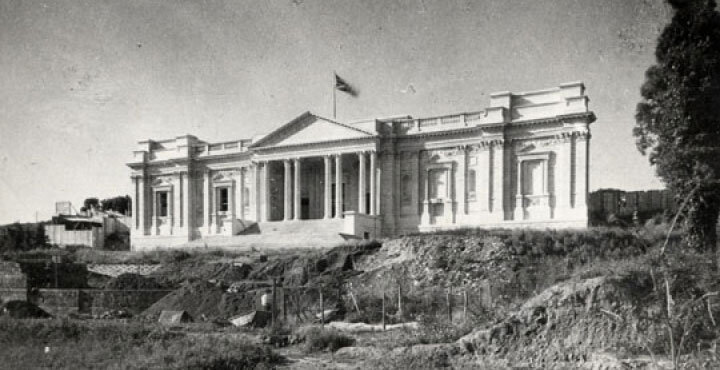
I’ve spent a lot of time in the archives with early photographic collections of archaeological objects and architecture (in particular, Agnes and Dora Bulwer’s documentation of ancient Rome and its surrounds, and art historian Eugénie Strong’s carefully retouched documentation of sculptural fragments). I’ve looked at them for both what they record and for what they have become: physical objects generated by specific technologies and customs, often faded or foxed by time.
Study of brick (Tuğrul Tower, Poelzig's sulphuric acid factory), 2026, polymer on aluminium composite, 98 x 112 cm
100 years ago, Aby Warburg proposed that the arrangement of images could be a form of knowledge itself, relationally and psychologically generative. Today, his Mnemosyne Atlas project feels like an ancestor to the screen. I’m interested in what happens when meaning is built from both combination and dissonance, as it is in psychological space, like memory, dreams, and (more often than not) online.
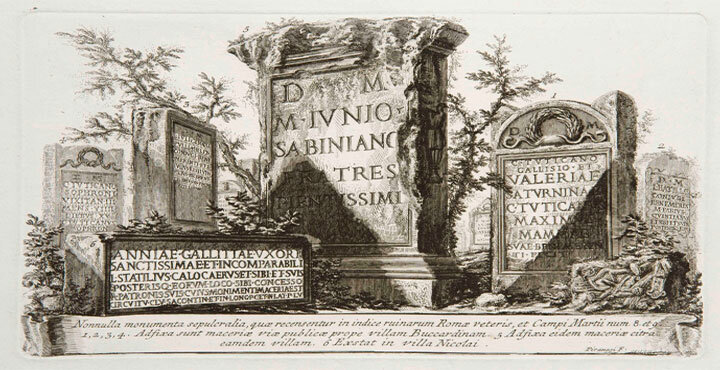
In Rome, this instinct is old and everywhere. The city is an archive full of archives: private and public museums, spolia, overbuilt churches, time-collaged floors. Piranesi and Panini impressed this upon their contemporaries via fantastical spaces and near boundless architecture.
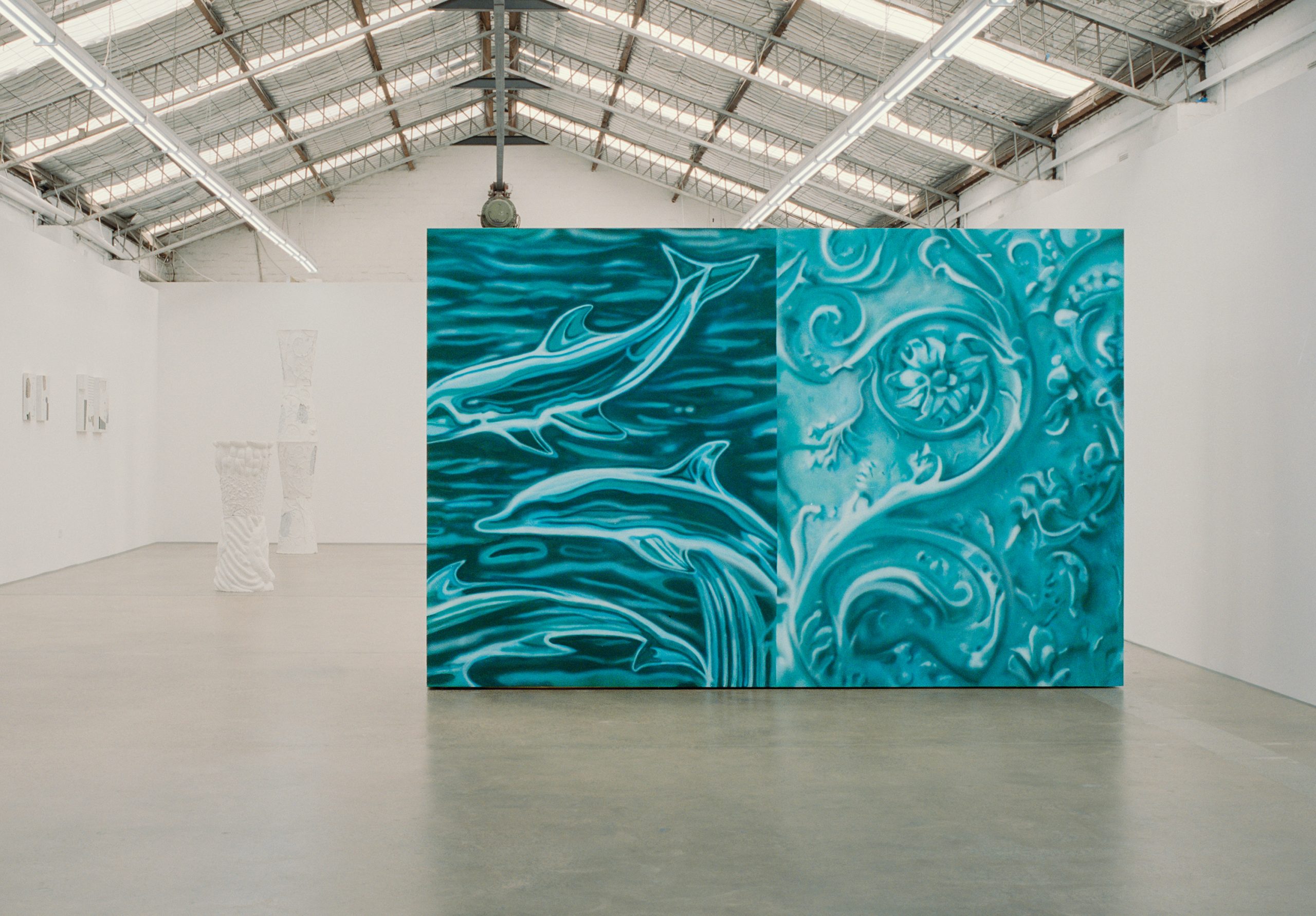
Genevieve Felix Reynolds, Luciferin, polymer wall mural, 300 x 420 cm (image: David Chatfield)
My practice synthesises fragments in the same spirit, flattening images and artefacts into compositions where objects find meaning through proximity, disparity or isomorphic relationships. During my time here I’ve been expanding this collage approach into digital space using game design software. I’ve collected architectures built from marbles and patterns photographed in Rome, and I’m populating this with a borrowed collection of my own, assembled from photographs and 3D scans. The archives hold far more than a few months could exhaust, and every fragment I photograph or scan opens onto others, so the collection grows past any edge I try to set for it. I expect the material gathered here – images, marbles, patterns, scanned ruins – to feed my practice for many years.
Building a virtual space is an attempt to unfold my paintings and give them depth. The historical artefacts here are characterised by the errors of their medium: fragmented digitally as well as sculpturally. Navigated by a disembodied, floating viewer, space is limitless in a way that opposes the picture frame. Its contents are loosened in the same way: objects sit at impossible scales, hollow, doubled or weightless. RIP Piranesi – you would have loved video game space.
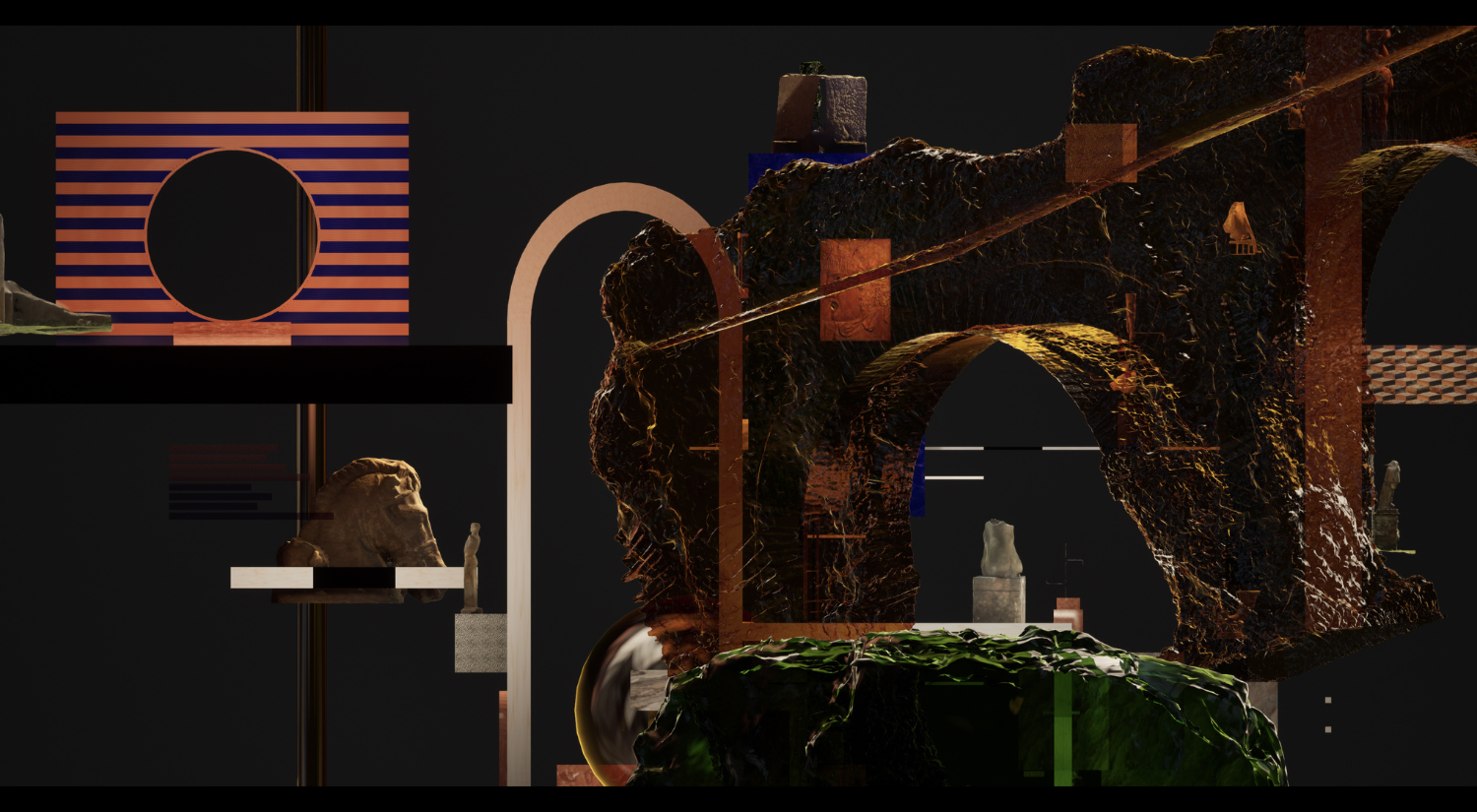
Genevieve Felix Reynolds, SKARPA2.0 digital collage
Ethan Scanlon, Leverhulme Study Abroad Student at the British School at Rome from October 2025 to July 2026, shares insights into the development of his
Valeria Tettamanti, Ecole française de Rome (résidence scientifique jeunes chercheurs UNIONE –November 2025-July 2026) Awardee, discuss her project “Popular science in Italian feminine press at
Ethan Scanlon, Leverhulme Study Abroad Student at the British School at Rome from October 2025 to July 2026, shares insights into the development of his
Valeria Tettamanti, Ecole française de Rome (résidence scientifique jeunes chercheurs UNIONE –November 2025-July 2026) Awardee, discuss her project “Popular science in Italian feminine press at
Emlyn Dodd is former Assistant Director of the British School at Rome, an Associate Fellow of the Institute of Classical Studies at the University of
We use cookies on our website to give you the most relevant experience by remembering your preferences and repeat visits. By clicking “Accept All”, you consent to the use of ALL the cookies. However, you may visit "Cookie Settings" to provide a controlled consent.
This website uses cookies to improve your experience while you navigate through the website. Out of these, the cookies that are categorized as necessary are stored on your browser as they are essential for the working of basic functionalities of the website. We also use third-party cookies that help us analyze and understand how you use this website. These cookies will be stored in your browser only with your consent. You also have the option to opt-out of these cookies. But opting out of some of these cookies may affect your browsing experience.
Necessary cookies are absolutely essential for the website to function properly. These cookies ensure basic functionalities and security features of the website, anonymously.
Cookie
Duration
Description
cookielawinfo-checkbox-advertisement
1 year
Set by the GDPR Cookie Consent plugin, this cookie records the user consent for the cookies in the "Advertisement" category.
cookielawinfo-checkbox-analytics
11 months
This cookie is set by GDPR Cookie Consent plugin. The cookie is used to store the user consent for the cookies in the category "Analytics".
cookielawinfo-checkbox-functional
11 months
The cookie is set by GDPR cookie consent to record the user consent for the cookies in the category "Functional".
cookielawinfo-checkbox-necessary
11 months
This cookie is set by GDPR Cookie Consent plugin. The cookies is used to store the user consent for the cookies in the category "Necessary".
cookielawinfo-checkbox-others
11 months
This cookie is set by GDPR Cookie Consent plugin. The cookie is used to store the user consent for the cookies in the category "Other.
cookielawinfo-checkbox-performance
11 months
This cookie is set by GDPR Cookie Consent plugin. The cookie is used to store the user consent for the cookies in the category "Performance".
CookieLawInfoConsent
1 year
CookieYes sets this cookie to record the default button state of the corresponding category and the status of CCPA. It works only in coordination with the primary cookie.
elementor
never
The website's WordPress theme uses this cookie. It allows the website owner to implement or change the website's content in real-time.
viewed_cookie_policy
11 months
The cookie is set by the GDPR Cookie Consent plugin and is used to store whether or not user has consented to the use of cookies. It does not store any personal data.
Functional cookies help to perform certain functionalities like sharing the content of the website on social media platforms, collect feedbacks, and other third-party features.
Performance cookies are used to understand and analyze the key performance indexes of the website which helps in delivering a better user experience for the visitors.
Analytical cookies are used to understand how visitors interact with the website. These cookies help provide information on metrics the number of visitors, bounce rate, traffic source, etc.
Cookie
Duration
Description
_ga
1 year 1 month 4 days
Google Analytics sets this cookie to calculate visitor, session and campaign data and track site usage for the site's analytics report. The cookie stores information anonymously and assigns a randomly generated number to recognise unique visitors.
_ga_*
1 year 1 month 4 days
Google Analytics sets this cookie to store and count page views.
_gat_gtag_UA_*
1 minute
Google Analytics sets this cookie to store a unique user ID.
_gid
1 day
Google Analytics sets this cookie to store information on how visitors use a website while also creating an analytics report of the website's performance. Some of the collected data includes the number of visitors, their source, and the pages they visit anonymously.
CONSENT
2 years
YouTube sets this cookie via embedded YouTube videos and registers anonymous statistical data.
Advertisement cookies are used to provide visitors with relevant ads and marketing campaigns. These cookies track visitors across websites and collect information to provide customized ads.
Cookie
Duration
Description
VISITOR_INFO1_LIVE
5 months 27 days
YouTube sets this cookie to measure bandwidth, determining whether the user gets the new or old player interface.
YSC
session
Youtube sets this cookie to track the views of embedded videos on Youtube pages.