In this blog, Odile Lamy – Conseil des arts e des lettres du Québec Residency at the BSR from April to June 2026 – reflects on her project “Pines of Rome“.
After working with wood buildings for many years, I have come to believe that timber architecture begins with the life of trees. My research is rooted in a desire to better understand the tree species we build with and a journey to cure my own plant blindness by dwelling on la vie des plantes, to borrow the title of a book by philosopher Emanuele Coccia. Thinking of Rome, there was only one tree I could study. Whether called italian stone pines, domestic pines or umbrella pines, the pines of Rome (Pinus pinea) need no introduction. Their presence in the city is ubiquitous. Yet to the passing tourist they often remain a background to architecture and scenes of daily life, a mere visual trope. I was eager to learn more.
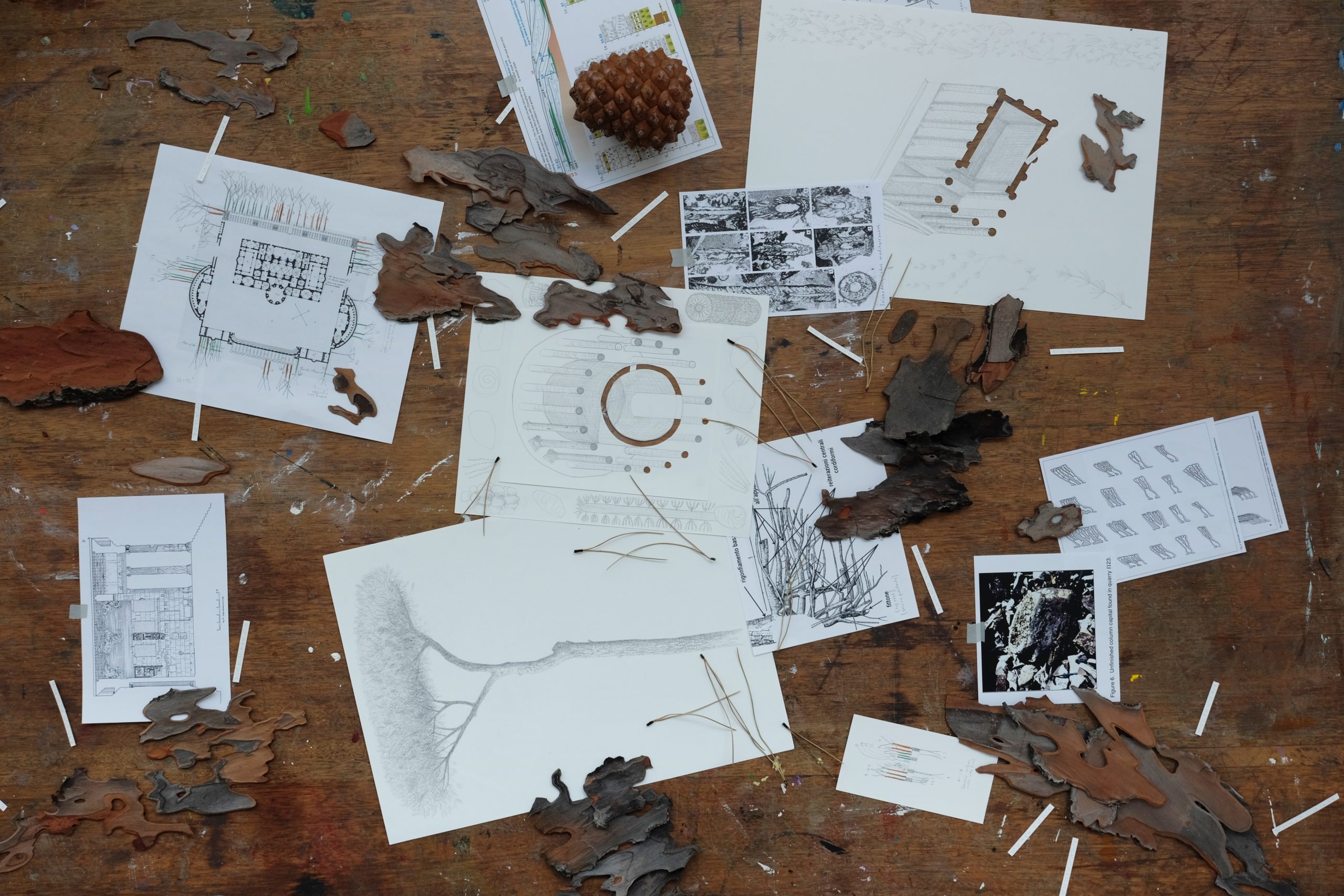
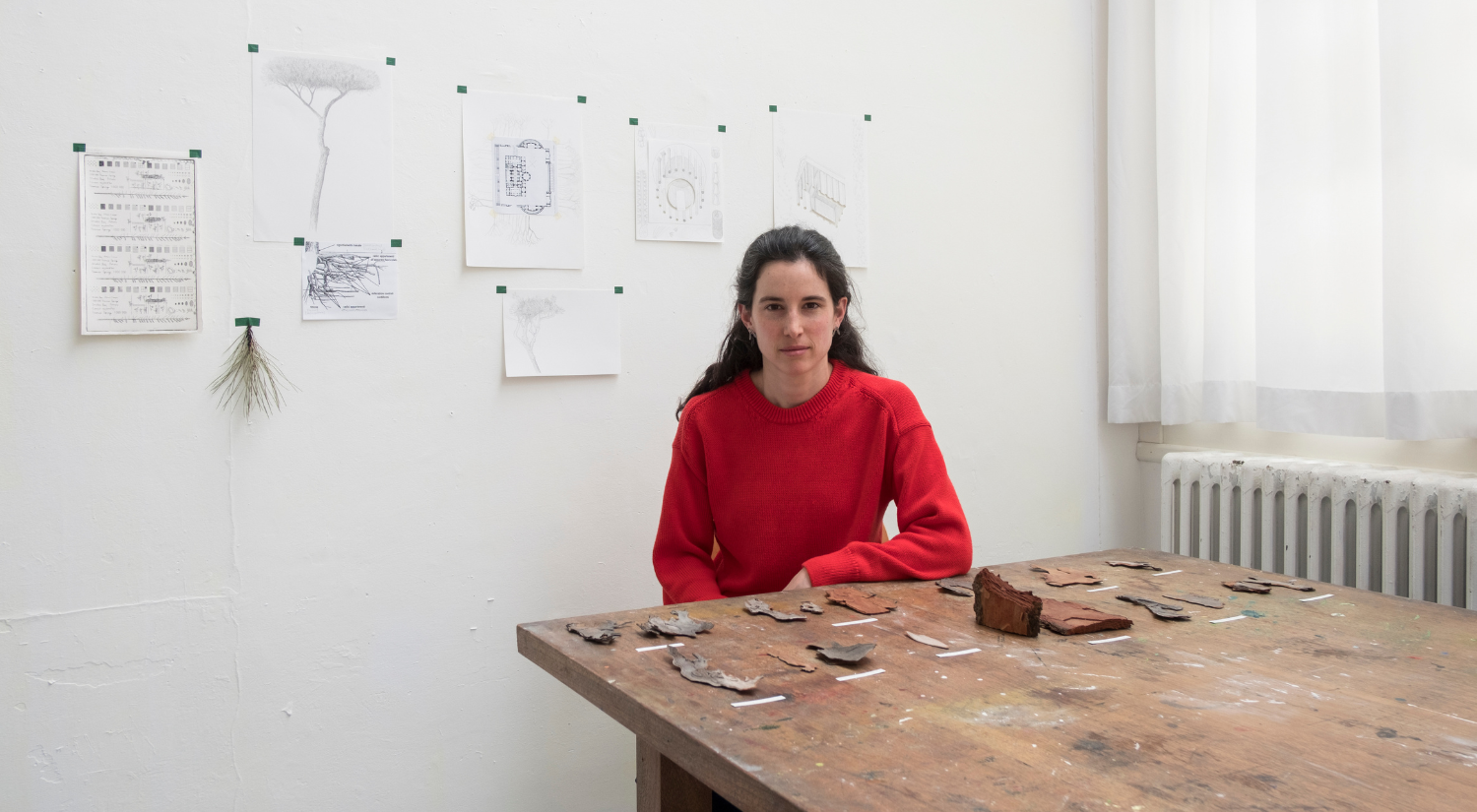
Work table in studio 5
On my first week at the British School at Rome in early April, we set out on a group tour of the city and I made a pivotal encounter: the stumps of twelve unstable pines felled only a few weeks prior on Via dei Fori Imperiali. It was my first of many long walks in Rome and the missing pines became the geographical center I would naturally gravitate back to. I wondered what had happened to the timber. I kept dreaming of finding it and filling my studio with the broken bodies of these towering giants. Would it not be an incredibly meaningful material to build with?
The twelve felled pines became the reference point of my study on the life of trees and the passage of time in the remains of Ancient Rome. I walked the city with Renaissance architect Andrea Palladio’s guidebooks to Rome in hand and wondered how many pines towered over the antiquities and churches when he wrote them in 1554, and how many pines will remain when I come back. Weakened by decades of human intervention, old age and the impacts of climate change, the trees now face the dual threat of consecutive infestations by the pine shoot beetle (Tomicus destruens) and the pine tortoise scale (Toumeyella pavicornis). On a short train ride outside of Rome, defoliated trees begin to appear, until I find myself surrounded by pine forests turned into graveyards. Their future is uncertain.
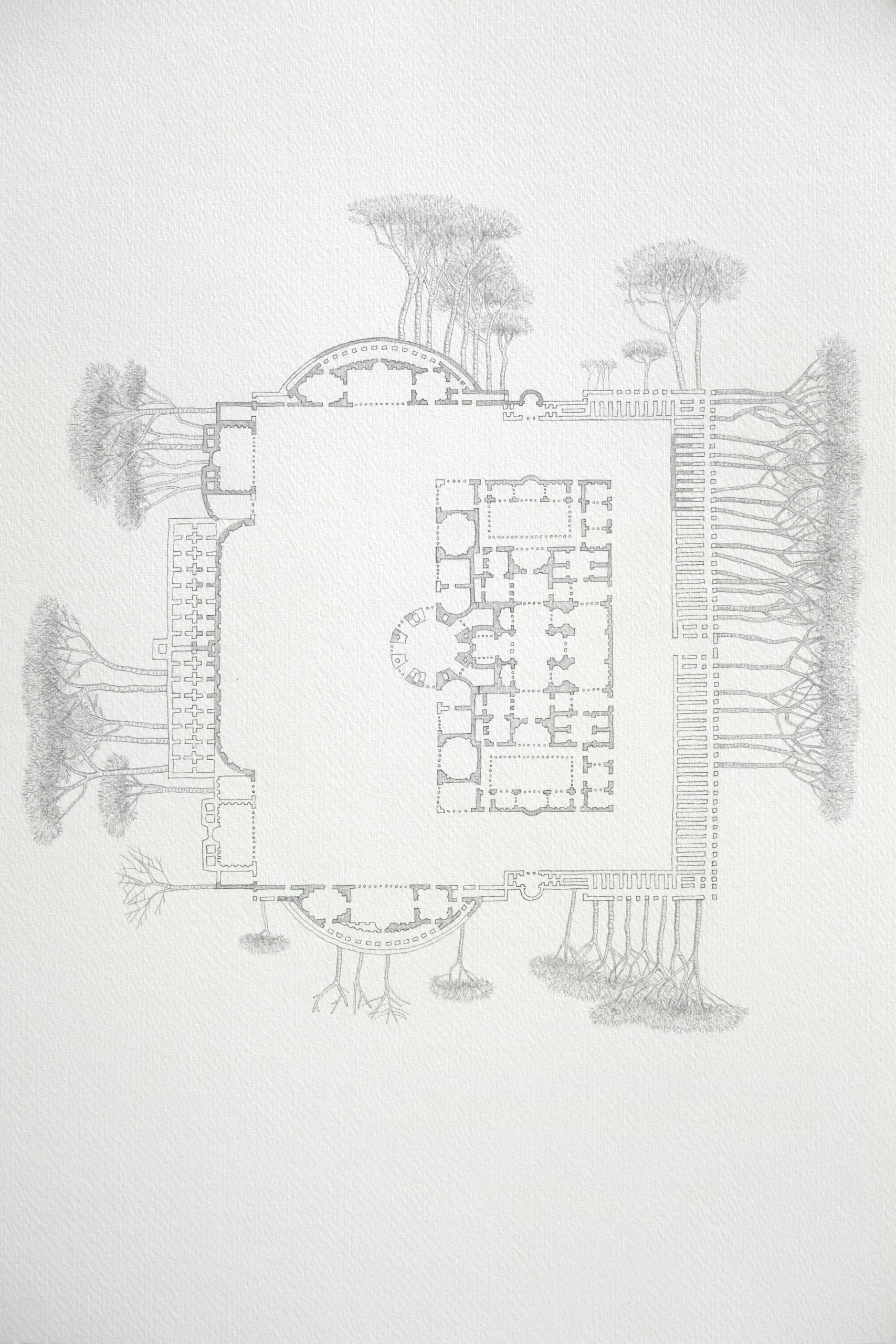
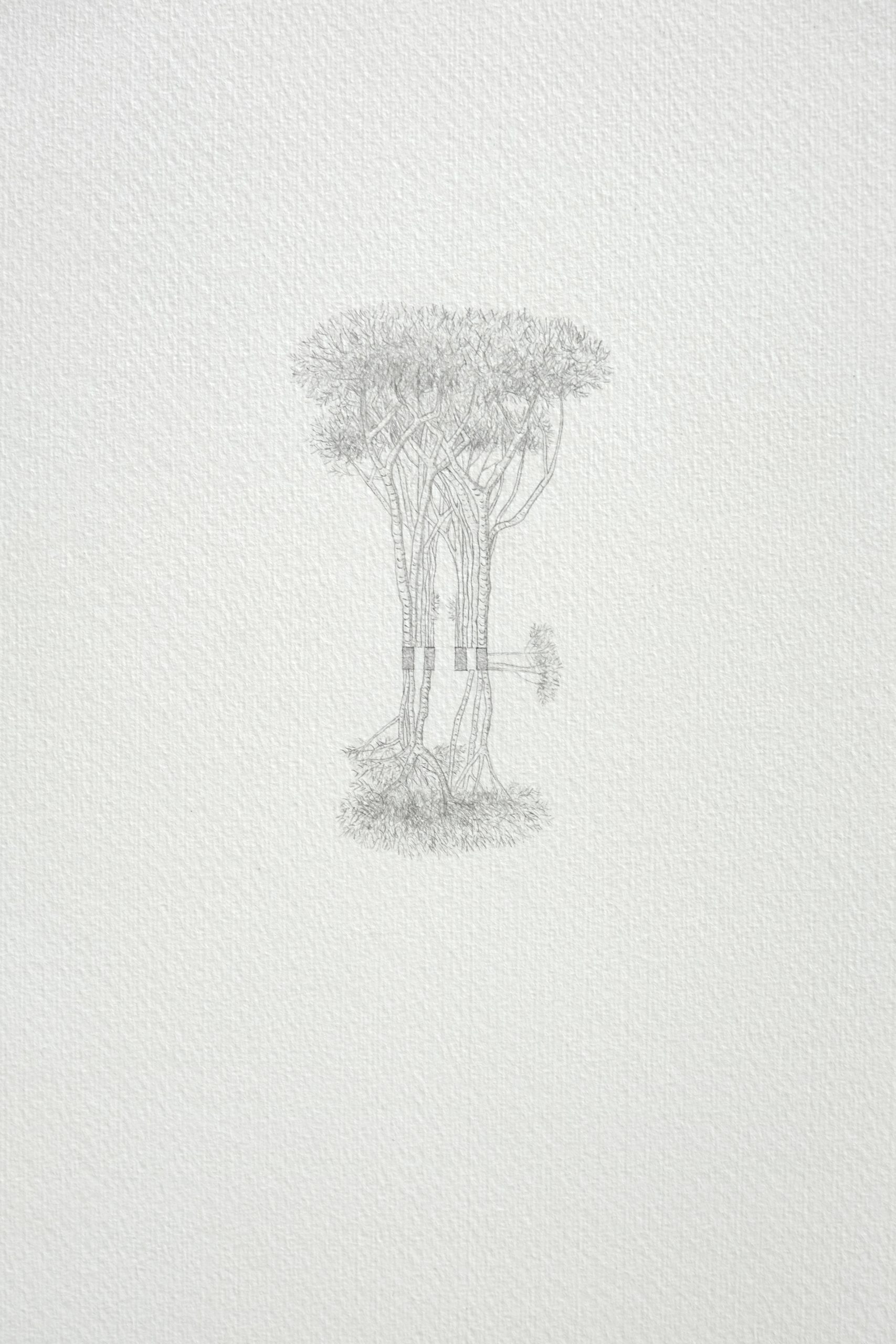
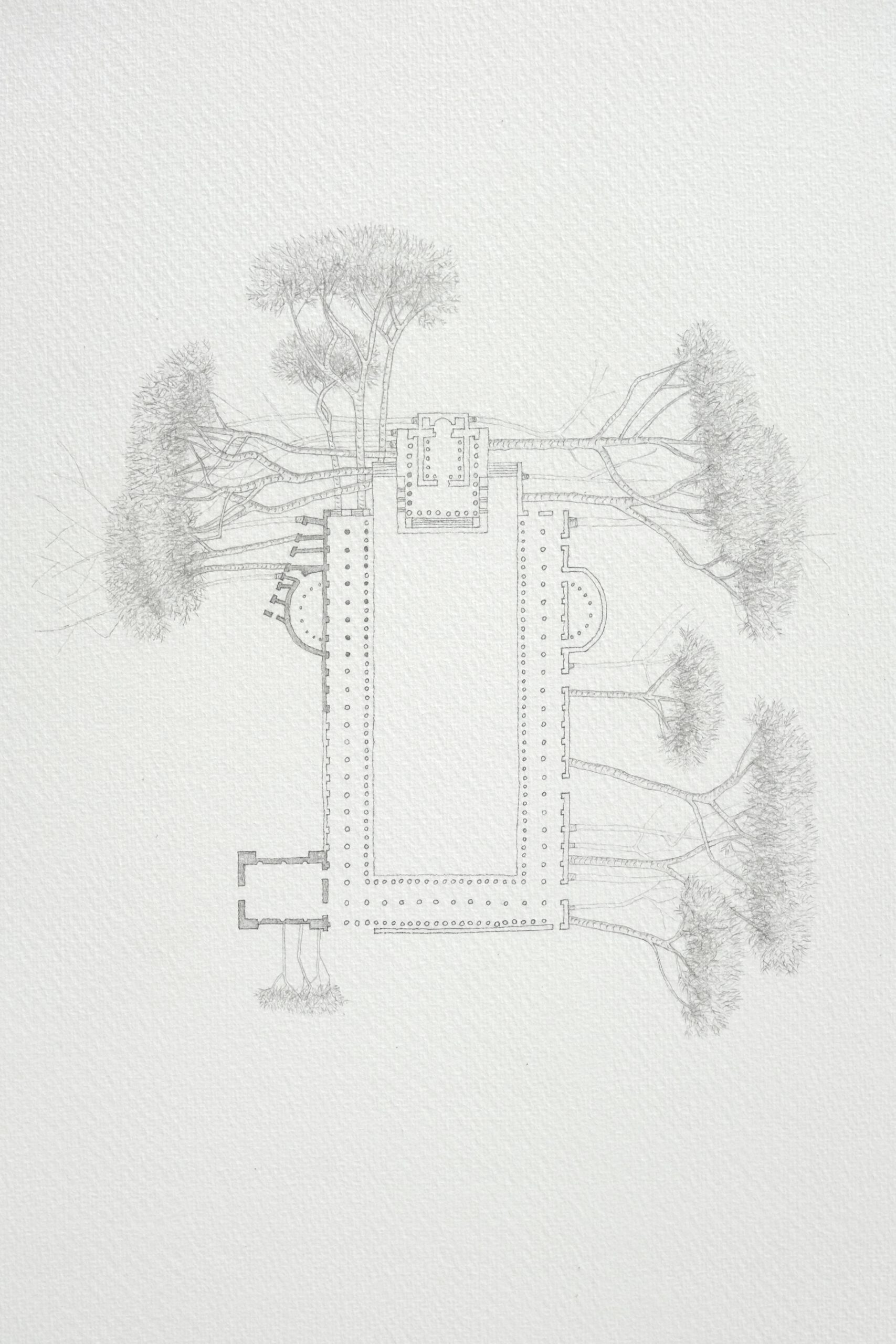
To document and remember, I draw an almost accurate record of the pines overlooking the Baths of Caracalla, the Arch of Constantine and the Forum of Caesar. From the architectural plan sprout the trees that defined my experience on site. Ancient buildings and monuments become a background to the study of plants.
Pines at the Baths of Caracalla, 2026, graphite on paper
Pines at the Arch of Constantine, 2026, graphite on paper
Pines at the Forum of Caesar, 2026, graphite on paper
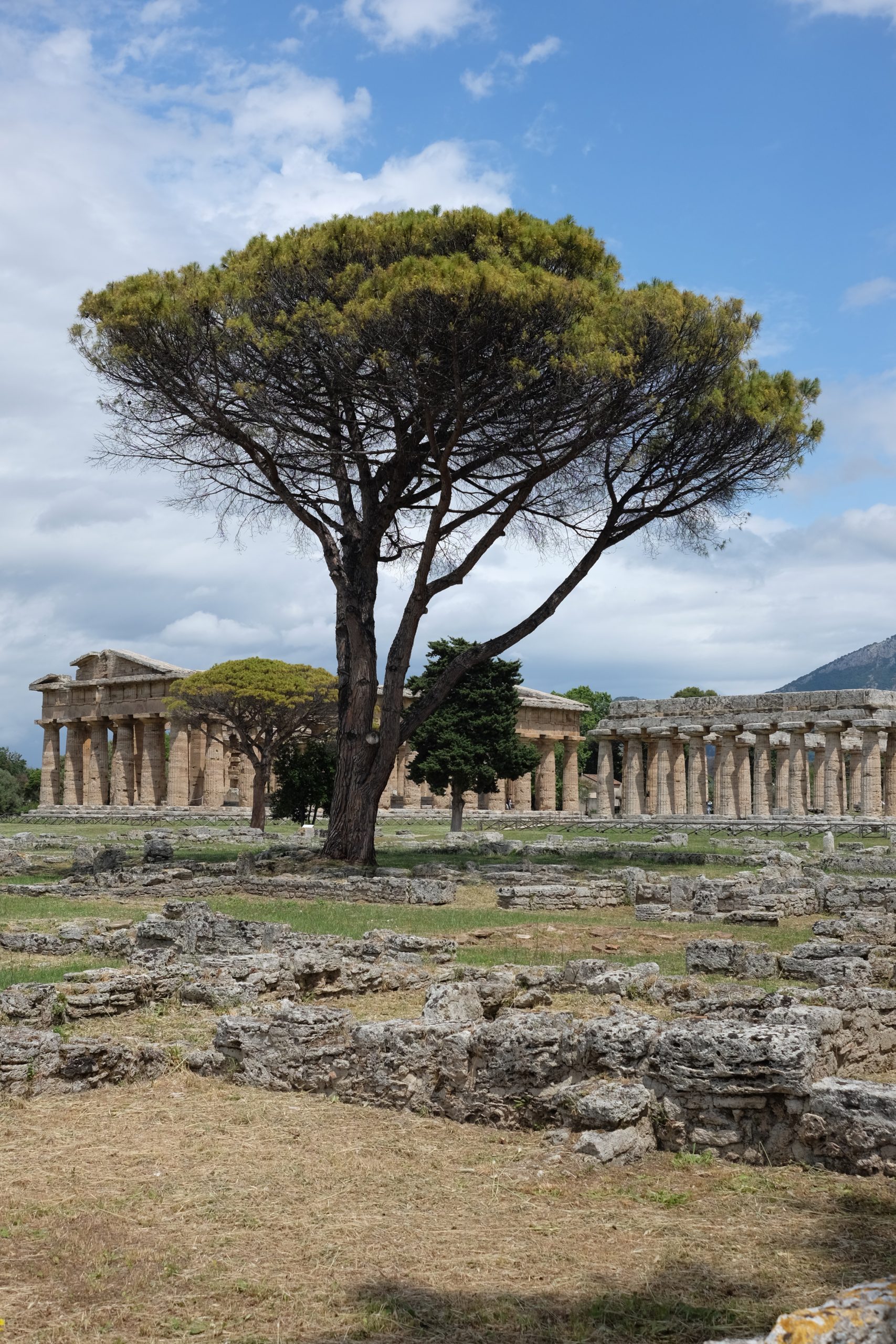
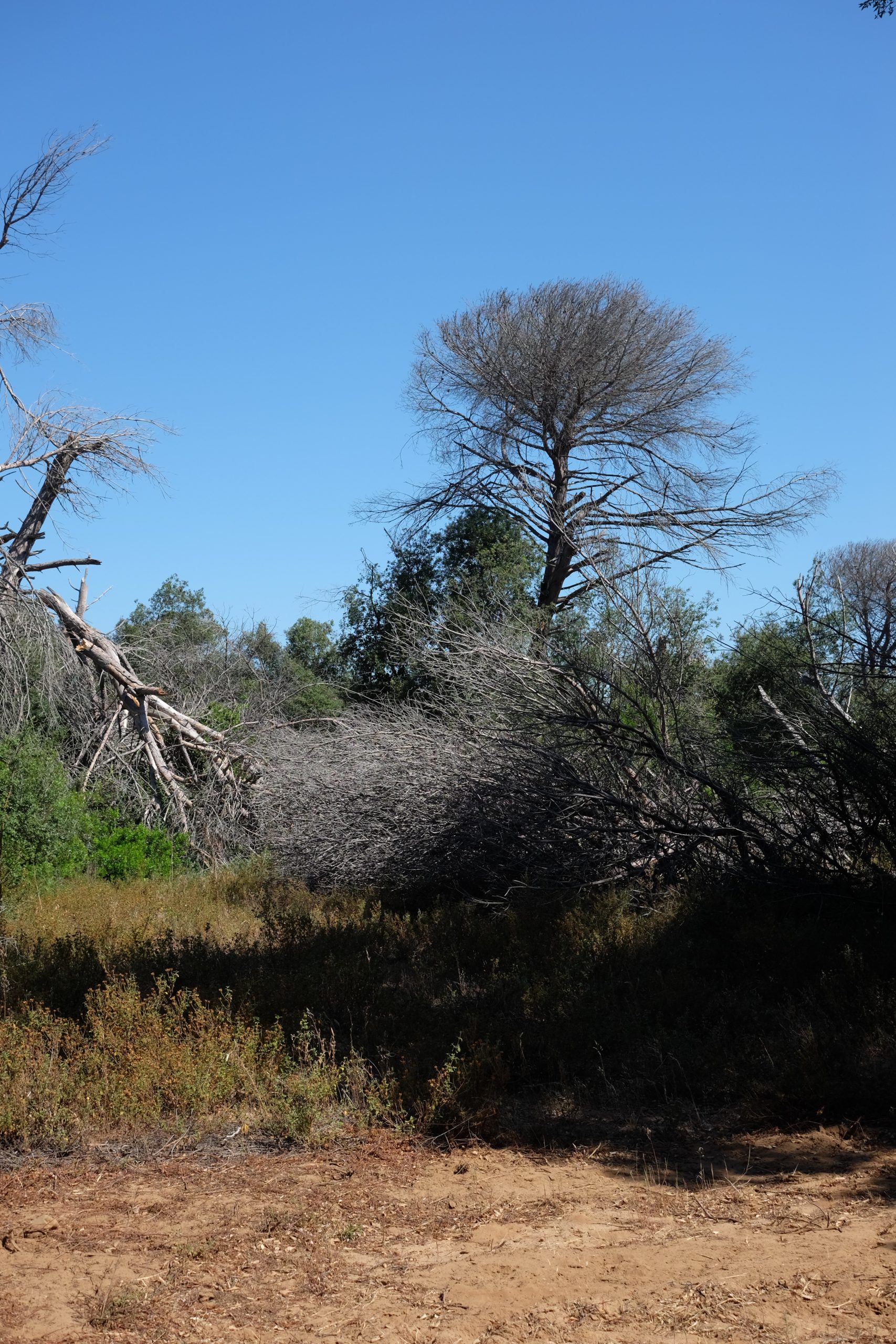
It is through the pine branches and their threatened life that I observe architecture during my residency: the partially defoliated pines growing near the Temple of Neptune in Paestum, whose fate is foreshadowed by the piles of wood chips and dead stumps that greet visitors on their walk from the train station to the ancient city; the ghost trees of the Castelporziano Presidential Estate, where ripe pine cones seem to hang in mid-air, nested among dead branches, their life cycle abruptly interrupted. The trees come and go, and the traces of architecture remain. I think about the longevity of stone over wood.
Defoliated pine in Paestum, Campania
Dead pine at the Castelporziano Presidential Estate, Lazio
I did not find the timber of the pines felled on Via dei Fori Imperiali. I do not think that the great cultural significance they had in life was carried in death. Perhaps we can remedy that.
Ethan Scanlon, Leverhulme Study Abroad Student at the British School at Rome from October 2025 to July 2026, shares insights into the development of his
Valeria Tettamanti, Ecole française de Rome (résidence scientifique jeunes chercheurs UNIONE –November 2025-July 2026) Awardee, discuss her project “Popular science in Italian feminine press at
Ethan Scanlon, Leverhulme Study Abroad Student at the British School at Rome from October 2025 to July 2026, shares insights into the development of his
Valeria Tettamanti, Ecole française de Rome (résidence scientifique jeunes chercheurs UNIONE –November 2025-July 2026) Awardee, discuss her project “Popular science in Italian feminine press at
Emlyn Dodd is former Assistant Director of the British School at Rome, an Associate Fellow of the Institute of Classical Studies at the University of
We use cookies on our website to give you the most relevant experience by remembering your preferences and repeat visits. By clicking “Accept All”, you consent to the use of ALL the cookies. However, you may visit "Cookie Settings" to provide a controlled consent.
This website uses cookies to improve your experience while you navigate through the website. Out of these, the cookies that are categorized as necessary are stored on your browser as they are essential for the working of basic functionalities of the website. We also use third-party cookies that help us analyze and understand how you use this website. These cookies will be stored in your browser only with your consent. You also have the option to opt-out of these cookies. But opting out of some of these cookies may affect your browsing experience.
Necessary cookies are absolutely essential for the website to function properly. These cookies ensure basic functionalities and security features of the website, anonymously.
Cookie
Duration
Description
cookielawinfo-checkbox-advertisement
1 year
Set by the GDPR Cookie Consent plugin, this cookie records the user consent for the cookies in the "Advertisement" category.
cookielawinfo-checkbox-analytics
11 months
This cookie is set by GDPR Cookie Consent plugin. The cookie is used to store the user consent for the cookies in the category "Analytics".
cookielawinfo-checkbox-functional
11 months
The cookie is set by GDPR cookie consent to record the user consent for the cookies in the category "Functional".
cookielawinfo-checkbox-necessary
11 months
This cookie is set by GDPR Cookie Consent plugin. The cookies is used to store the user consent for the cookies in the category "Necessary".
cookielawinfo-checkbox-others
11 months
This cookie is set by GDPR Cookie Consent plugin. The cookie is used to store the user consent for the cookies in the category "Other.
cookielawinfo-checkbox-performance
11 months
This cookie is set by GDPR Cookie Consent plugin. The cookie is used to store the user consent for the cookies in the category "Performance".
CookieLawInfoConsent
1 year
CookieYes sets this cookie to record the default button state of the corresponding category and the status of CCPA. It works only in coordination with the primary cookie.
elementor
never
The website's WordPress theme uses this cookie. It allows the website owner to implement or change the website's content in real-time.
viewed_cookie_policy
11 months
The cookie is set by the GDPR Cookie Consent plugin and is used to store whether or not user has consented to the use of cookies. It does not store any personal data.
Functional cookies help to perform certain functionalities like sharing the content of the website on social media platforms, collect feedbacks, and other third-party features.
Performance cookies are used to understand and analyze the key performance indexes of the website which helps in delivering a better user experience for the visitors.
Analytical cookies are used to understand how visitors interact with the website. These cookies help provide information on metrics the number of visitors, bounce rate, traffic source, etc.
Cookie
Duration
Description
_ga
1 year 1 month 4 days
Google Analytics sets this cookie to calculate visitor, session and campaign data and track site usage for the site's analytics report. The cookie stores information anonymously and assigns a randomly generated number to recognise unique visitors.
_ga_*
1 year 1 month 4 days
Google Analytics sets this cookie to store and count page views.
_gat_gtag_UA_*
1 minute
Google Analytics sets this cookie to store a unique user ID.
_gid
1 day
Google Analytics sets this cookie to store information on how visitors use a website while also creating an analytics report of the website's performance. Some of the collected data includes the number of visitors, their source, and the pages they visit anonymously.
CONSENT
2 years
YouTube sets this cookie via embedded YouTube videos and registers anonymous statistical data.
Advertisement cookies are used to provide visitors with relevant ads and marketing campaigns. These cookies track visitors across websites and collect information to provide customized ads.
Cookie
Duration
Description
VISITOR_INFO1_LIVE
5 months 27 days
YouTube sets this cookie to measure bandwidth, determining whether the user gets the new or old player interface.
YSC
session
Youtube sets this cookie to track the views of embedded videos on Youtube pages.