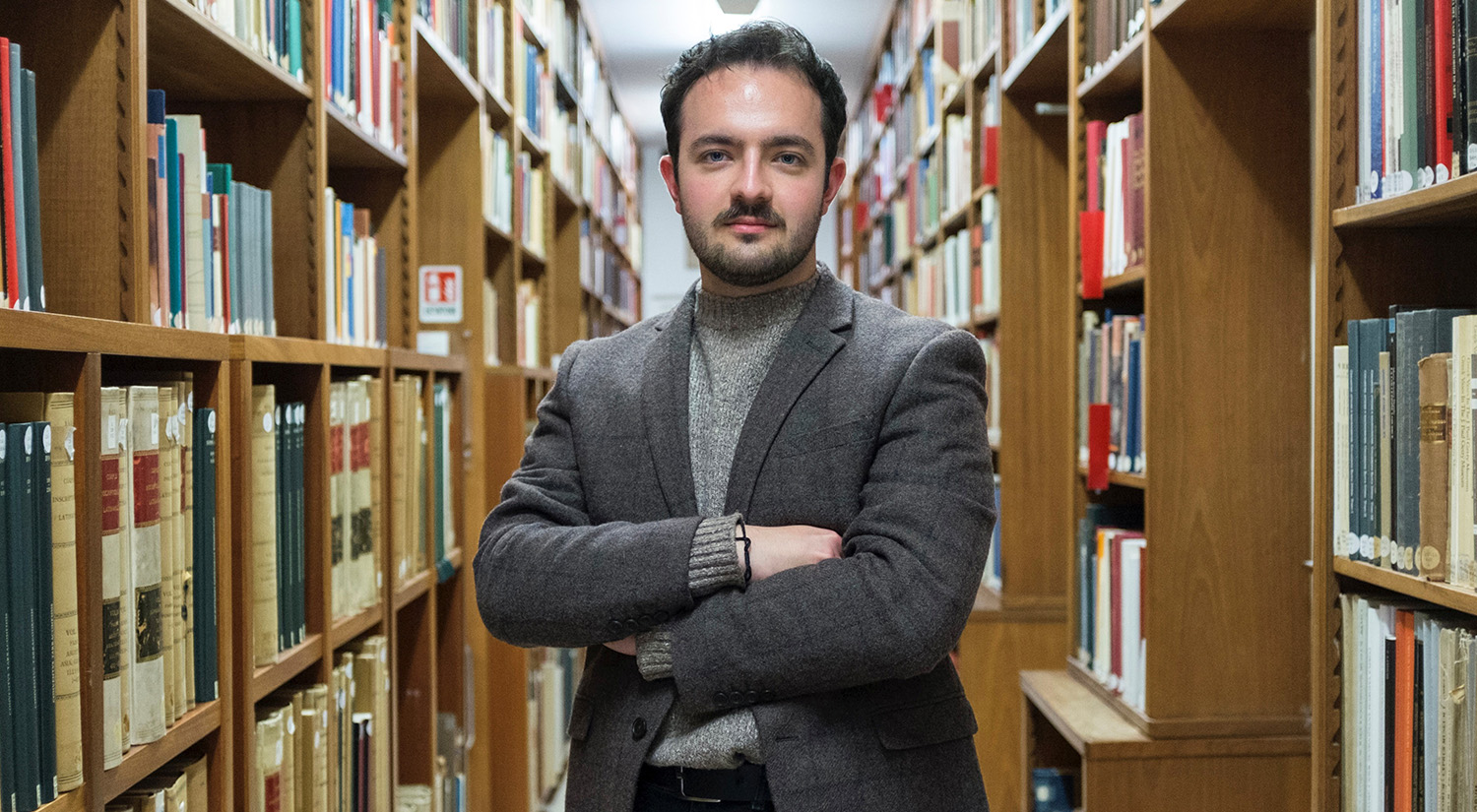
Jonathan Steward at the BSR, 2026, photo by Luana Rigolli
Jonathan Steward at the BSR, 2026, photo by Luana Rigolli
Jonathan Steward, Ralegh Radford Rome Awardee (January–March 2026), discusses his project Bodily Anxieties, the Sea, and the Dead in Ancient Rome in this blog.
Do you fear death? What about death scares you? Do you have a plan for the fate of your corpse? What if the plan goes wrong? And do you want to think about death and the dead body at all?
Every morning for the past three months and, indeed, for many months before that, I have woken up and thought about death. Not my own: my PhD examines how the Romans of the late republic and early empire—around the 1st century BC to the 2nd century AD—interacted with and imagined dead bodies. My work brings together a wide variety of sources and media to build a broad-strokes picture of Roman attitudes to death: how do Romans imagine dead bodies in their literature, and in the in the art and inscriptions that decorated their tombs, urns and sarcophagi? I care far less about the ‘reality’ of death than how it was perceived. Death two millennia ago can seem at once charmingly familiar and strikingly alien: a Roman idea of a ‘good death’ could simultaneously include holding hands with loved ones at the moment of your death, and having your relatives pick your fragmented bones directly out of your funeral pyre afterwards.
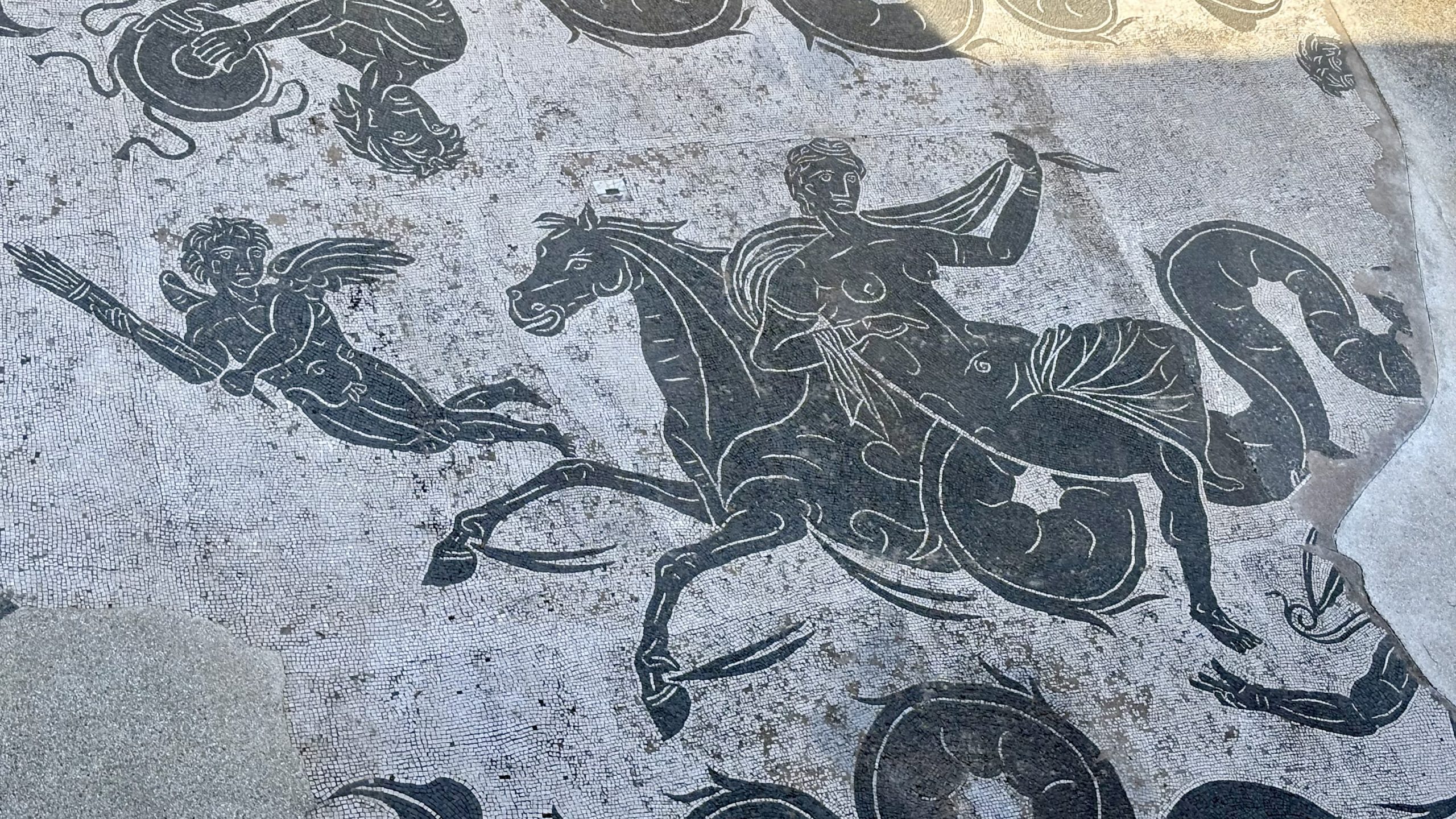
Mosaic: a sea-nymph (Amphitrite) rides a hippocampus, led by an amorino. Ostia, Baths of Neptune, 2nd century AD. Image: author.
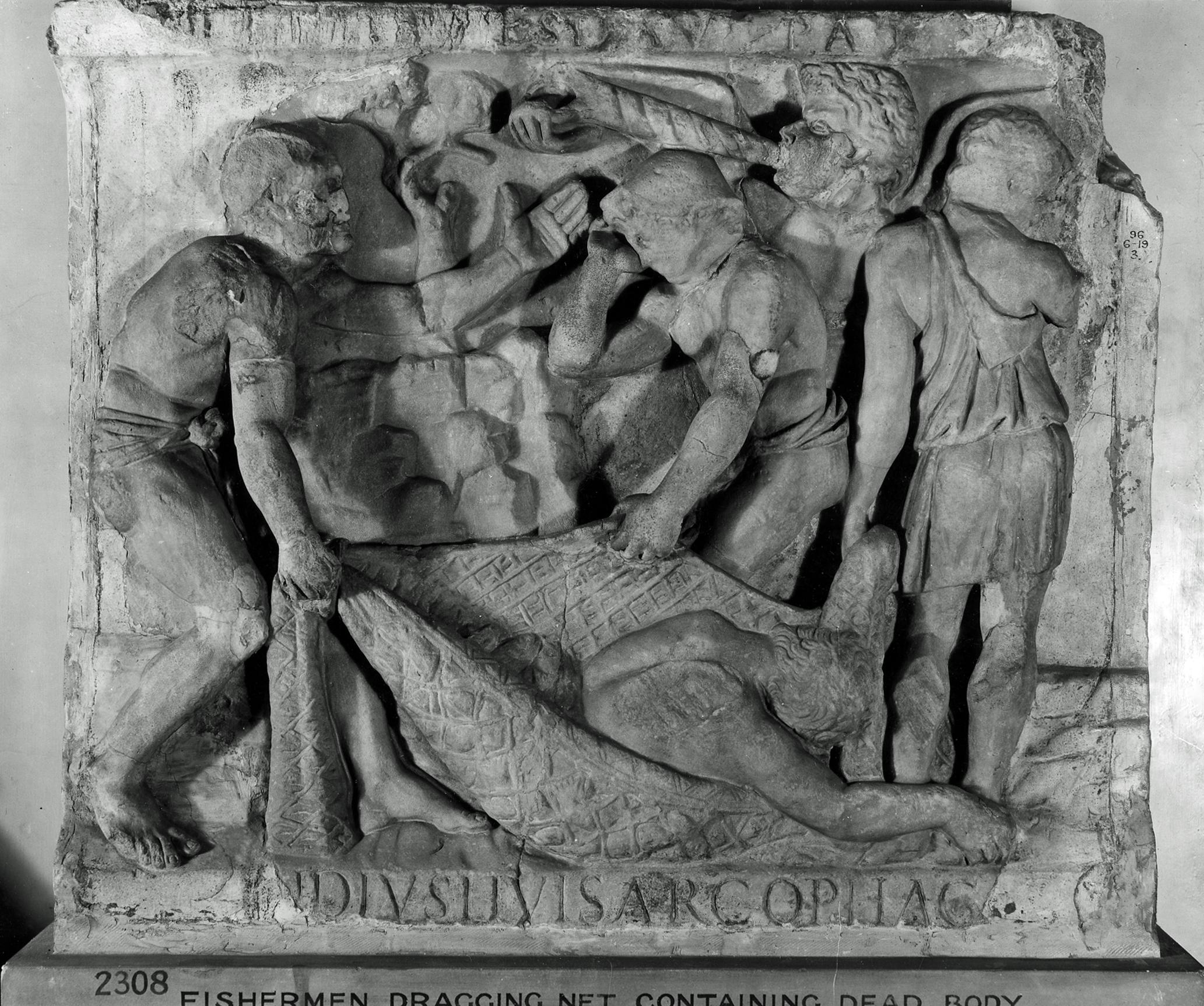
At the BSR, I’ve been researching and writing about the anxieties around death which filled the Roman imagination. Fears about death are not necessarily rational or real: one need only look at myths of vampires, zombies, and ghosts throughout history (and even the Romans had ghost stories, albeit not very scary ones). A particular fear rears its head in the Greek and Latin literature written in the Roman cultural milieu of the early empire: death at sea. It appears in generic lists of ‘bad deaths’; there are well over fifty poems written in a roughly one-hundred-year period at the turn of the millennium which tackle death at sea; and the theme even appears in oratorical exercises.
Such a death was more common in the ancient world than today, but, then again, so was death by tuberculosis, and the Romans seem not to have shared the later Victorian romanticisation of consumption, for example. Roman poetry seems to revel in aesthetic overload: bodies are churned up, flung on to foreign shores, and even eaten by fish (‘novel food for far-off fishes’, noua longinquis piscibus esca, Propertius Elegies 3.7.8, among many others). Not to therapise the ancient Romans, but it does seem unlikely that a pure, visceral fear of the sea motivates their writing: what are they really afraid of? These poems ask what’s left of a person when they die. They worry: how will you be remembered, once your body has decayed and dissolved?
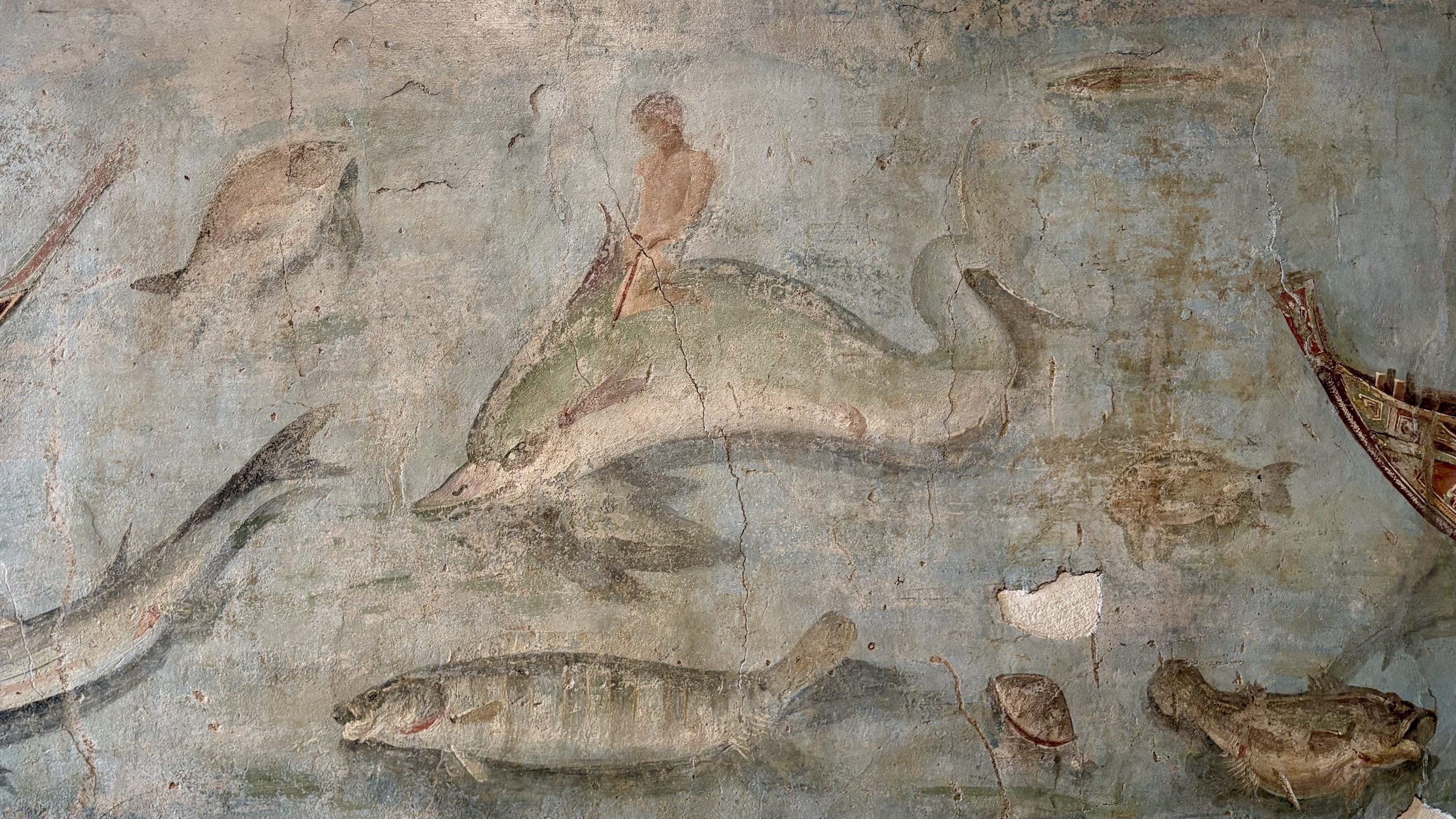
Fresco: an amorino rides a dolphin. From a villa excavated in Pietra Papa, Rome, 2nd century AD. Museo Romano Nazionale di Palazzo Massimo, inv. 121462. Image: author.
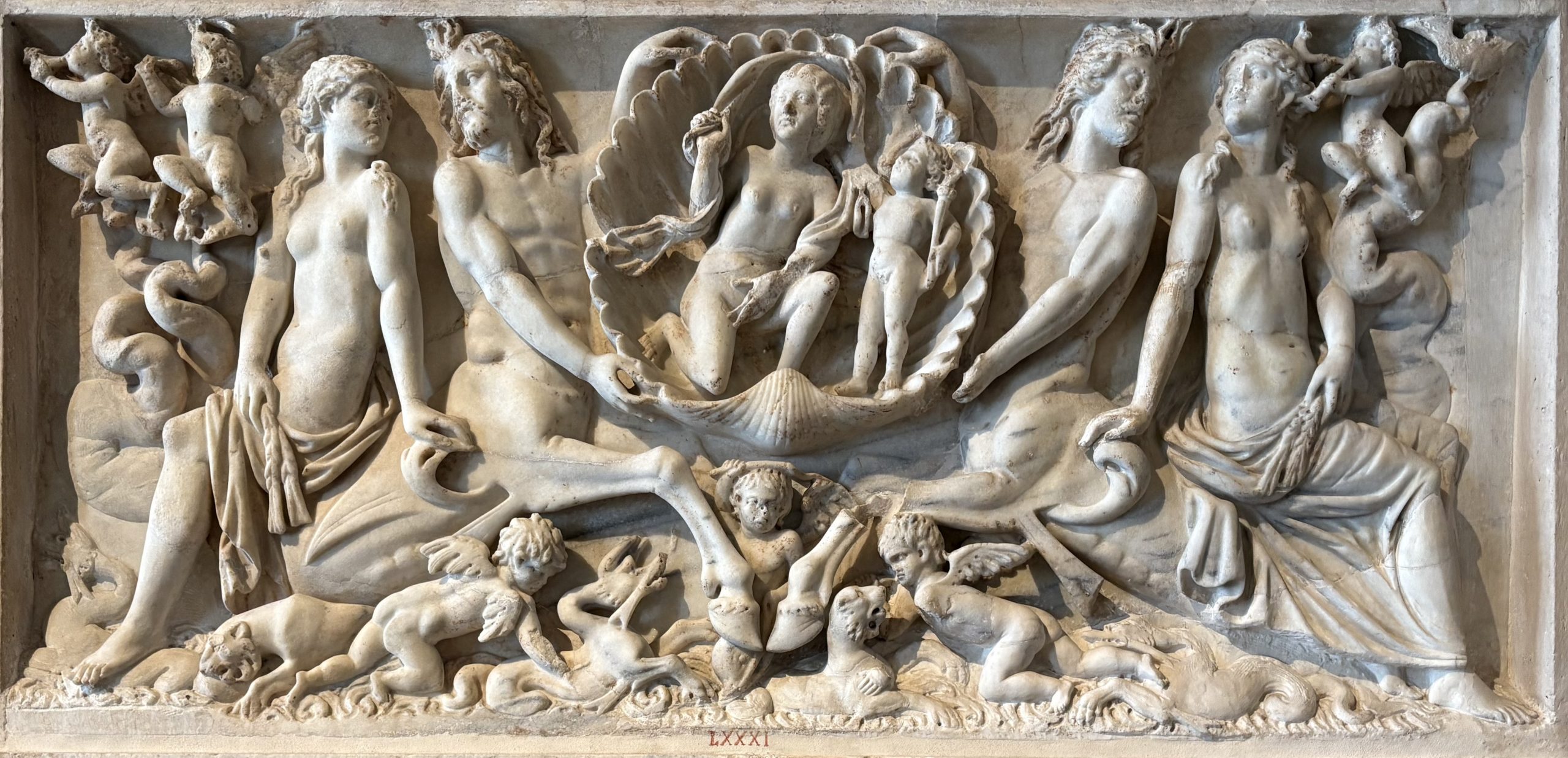
This world of vanishing bodies and devouring fish fits in with broader Roman conceptions of the sea as a mythical realm of impossibilities. Indeed, when I’ve ventured out of the BSR library and its excellent collection of catalogues, I’ve toured the many museums of Rome in search of marine motifs and even made it to the formerly seaside necropolis of Portus, known as Isola Sacra. Today, the ocean still holds a certain mystic allure: we are charmed by dolphin documentaries, fascinated by the bizarre and unsettling creatures of the deep sea, and our popular media is full of tales of pirates, mermaids, and more. There are the familiar Graeco-Roman myths of the sirens, Scylla and Charybdis, and the birth of Venus/Aphrodite, but, more generally, mythological and hybrid sea-creatures like nymphs, hippocampi, and sea-centaurs populated mosaics, frescoes, and reliefs in homes, baths, tombs, and sarcophagi. These sarcophagi in particular depict what is sometimes called a ‘marine thiasos’, a world of impossible, transforming, hybrid beasts and beautiful, eroticised nymphs playing among swirling seas. It is an image of pleasure and unreachability which speaks to (and masks) an anxiety about loss and death, about the transforming and decaying body within the coffin. In the broadest of terms, my research seeks to probe the fears and fantasies which fuel our relationship to death across time.
Sarcophagus relief: marine thiasos with Venus shell portrait. Rome, late 2nd/early 3rd century AD. Galleria Borghese, inv. LXXXI. Image: author.
Ethan Scanlon, Leverhulme Study Abroad Student at the British School at Rome from October 2025 to July 2026, shares insights into the development of his
Valeria Tettamanti, Ecole française de Rome (résidence scientifique jeunes chercheurs UNIONE –November 2025-July 2026) Awardee, discuss her project “Popular science in Italian feminine press at
Ethan Scanlon, Leverhulme Study Abroad Student at the British School at Rome from October 2025 to July 2026, shares insights into the development of his
Valeria Tettamanti, Ecole française de Rome (résidence scientifique jeunes chercheurs UNIONE –November 2025-July 2026) Awardee, discuss her project “Popular science in Italian feminine press at
Emlyn Dodd is former Assistant Director of the British School at Rome, an Associate Fellow of the Institute of Classical Studies at the University of
We use cookies on our website to give you the most relevant experience by remembering your preferences and repeat visits. By clicking “Accept All”, you consent to the use of ALL the cookies. However, you may visit "Cookie Settings" to provide a controlled consent.
This website uses cookies to improve your experience while you navigate through the website. Out of these, the cookies that are categorized as necessary are stored on your browser as they are essential for the working of basic functionalities of the website. We also use third-party cookies that help us analyze and understand how you use this website. These cookies will be stored in your browser only with your consent. You also have the option to opt-out of these cookies. But opting out of some of these cookies may affect your browsing experience.
Necessary cookies are absolutely essential for the website to function properly. These cookies ensure basic functionalities and security features of the website, anonymously.
Cookie
Duration
Description
cookielawinfo-checkbox-advertisement
1 year
Set by the GDPR Cookie Consent plugin, this cookie records the user consent for the cookies in the "Advertisement" category.
cookielawinfo-checkbox-analytics
11 months
This cookie is set by GDPR Cookie Consent plugin. The cookie is used to store the user consent for the cookies in the category "Analytics".
cookielawinfo-checkbox-functional
11 months
The cookie is set by GDPR cookie consent to record the user consent for the cookies in the category "Functional".
cookielawinfo-checkbox-necessary
11 months
This cookie is set by GDPR Cookie Consent plugin. The cookies is used to store the user consent for the cookies in the category "Necessary".
cookielawinfo-checkbox-others
11 months
This cookie is set by GDPR Cookie Consent plugin. The cookie is used to store the user consent for the cookies in the category "Other.
cookielawinfo-checkbox-performance
11 months
This cookie is set by GDPR Cookie Consent plugin. The cookie is used to store the user consent for the cookies in the category "Performance".
CookieLawInfoConsent
1 year
CookieYes sets this cookie to record the default button state of the corresponding category and the status of CCPA. It works only in coordination with the primary cookie.
elementor
never
The website's WordPress theme uses this cookie. It allows the website owner to implement or change the website's content in real-time.
viewed_cookie_policy
11 months
The cookie is set by the GDPR Cookie Consent plugin and is used to store whether or not user has consented to the use of cookies. It does not store any personal data.
Functional cookies help to perform certain functionalities like sharing the content of the website on social media platforms, collect feedbacks, and other third-party features.
Performance cookies are used to understand and analyze the key performance indexes of the website which helps in delivering a better user experience for the visitors.
Analytical cookies are used to understand how visitors interact with the website. These cookies help provide information on metrics the number of visitors, bounce rate, traffic source, etc.
Cookie
Duration
Description
_ga
1 year 1 month 4 days
Google Analytics sets this cookie to calculate visitor, session and campaign data and track site usage for the site's analytics report. The cookie stores information anonymously and assigns a randomly generated number to recognise unique visitors.
_ga_*
1 year 1 month 4 days
Google Analytics sets this cookie to store and count page views.
_gat_gtag_UA_*
1 minute
Google Analytics sets this cookie to store a unique user ID.
_gid
1 day
Google Analytics sets this cookie to store information on how visitors use a website while also creating an analytics report of the website's performance. Some of the collected data includes the number of visitors, their source, and the pages they visit anonymously.
CONSENT
2 years
YouTube sets this cookie via embedded YouTube videos and registers anonymous statistical data.
Advertisement cookies are used to provide visitors with relevant ads and marketing campaigns. These cookies track visitors across websites and collect information to provide customized ads.
Cookie
Duration
Description
VISITOR_INFO1_LIVE
5 months 27 days
YouTube sets this cookie to measure bandwidth, determining whether the user gets the new or old player interface.
YSC
session
Youtube sets this cookie to track the views of embedded videos on Youtube pages.