Jana Kopáčková, Simon Keay Awardee in Mediterranean Archaeology from April to June 2026, shares insights into the development of her research project, “Roman Olive Oil and Wine Production Between the West and East: A Comparison of Agricultural Technology on Both Sides of the Adriatic Sea”
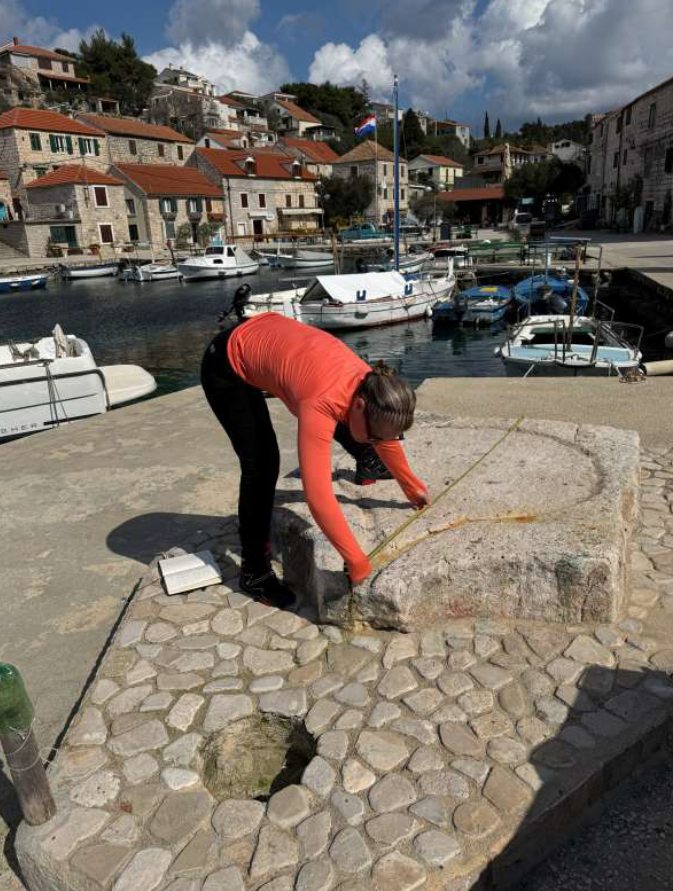
When you travel through the eastern Adriatic, olive groves and vineyards are omnipresent. The landscape is beautiful, sapphire-blue sea, deep green of the vine leaves, olive green of olive trees, intense orange red of the soil combined with bright white of the bedrock. This part of the world is indeed full of beauty. We can imagine that similar picture was offered to Cassiodorus when he was traveling along the Histrian coast during his duty as senator and prefect of the Ostrogothic king’s praetoria. In his letter (Autumn of 537 CE) he described the region being “covered with olives, glorious for its corn, rich in vines, where all crops flow in desirable fertility” (Cassiodorus Var. XII.22).
As a Czech, raised in a country famous for its beer production, I found Roman wine and olive oil production to be a fascinating exotic topic. Surprisingly, Roman wine and olive oil production in the eastern Adriatic has never been thoroughly studied; thus, I decided to focus on it during my PhD. At the beginning, I had at my disposal two major works: J.-P. Brun and R. Matijašić, with altogether 12 sites in Histria and 14 sites in Dalmatia. In previous relevant publications, a startling assumption was consistently being repeated: poor climate conditions resulted with an almost non-existent local production of wine and olive oil in those regions. As my research went on, the numbers of sites grew exponentially and it became obvious that this deep-rooted assumption is no longer sustainable. Results of my decade long research were subsequently published under the title “Olevm et vinvm adriaticvm” (Zagreb, 2023) with 236 sites in the catalogue.
My research is still ongoing; number of sites is steadily increasing and currently my database includes almost 271 sites. It is a good starting point for a broader analysis of different technological approaches used in the eastern Adriatic and their comparison with other Mediterranean regions. That is something I am currently focusing on. All previously published works addressed the spread of technology only in the simplest ways. Researchers were stating as a fact that the ideas travelled from Italy together with colonists who settled first in Histria (late 2nd-1st c. BCE) and later in Dalmatia (late 1st c. BCE-1st c. CE). This assumption is widely agreed upon, however there are no significant studies focusing on this topic so far. While conducting research for my thesis I learned not to blindly believe older theories and assumptions without any scientific backup as many of them were proven partially or even entirely incorrect by my own findings.
So far, my investigation exposed rather significant differences between the ‘western’ Italian technology and the technology actually evidenced and used in the eastern Adriatic. For example, the most puzzling discrepancy is the lack of use of the horizontal olive mill with hemispherical mill stones (previously called trapetum). It was commonly used in Italy (a well-known example of such an olive mill was excavated in Pompeii), but none have so far been found neither in Histria nor in Dalmatia. Another example of uneven occurrence of technology is represented by opus spicatum (small clay bricks assembled in herringbone pattern). The press-beds made of opus spicatum are common in Republican Italy, we can find them also in Histria in the 1st c. CE but so far only one was detected in Dalmatia (very close to the border with Histria). In this case it seems plausible that the influence came with first Italian colonists, but somehow did not spread to Dalmatia. On the other hand, the presence of an arca lapidum (type of counterweight used by lever pressing device) at two sites is quite stunning. This type of massive and technologically highly developed mechanism was commonly used in Spain (1st-2nd c. CE) but was so far not found outside of this region and its presence in the eastern Adriatic is astounding. While it is a well-established fact that all parts of the Roman Empire were well connected by sea, trade was flourishing and goods were exchanged all-over the Mediterranean, the idea of typical Spanish technology travelling as far as the Adriatic was a truly eye-opening moment in my research. While it does not necessarily contradict the theory of regional technological influence originating from Italy, such exotic finds definitely broaden our expectations in future research.