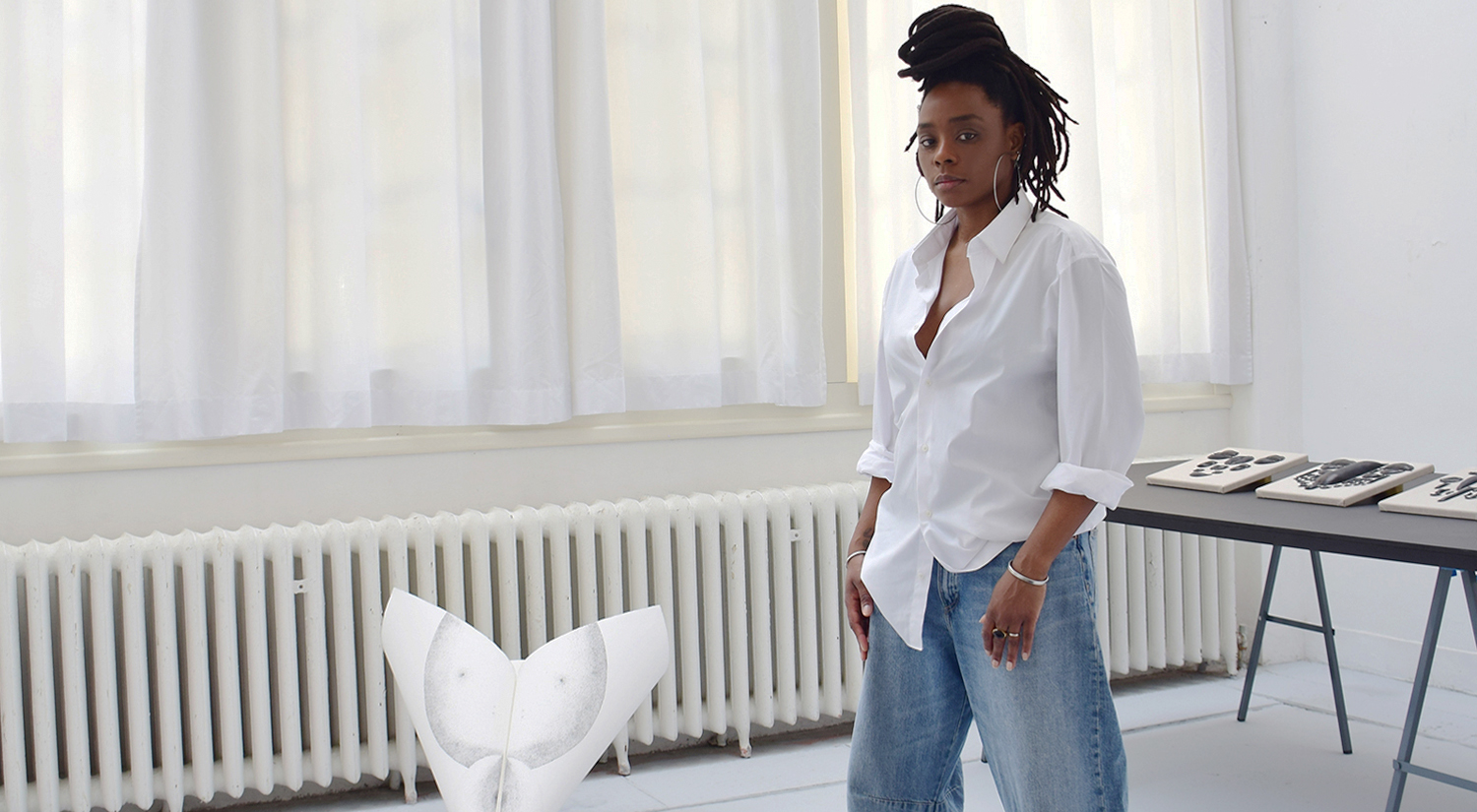
Lisa-Marie Harris, Sainsbury Scholar at the BSR from January to June 2026, shares in this blog her reflections on her residency experience and the research she is carrying out.
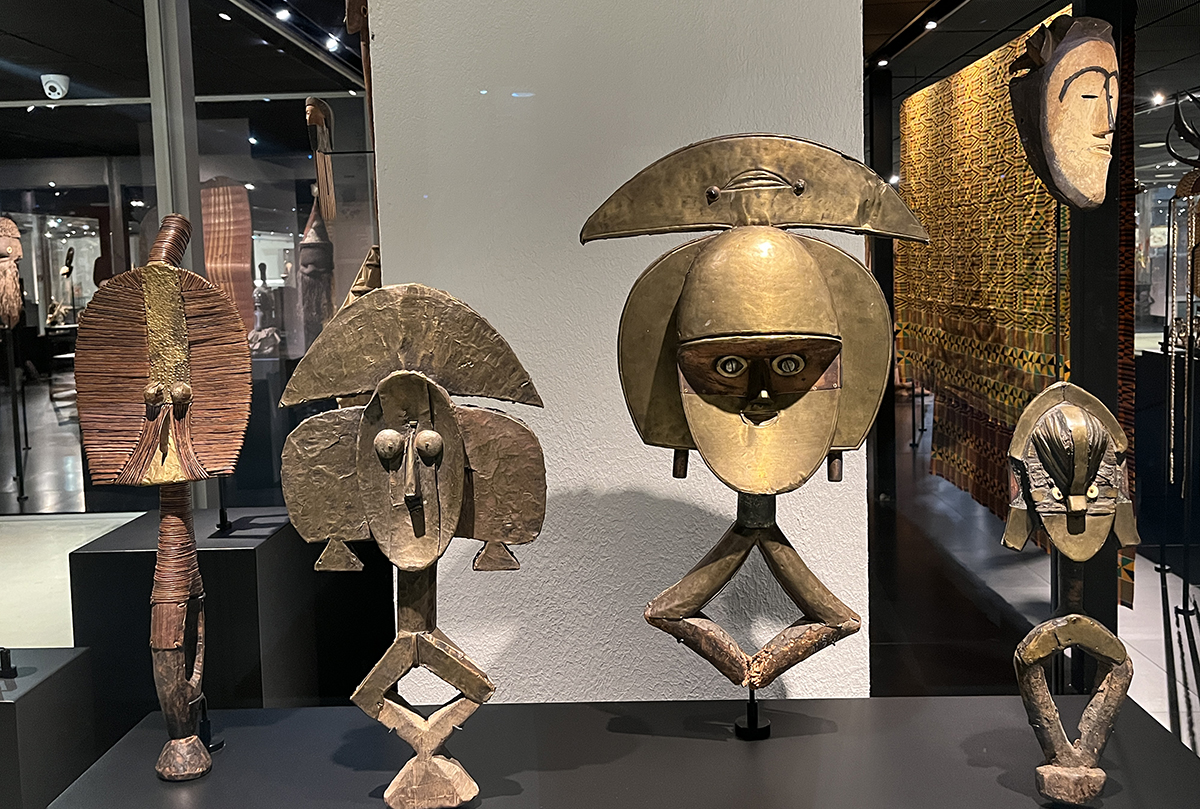
A specific set of concerns relating to floor-based mosaics, bodies being forced underfoot, and reframing the female form defined my intended research at the BSR; within the first weeks of being in Rome, my interests promptly meandered towards all manner of distractions. I became fascinated by the minimalism of African totems and brass sculptures found in museum archives; the uneven slopes of the ancient pathways still being trod in 2026; the merits of crisp, Romanesque pizza cut into mosaic-like squares and folded, sandwich-style, at the pizza parlour on Via Flaminio…
Kota reliquaries from Gabon seen at the Vatican Museum
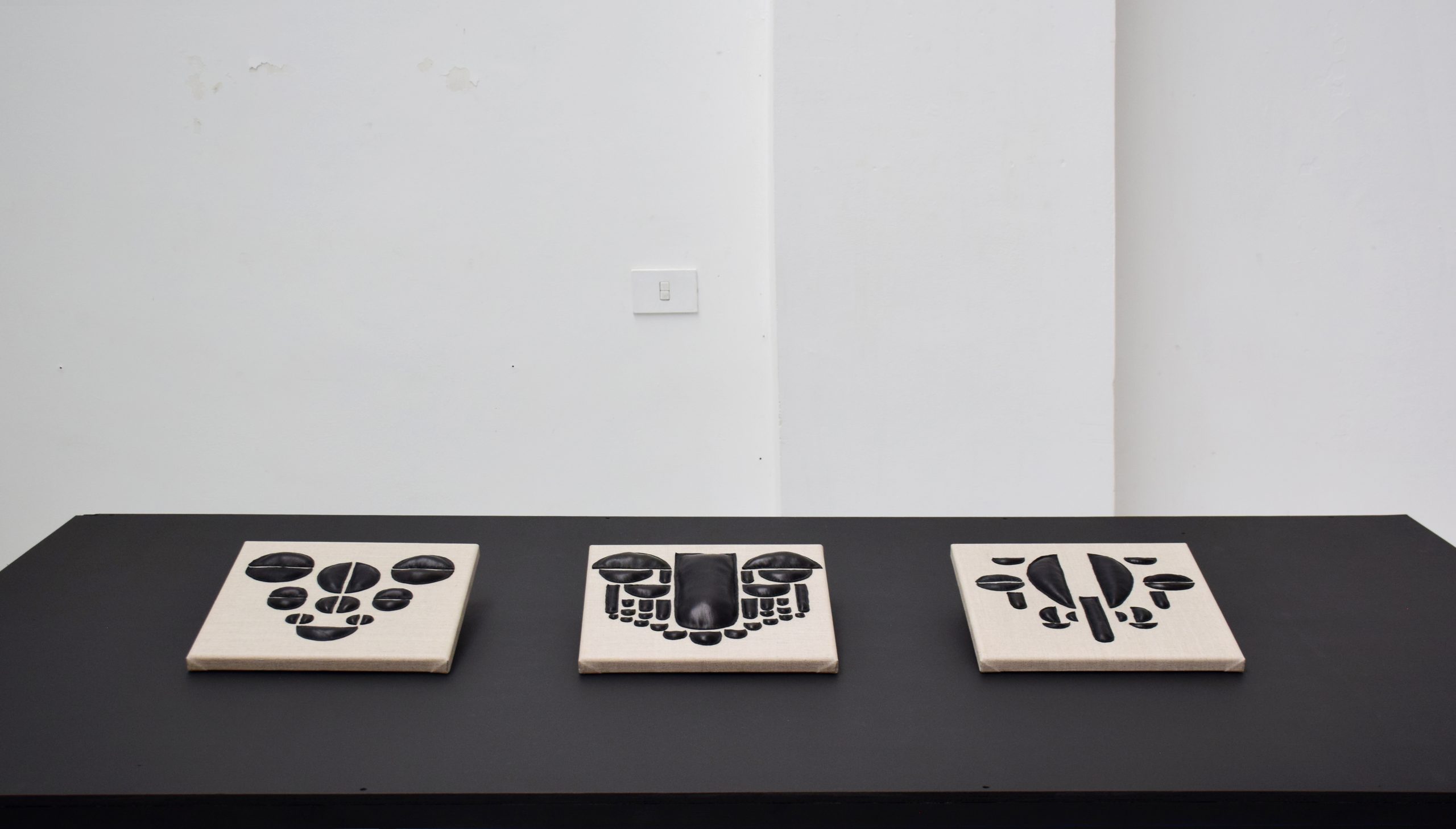
These disparate bits somehow took me full circle to the core interests of my practice, in which I contend with unpacking the thinghood of a woman’s body (understanding of the inherent aspects of being in a female form) and the subsequent objectification directed towards said form. Materiality holds great significance in my approach, and I often repurpose leather skins from used womenswear garments and household furniture to question and expose the ways in which women’s bodies are viewed as a malleable surface upon which societal and gendered demands are heaped, with the expectation that the body maintains its utility and desirability even as parts of the whole break apart, or cease to function.
Double Entendre Series: Nº 01 to Nº 03, 2026. Archival leather on raw linen. Installation View BSR Spring 2026 Open Studios
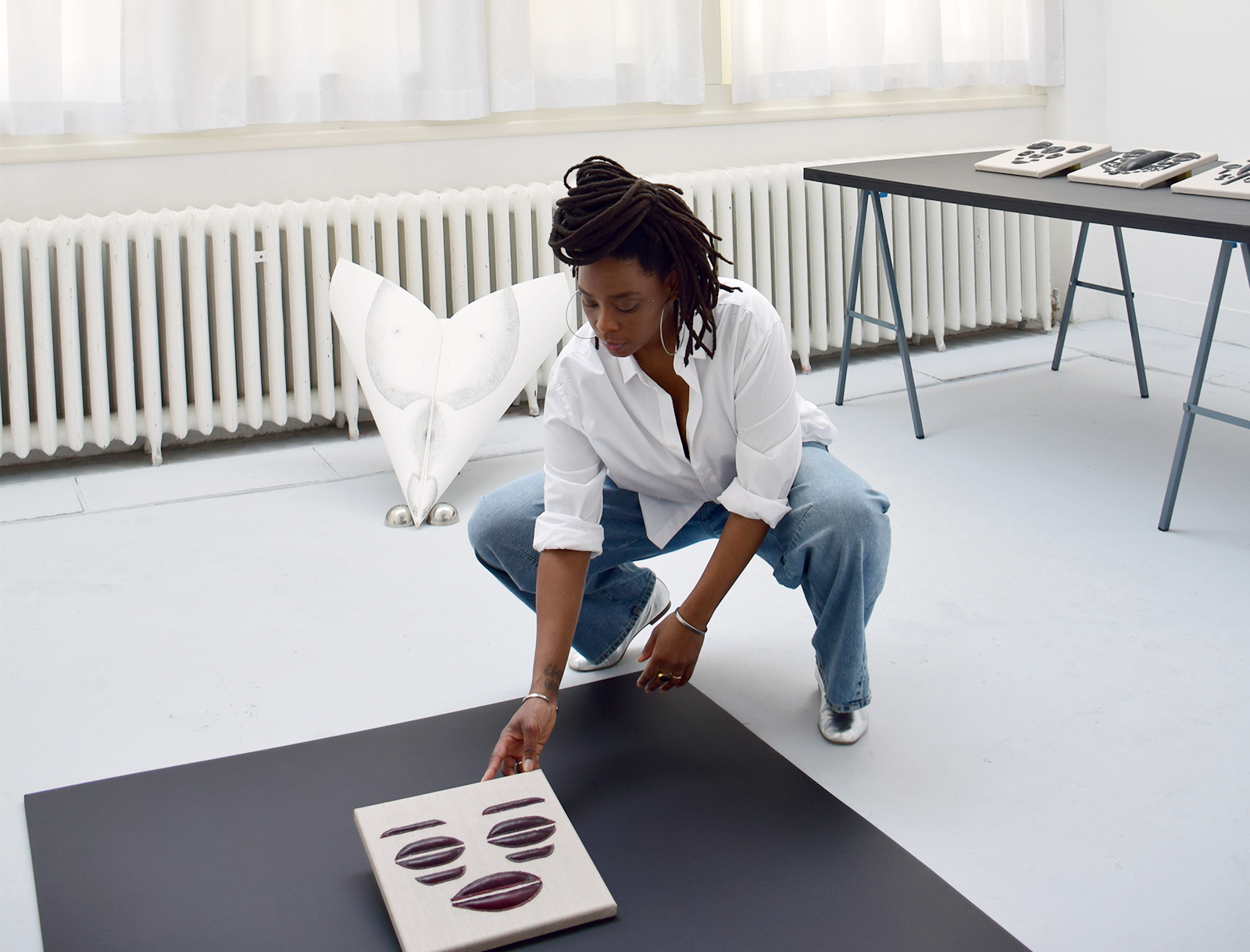
Double Entendre Series: Nº 04. Archival leather on raw linen. Installation View BSR Spring 2026 Open Studios
Reintegrating those broken parts within my work – questioning this facade of ‘wholeness’ by assembling geometric forms into near-symmetrical compositions – allows for the ambiguity of my outcomes to problematise the limiting, gendered projections set upon the dehumanised female body. It allows the work to broach the uncomfortable questions about women’s bodies and experiences that are overshadowed by the often gratuitous allure of the figurative.
The compositions within my practice thus serve as invitations to question the encoded meaning within the skin, literally and theoretically. Our eyes fill-in-the-blanks as it were, attaching emotion and intent to the supple curves or the bulbous shapes pulled taut in the works, with splayed bodies or haunted faces appearing even without the definitive suggestion of bodily forms. These occurrences resonated deeply as I considered the ambiguity also present in Rome itself, where layers of constructions and reconstructions done at a grandiose scale can conceal the presence of, and labour enacted by, bodies across time.
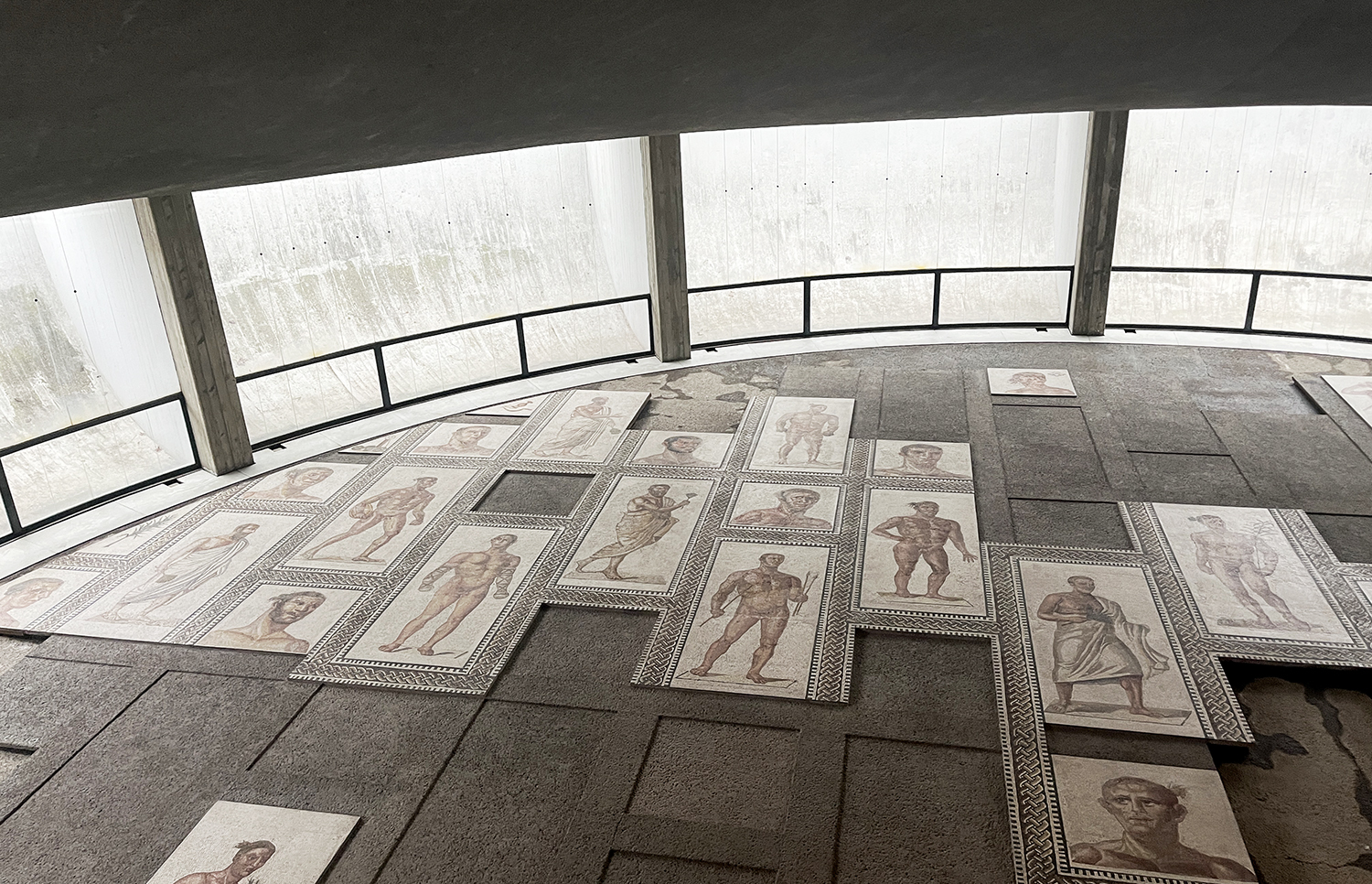
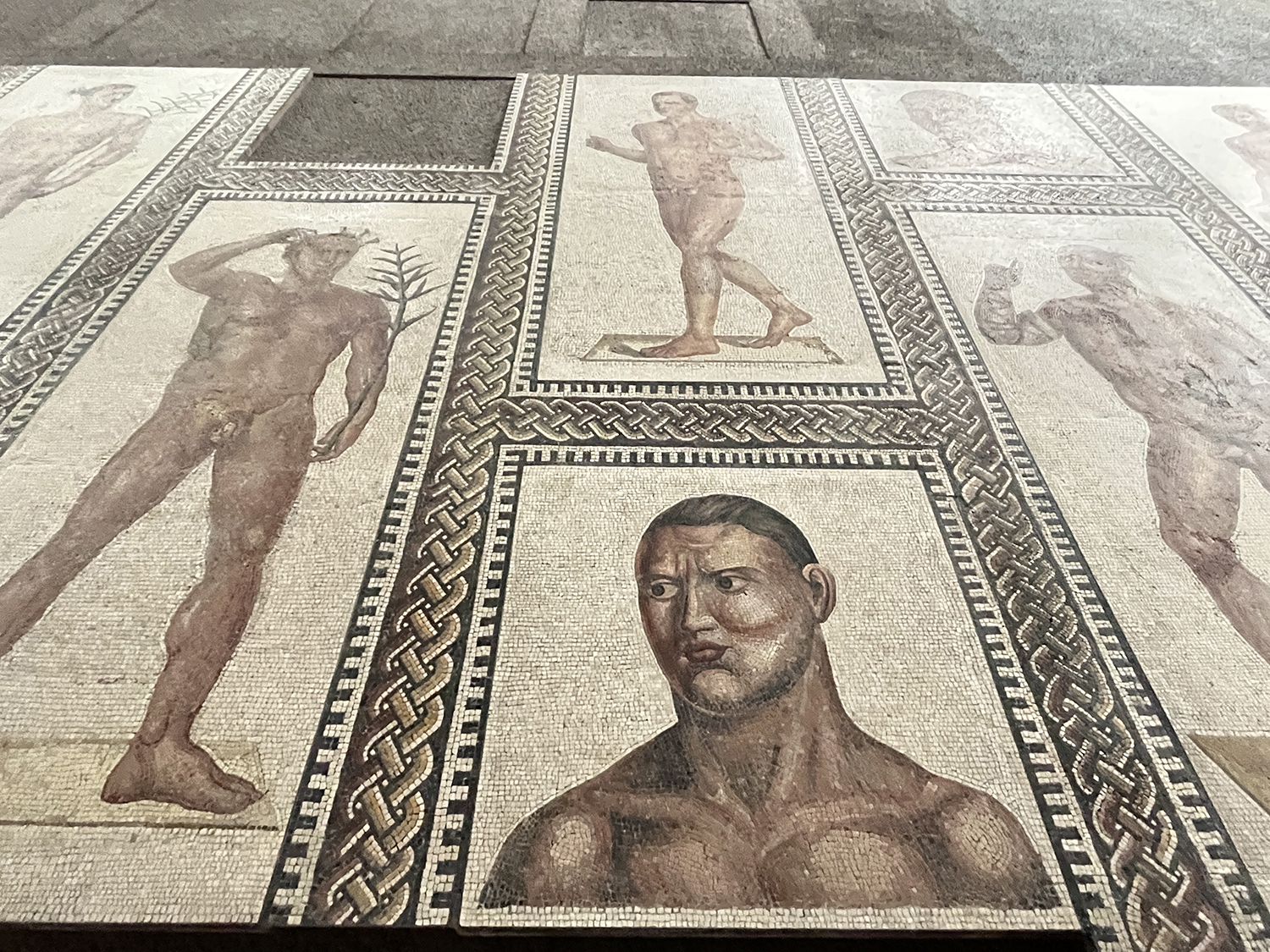
Mosaics from the Bath of Caracalla, installed at the Vatican Museum
To that end, I’ve been spending time in research at the Vatican Museum, sitting with the reassembled figurative mosaic inlays that were transported to the museum’s basement from the Bath of Caracalla. The forms themselves were impressive, with each tessellated surface comprising hundreds, perhaps thousands of tiny, squarish tesserae delineating the muscled planes of the sportsmen that probably dominated the imaginations of Roman citizens in the era of gladiators.
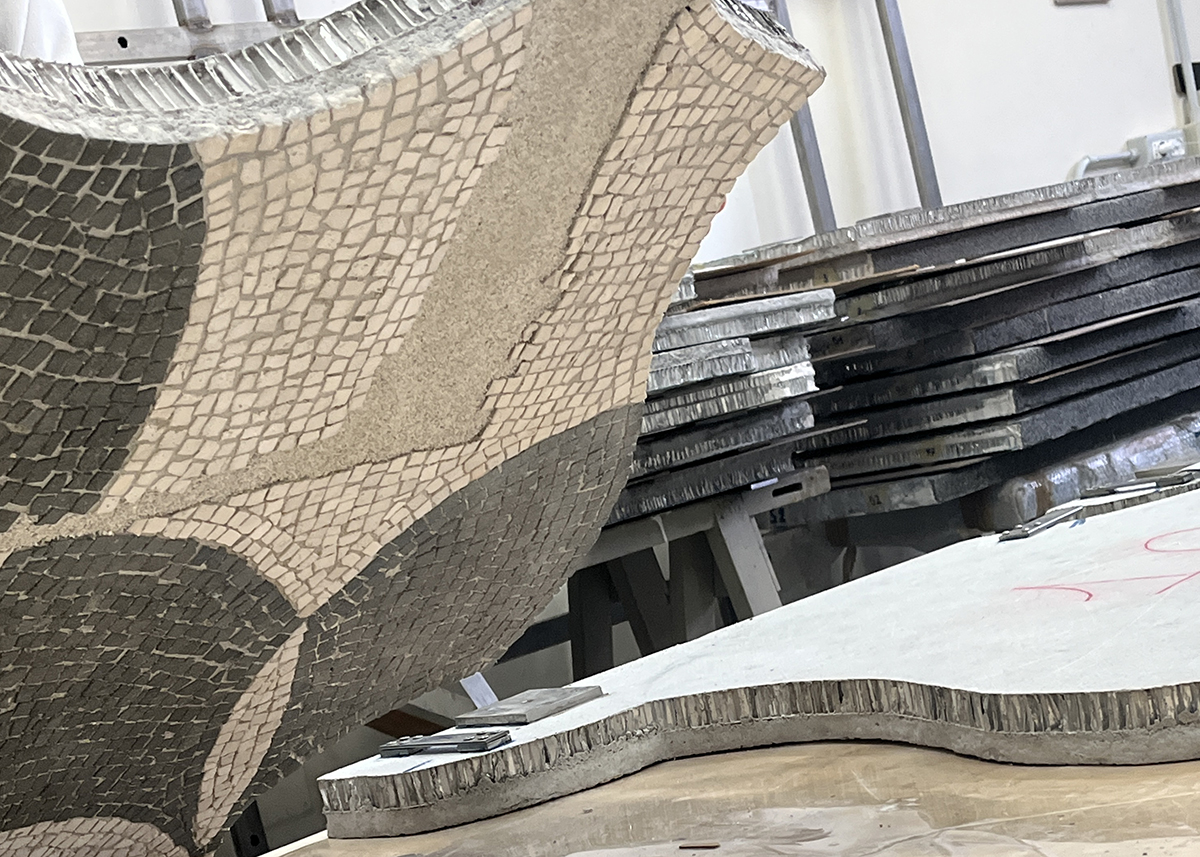
Mosaic segments being reconstructed
Additional time spent in the Vatican Mosaic Restoration lab helped me to further understand the underlying construction of each segment; how the substrates of mosaic panels were historically comprised and how that process has been adapted over time, with segments being deconstructed, surface decoration lifted, new materials chemically matched, then meticulously layered with many interventions concealed in each step, in order to present something seemingly untouched and effortlessly preserved across the ages.
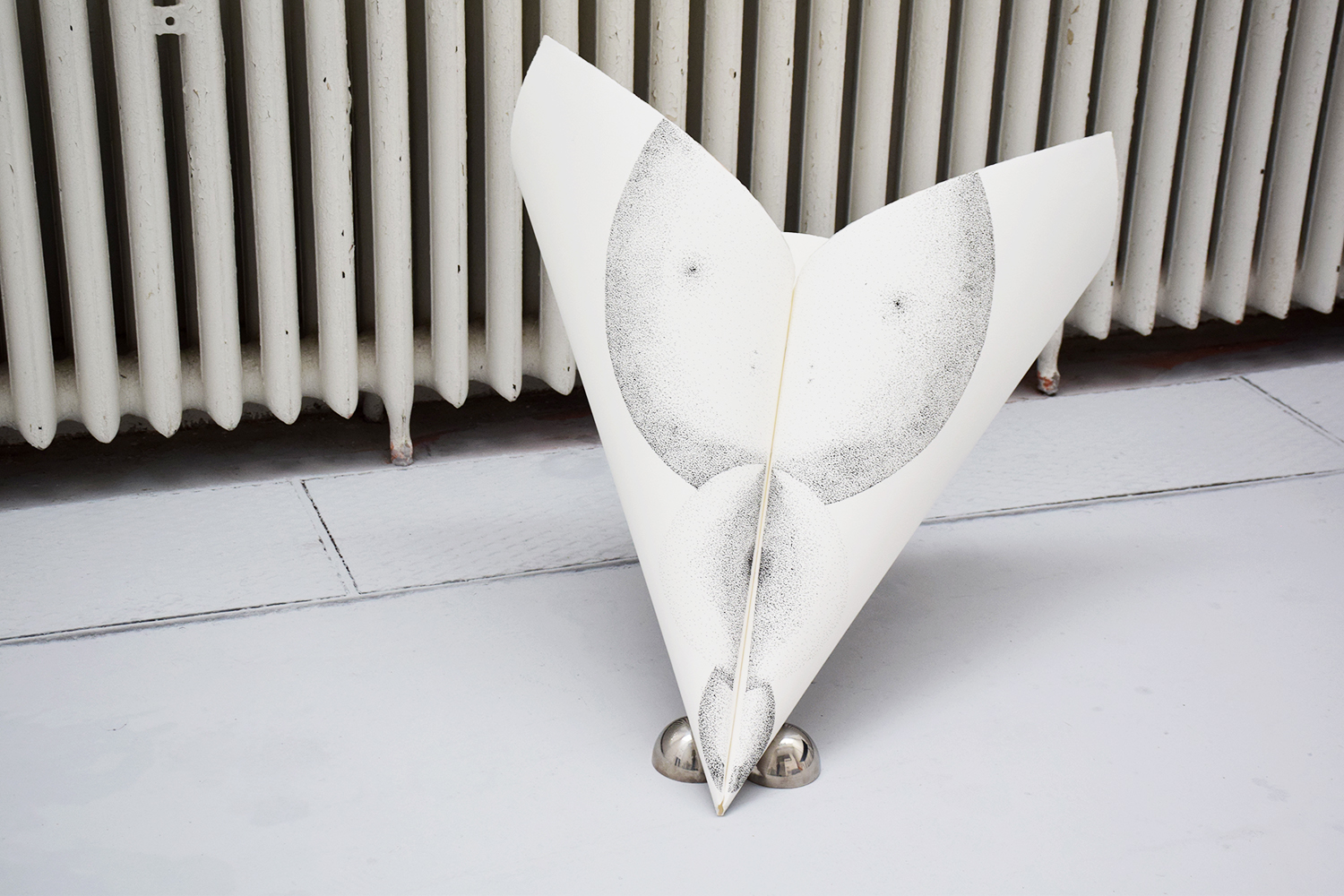
Splayed Form 01, 2026. Pen & ink on paper. Installation view, BSR Spring 2026 Open Studios
I’ve also been working through different methodologies for articulating the cultural, ancestral and gendered traumas or experiences carried in the female body, which led me towards incorporating mechanical drawings and spatial constructions to encapsulate the fragility of these unseen, yet weighty occurrences.
Where the leather works present a tangible, often visceral route to understanding embedded bodily meaning, manipulating sculptural drawings on paper within the residency has allowed for the creation of a new visual lexicon within my practice, where the mark making I’d normally perform as an initial sculptural exploration has been given space to develop into fully realised works in their own right.
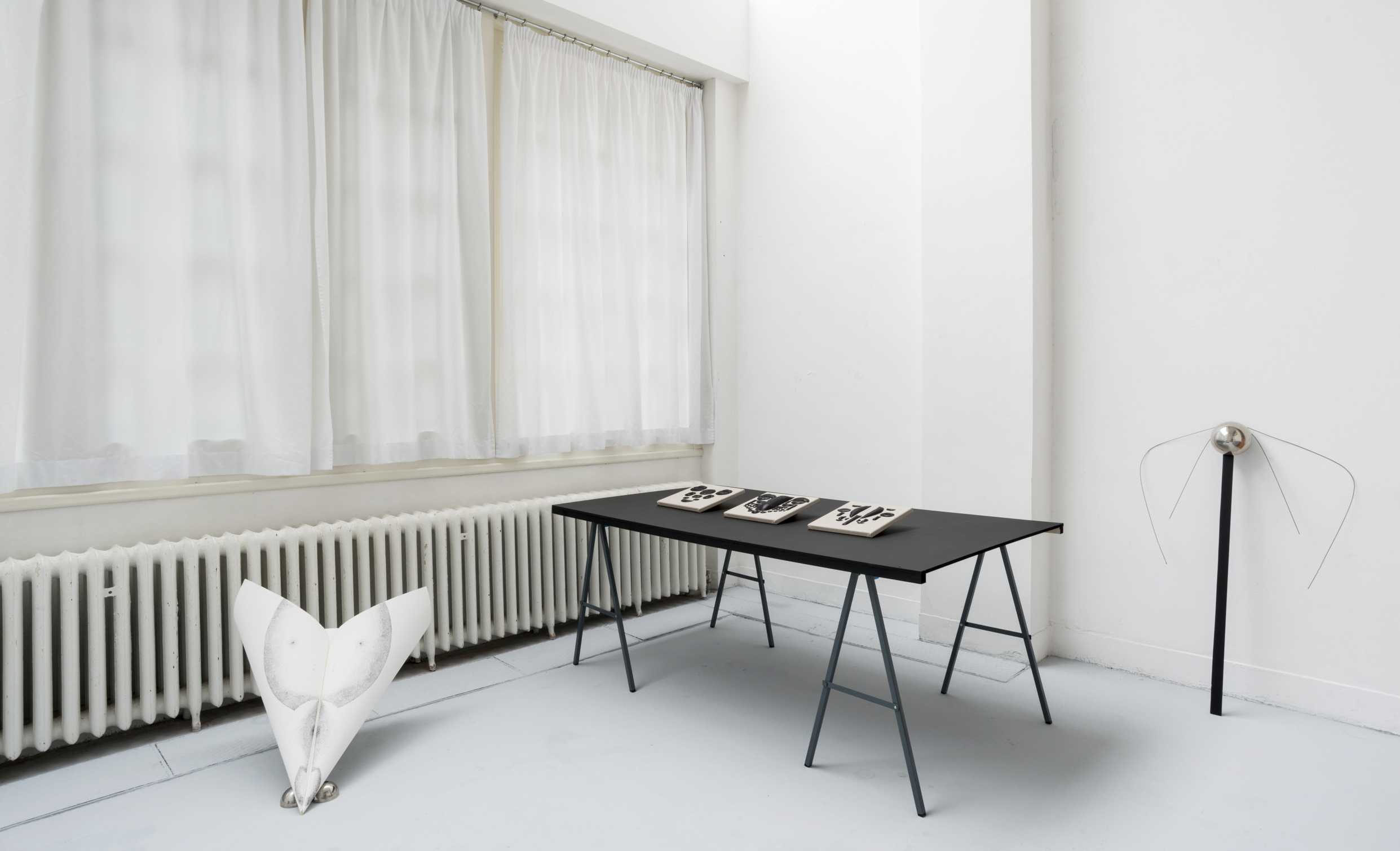
Installation view, BSR Spring 2026 Open Studios
This new language has decidedly inserted itself between the suggestiveness of the relief work in my practice, and the provocative dimensionality of the sculpture. The drawings balance the fragile aspects of female interiority with the need for a shell of self-preservation, the latter taking its shape by negotiating the space with the aggressively pointed, weaponised guise normally associated with masculinity: another façade that women are often required to wield as an act of self-preservation.
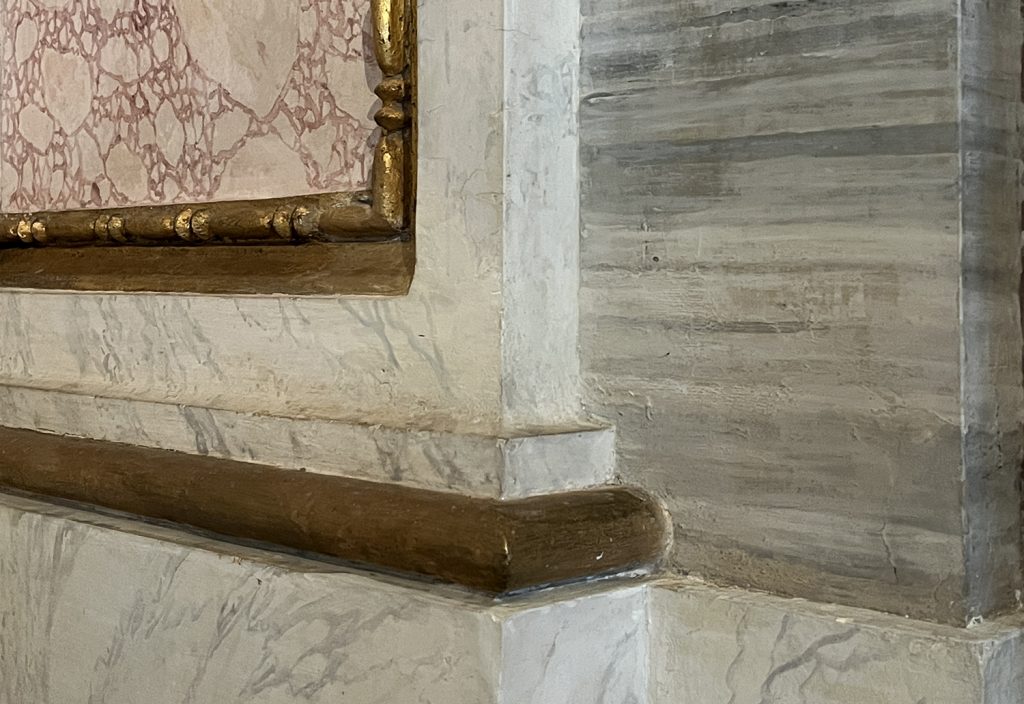
This idea of ‘the guise’ became unmissable the more I wandered throughout Rome, which has been awe-inspiring and generative in a way that only a city designed to impress across millennia could manage. The more one looks around and notes the many surfaces artfully manufactured to withstand the passage of time, the sensation of things being seemingly untouched begins to confuse the senses. Frescoes trick the eye, creating stone surfaces and depth where there is none, and monuments seem geometrically precise until you stand at a certain angle and notice how the pediment shortens oddly on one side. Even the square pizzas are deceptive, being cut sometimes in rectangles, other times in squares, yet ‘fitting’ altogether in the apparent harmony of their large baking trays…
Walls painted to appear as veined marble in the Villa Medici salons
There is a curious overflow of the ambiguous in Romen despite its totemic scale, and considering the implications of that opacity in relation to the landscape’s dominance over the body has given me much to tease apart as I encode – or decode – meaning in the reassembled bodily forms of my practice.
In this blog, David Osbaldeston, Abbey Fellow from January to March 2026, reflects on his residency experience and the research he presented at the Spring
For over thirty years the BSR has run undergraduate (Summer School) and postgraduate (City of Rome) courses on the ancient history, archaeology, and topography of
For over thirty years the BSR has run undergraduate (Summer School) and postgraduate (City of Rome) courses on the ancient history, archaeology, and topography of
In this blog, David Osbaldeston, Abbey Fellow from January to March 2026, reflects on his residency experience and the research he presented at the Spring
For over thirty years the BSR has run undergraduate (Summer School) and postgraduate (City of Rome) courses on the ancient history, archaeology, and topography of
For over thirty years the BSR has run undergraduate (Summer School) and postgraduate (City of Rome) courses on the ancient history, archaeology, and topography of
We use cookies on our website to give you the most relevant experience by remembering your preferences and repeat visits. By clicking “Accept All”, you consent to the use of ALL the cookies. However, you may visit "Cookie Settings" to provide a controlled consent.
This website uses cookies to improve your experience while you navigate through the website. Out of these, the cookies that are categorized as necessary are stored on your browser as they are essential for the working of basic functionalities of the website. We also use third-party cookies that help us analyze and understand how you use this website. These cookies will be stored in your browser only with your consent. You also have the option to opt-out of these cookies. But opting out of some of these cookies may affect your browsing experience.
Necessary cookies are absolutely essential for the website to function properly. These cookies ensure basic functionalities and security features of the website, anonymously.
Cookie
Duration
Description
cookielawinfo-checkbox-advertisement
1 year
Set by the GDPR Cookie Consent plugin, this cookie records the user consent for the cookies in the "Advertisement" category.
cookielawinfo-checkbox-analytics
11 months
This cookie is set by GDPR Cookie Consent plugin. The cookie is used to store the user consent for the cookies in the category "Analytics".
cookielawinfo-checkbox-functional
11 months
The cookie is set by GDPR cookie consent to record the user consent for the cookies in the category "Functional".
cookielawinfo-checkbox-necessary
11 months
This cookie is set by GDPR Cookie Consent plugin. The cookies is used to store the user consent for the cookies in the category "Necessary".
cookielawinfo-checkbox-others
11 months
This cookie is set by GDPR Cookie Consent plugin. The cookie is used to store the user consent for the cookies in the category "Other.
cookielawinfo-checkbox-performance
11 months
This cookie is set by GDPR Cookie Consent plugin. The cookie is used to store the user consent for the cookies in the category "Performance".
CookieLawInfoConsent
1 year
CookieYes sets this cookie to record the default button state of the corresponding category and the status of CCPA. It works only in coordination with the primary cookie.
elementor
never
The website's WordPress theme uses this cookie. It allows the website owner to implement or change the website's content in real-time.
viewed_cookie_policy
11 months
The cookie is set by the GDPR Cookie Consent plugin and is used to store whether or not user has consented to the use of cookies. It does not store any personal data.
Functional cookies help to perform certain functionalities like sharing the content of the website on social media platforms, collect feedbacks, and other third-party features.
Performance cookies are used to understand and analyze the key performance indexes of the website which helps in delivering a better user experience for the visitors.
Analytical cookies are used to understand how visitors interact with the website. These cookies help provide information on metrics the number of visitors, bounce rate, traffic source, etc.
Cookie
Duration
Description
_ga
1 year 1 month 4 days
Google Analytics sets this cookie to calculate visitor, session and campaign data and track site usage for the site's analytics report. The cookie stores information anonymously and assigns a randomly generated number to recognise unique visitors.
_ga_*
1 year 1 month 4 days
Google Analytics sets this cookie to store and count page views.
_gat_gtag_UA_*
1 minute
Google Analytics sets this cookie to store a unique user ID.
_gid
1 day
Google Analytics sets this cookie to store information on how visitors use a website while also creating an analytics report of the website's performance. Some of the collected data includes the number of visitors, their source, and the pages they visit anonymously.
CONSENT
2 years
YouTube sets this cookie via embedded YouTube videos and registers anonymous statistical data.
Advertisement cookies are used to provide visitors with relevant ads and marketing campaigns. These cookies track visitors across websites and collect information to provide customized ads.
Cookie
Duration
Description
VISITOR_INFO1_LIVE
5 months 27 days
YouTube sets this cookie to measure bandwidth, determining whether the user gets the new or old player interface.
YSC
session
Youtube sets this cookie to track the views of embedded videos on Youtube pages.