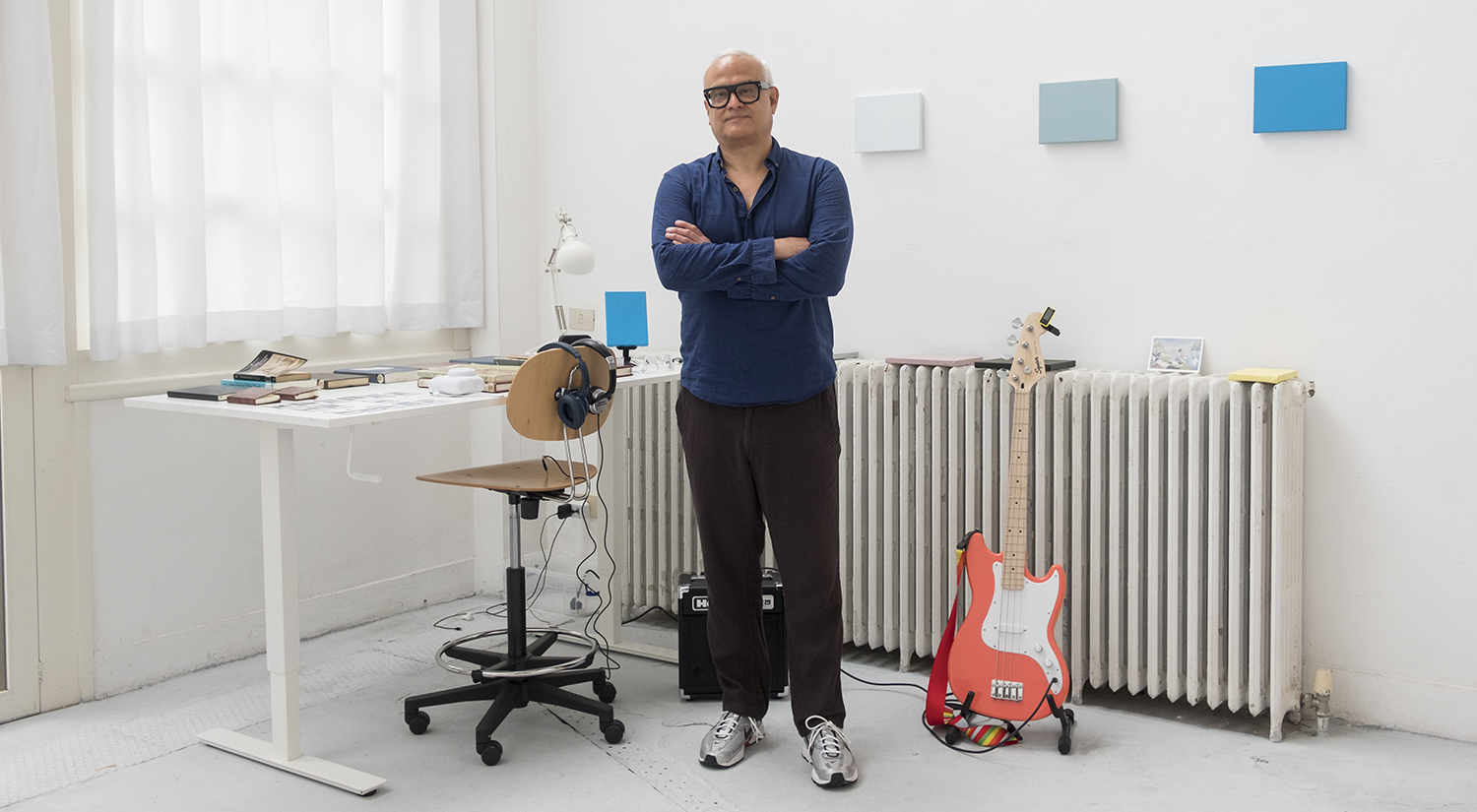
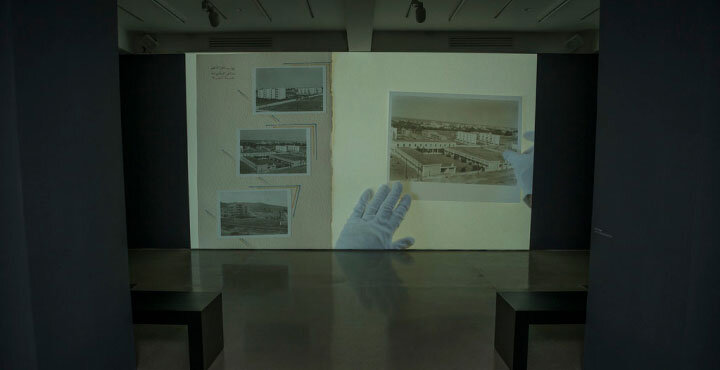
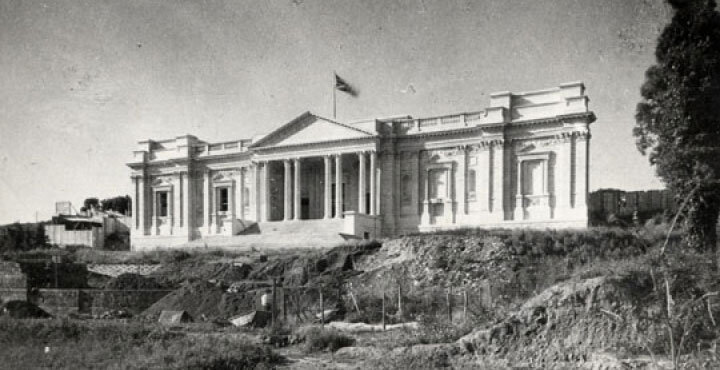
In this blog, Juan Bolivar —UAL Rome Research Fellow at the BSR from September to December 2025—shares reflections on his residency experience and the research he will present at the December 2025 Winter Open Studios.
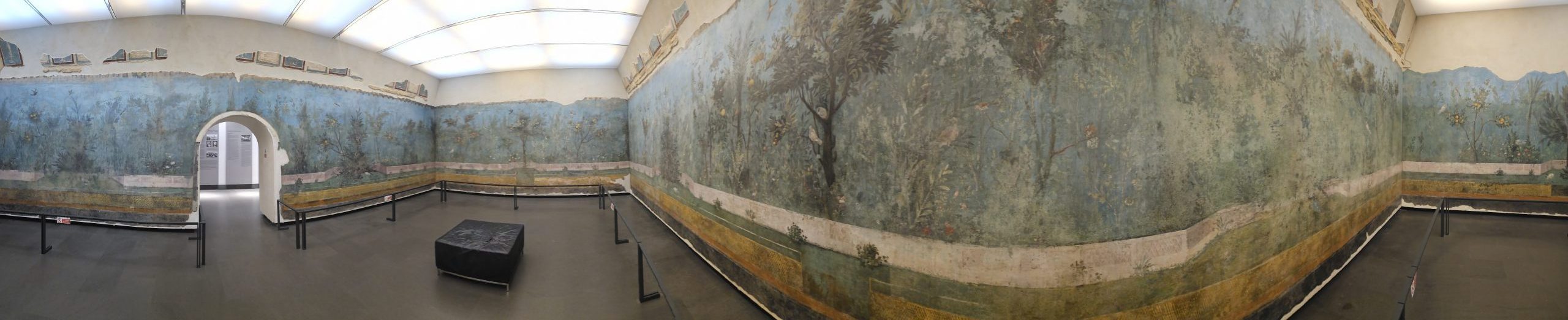
As part of my research I have been thinking about the social setting of fresco paintings with special focus on case studies such as Livia’s Garden, House of Augustus and St Ignatius Room in Rome, and the Room of Mysteries and House of the Orchards in Pompeii.
These encounters are slowly coalescing into outputs and ideas for future projects. My overall experience at the British School at Rome has been magical, sometimes in the literal sense with a serendipity of coincidences and discoveries along the way. I have been thinking about the use of colour, perspective and illusion in the interior space of frescoes but also the (less visible) surrounding objects, music and lighting of rooms with special attention to ‘lucernes’ or oil lamps.
In my practice I bring together disparate contexts for viewing and interpretation of painting. As a South American-born artist I am deeply influenced by Latin American Geometric Abstraction. Translocating to the UK in the 1980s heightened my awareness of this movement’s connections to Europe and North America. This enquiry has expanded to explore abstraction’s cross-cultural presence across new territories, from Dansaekhwa Korean monochromes, cinema, popular culture and now fresco painting.
Juan Bolivar, Painting 51 (assisted monochrome), 2025, acrylic on canvas and mirror (canvas 20 x 20 cm)
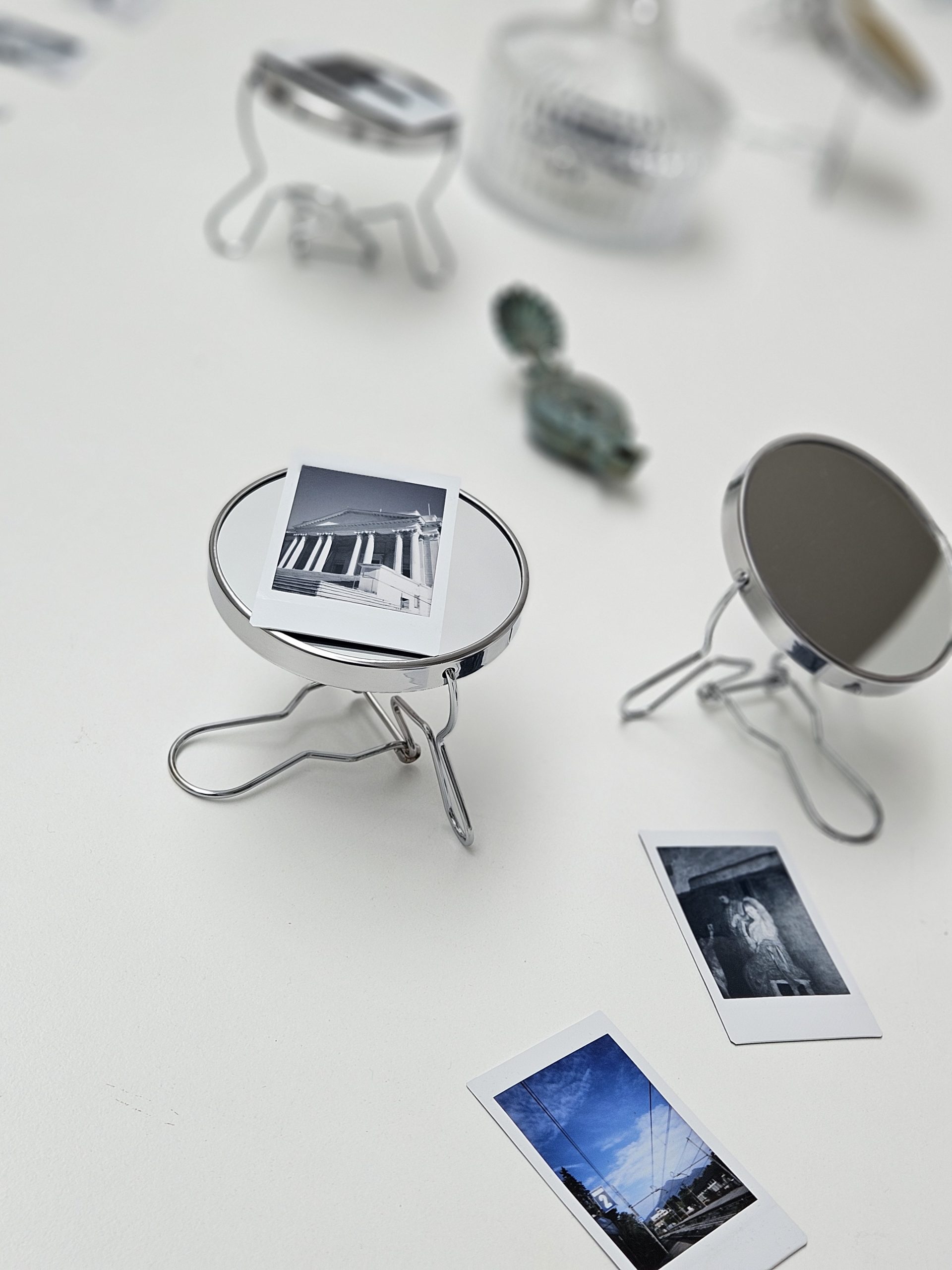
The experience as a BSR fellow has been unique and transformative actively and tacitly encouraging new conversations through planned and chance encounters so in addition to writing, painting, film and photography I have been learning to play the bass guitar and had a singing lesson with an opera singer. These activities echo and inform writing I have been working on about a travelling musician through whom I witness frescoes in Rome and Pompeii. There is a folding and looping of time echoed in panoramic photographs and in low resolution black and white polaroid photographs I have been taking, with imagery and textures suggesting this idea of memory and time travel.
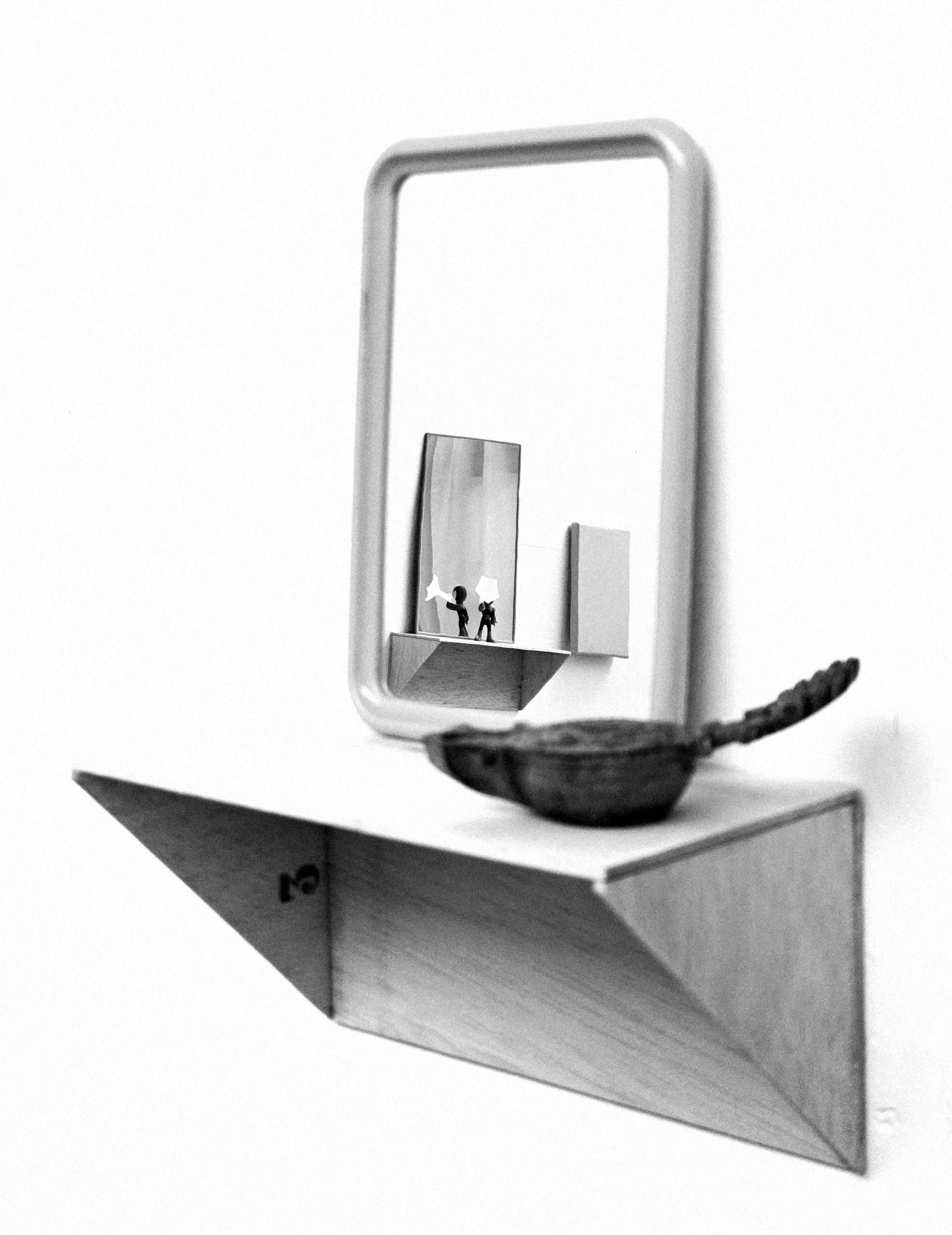
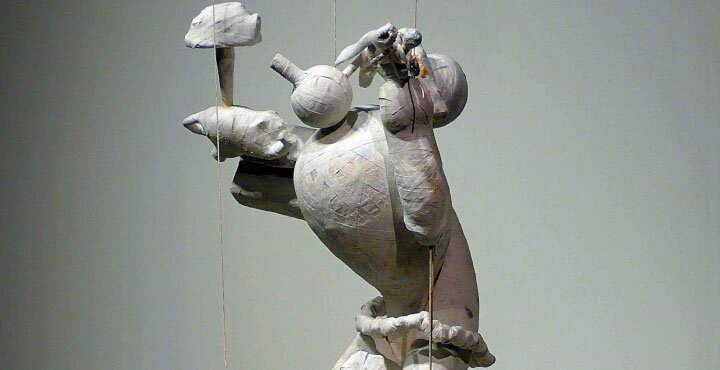
'Troubadour', 2025 Mirror, acrylic on canvas, replica oil lamp and toy spiderman. Dimensions variable
I have had the opportunity to visit the ancient city of Pompeii to see frescoes made using a highly sophisticated visual and material language. My interest here is how the frescoes formed part of a larger intermedial and social experience and operated as an unfolding space where images and patterns on walls acted as extensions of the interiors they were set within. This has led to research into how frescoes in Pompeiian painting communicated ideas of social status through a series of language games and visual clues and their evolution through the four styles of Pompeiian painting which varied in their use of flatness, perspective, insertion of pictures within pictures and decoration. These frescoes were executed by organised painting teams of artists and when completed they were accompanied by social activities interactions and entertainment; lit by oil lamps they created flickering shadows further animating these scenes.
'Thoughtographs' (Rome and Pompeii), 2025 Polaroids, mirrors and replica oil lamp. Dimensions variable
Having met and spoken to scholars, visual artists and academics here in Rome my ambition is to bring these explorations to a new stage for contemplation, magic realism and exploring painting’s social setting. In addition to an exhibition exploring the idea of a ‘total experience’, I am thinking how different perspectives can be brought together in a conference and possibly a book around the idea of the social setting of frescoes: from murals and wall painting to music, food and use of lighting. I am also interested in the idea of re-enactment and I hope this project can initiate a conversation with other institutions such as the Kelsey Museum, Michigan University who have as part of their collection a life size copy of Pompeii’s Room of Mysteries, painted in the 1920s, exhibited in Rome and later kept at the Kelsey where it has been ever since. In March next year I will be speaking at the Istituto Italiano di Cultura di Londra, sharing some of my experiences at BSR and plans for future research, artworks and collaborations.
Juan Bolivar, Painting 17 (assisted monochrome), 2025
Lisa-Marie Harris, Sainsbury Scholar at the BSR from January to June 2026, shares in this blog her reflections on her residency experience and the research
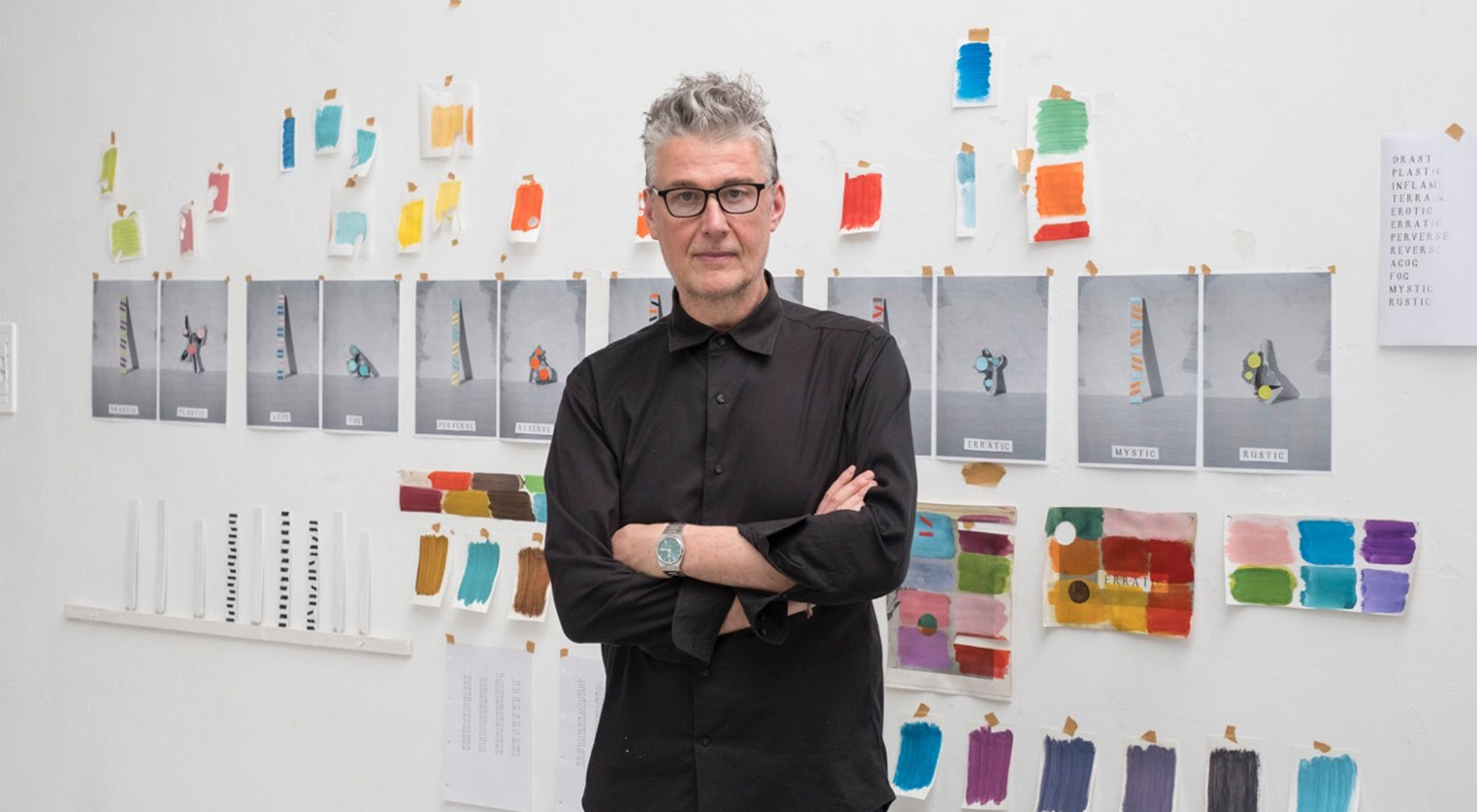
In this blog, David Osbaldeston, Abbey Fellow from January to March 2026, reflects on his residency experience and the research he presented at the Spring
Lisa-Marie Harris, Sainsbury Scholar at the BSR from January to June 2026, shares in this blog her reflections on her residency experience and the research
In this blog, David Osbaldeston, Abbey Fellow from January to March 2026, reflects on his residency experience and the research he presented at the Spring
We use cookies on our website to give you the most relevant experience by remembering your preferences and repeat visits. By clicking “Accept All”, you consent to the use of ALL the cookies. However, you may visit "Cookie Settings" to provide a controlled consent.
This website uses cookies to improve your experience while you navigate through the website. Out of these, the cookies that are categorized as necessary are stored on your browser as they are essential for the working of basic functionalities of the website. We also use third-party cookies that help us analyze and understand how you use this website. These cookies will be stored in your browser only with your consent. You also have the option to opt-out of these cookies. But opting out of some of these cookies may affect your browsing experience.
Necessary cookies are absolutely essential for the website to function properly. These cookies ensure basic functionalities and security features of the website, anonymously.
Cookie
Duration
Description
cookielawinfo-checkbox-advertisement
1 year
Set by the GDPR Cookie Consent plugin, this cookie records the user consent for the cookies in the "Advertisement" category.
cookielawinfo-checkbox-analytics
11 months
This cookie is set by GDPR Cookie Consent plugin. The cookie is used to store the user consent for the cookies in the category "Analytics".
cookielawinfo-checkbox-functional
11 months
The cookie is set by GDPR cookie consent to record the user consent for the cookies in the category "Functional".
cookielawinfo-checkbox-necessary
11 months
This cookie is set by GDPR Cookie Consent plugin. The cookies is used to store the user consent for the cookies in the category "Necessary".
cookielawinfo-checkbox-others
11 months
This cookie is set by GDPR Cookie Consent plugin. The cookie is used to store the user consent for the cookies in the category "Other.
cookielawinfo-checkbox-performance
11 months
This cookie is set by GDPR Cookie Consent plugin. The cookie is used to store the user consent for the cookies in the category "Performance".
CookieLawInfoConsent
1 year
CookieYes sets this cookie to record the default button state of the corresponding category and the status of CCPA. It works only in coordination with the primary cookie.
elementor
never
The website's WordPress theme uses this cookie. It allows the website owner to implement or change the website's content in real-time.
viewed_cookie_policy
11 months
The cookie is set by the GDPR Cookie Consent plugin and is used to store whether or not user has consented to the use of cookies. It does not store any personal data.
Functional cookies help to perform certain functionalities like sharing the content of the website on social media platforms, collect feedbacks, and other third-party features.
Performance cookies are used to understand and analyze the key performance indexes of the website which helps in delivering a better user experience for the visitors.
Analytical cookies are used to understand how visitors interact with the website. These cookies help provide information on metrics the number of visitors, bounce rate, traffic source, etc.
Cookie
Duration
Description
_ga
1 year 1 month 4 days
Google Analytics sets this cookie to calculate visitor, session and campaign data and track site usage for the site's analytics report. The cookie stores information anonymously and assigns a randomly generated number to recognise unique visitors.
_ga_*
1 year 1 month 4 days
Google Analytics sets this cookie to store and count page views.
_gat_gtag_UA_*
1 minute
Google Analytics sets this cookie to store a unique user ID.
_gid
1 day
Google Analytics sets this cookie to store information on how visitors use a website while also creating an analytics report of the website's performance. Some of the collected data includes the number of visitors, their source, and the pages they visit anonymously.
CONSENT
2 years
YouTube sets this cookie via embedded YouTube videos and registers anonymous statistical data.
Advertisement cookies are used to provide visitors with relevant ads and marketing campaigns. These cookies track visitors across websites and collect information to provide customized ads.
Cookie
Duration
Description
VISITOR_INFO1_LIVE
5 months 27 days
YouTube sets this cookie to measure bandwidth, determining whether the user gets the new or old player interface.
YSC
session
Youtube sets this cookie to track the views of embedded videos on Youtube pages.