Anna Clough, Rebecca Scott Rome Resident at the BSR from January to March 2026, shares in this blog her reflections on her residency experience and the research she is carrying out.
‘It is much better to think of the present as an artefact of the sliding of the past against future like trains at a junction. I call this sliding nowness.’ 1
During my time in Rome, I have been focusing on sculptural and sound work.
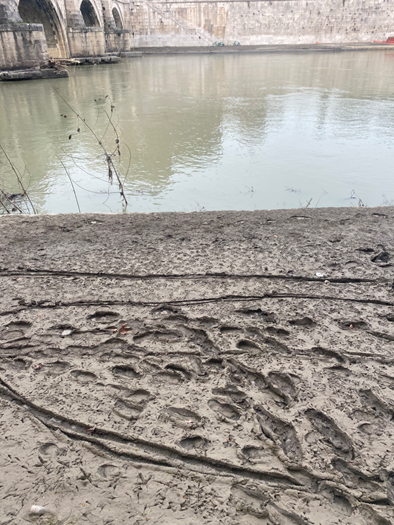
Throughout the residency, I have been spending time at the Tiber River, which has been flooding, washing clay onto the paths that run along it. At points, the silt completely covers the path with a thick layer, all the way from the bamboo-studded banks to the shoreline. In Rome, the recycling of history is present on every street corner, ideas and materials losing their chronology. The past becomes mystified, much like the paths parallel to the Tiber – where not even the efficient technology of Lime Bikes can get through!
The mud from the river Tiber.
Occasionally, when walking, I come across debris abandoned by the current; logs, stones, leaves, man-made litter. To cross, I hop onto this material. It provides a make-shift stepping-stones, guiding me. Beyond creating a path, it signals where the river has been, an organic archive of the past. But to me, it also shows signs of what may come next, like futures are read in the patterns of stranded tea leaves. Debris can tellstories. This is what I read on the banks of the Tiber.
‘The proper, fitting shape of the novel might be that of a sack, a bag. A book holds words. Words hold things.’2
I climb up onto the bank to collect dry bamboo leaves. Bamboo is new to Rome and doesn’t grow from seed; instead, it self-reproduces. Underneath the ground, its roots form a large network spreading outwards, digesting rotting leaves, mud and crisp packets, springing up new shoots as it goes.
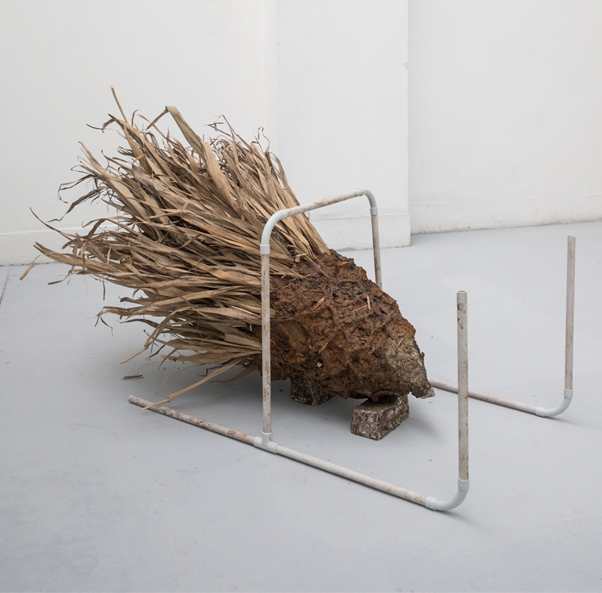
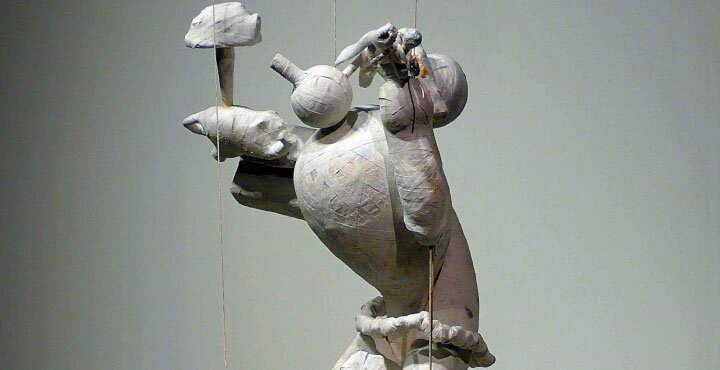
‘Modes’, (2026) Newspaper, bamboo leaves, pigment, soil, wire, tinfoil, plastic piping and sand. 116 x 64 x 67cm.
I can’t define whether the bamboo is decaying or growing. The plant is expanding in every direction across the bank; nothing is standing in its way. I can’t tell where it starts or finishes, whether it’s an old stem or a new one.
‘…time was not passing…it was turning in a circle…’3
One day soon, it will reach the bridge. I wonder what will happen when its roots meet the stone; perhaps it will force its way through the materials’ weak points. It will wait until the lights turn green and cross over the road. I imagine it would carry a comb to keep its leaves in order.
I cannot truly understand how the Bamboo communicates its living. Perhaps its voice is silent or uses a language I cannot comprehend. But I can trust it has an inherent obligation to grow, to die, and to make music whilst doing it.
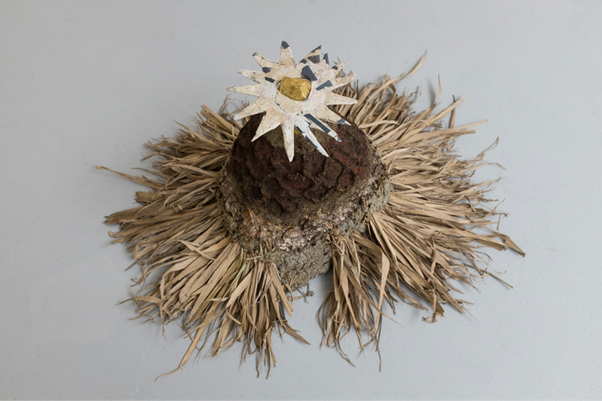
‘Sun-King’, (2026) bamboo leaves, sand, mud, newspaper, gold leaf, found posters, cardboard, tinfoil, wood & chicken wire. 120 x 80 x 50cm
I’ve read that Orpheus’s music was so fantastical that stones and trees would dance to it. He falls in love with Eurydice, who dies when bitten by a snake. Hades, the god of the Underworld, makes a deal with Orpheus that she can come back. The deal is: Eurydice must walk behind Orpheus until they return to the mortal surface, and he must trust that she is there, without looking back at her.
Robbed of his sight, he can only listen to the body-less music of her voice. Without a tangible connection to Eurydice, he becomes afraid. When they near the end of their journey, despite her words of reassurance, he looks back for her.
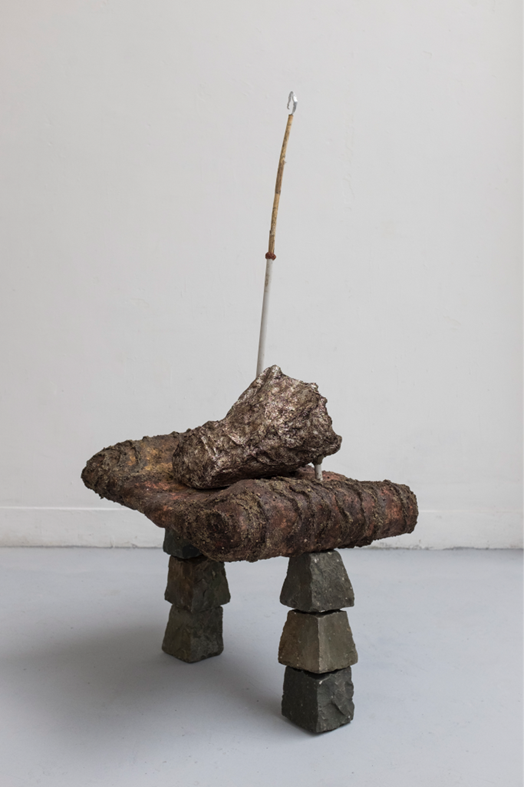
‘Sampietrini’ (2026), plaster, tin foil, bamboo, soil, pigment, plastic piping, sampietrini, sand, wire, wood. 63 x 54 x 136cm
Behind me, there is a Canoeist speeding along the Tiber. A Nutria sits on the bank opposite, chewing disappointedly. She comments on the Willow branches, so old that they taste of vinegar and history.
‘Too bland this, and half rotten, I can’t stomach another day chewing that!’ She whistles through her tangerine-stained teeth.
The Canoeist hears this, and in his own way, feels sorry for her.Remembering his tasty pre-training banana, he turns back. He kindly offers her his wooden vanished ore to gnaw on instead.
She gobbles it in one bite.
‘Oi!’ Croaks the Willow, with the billow-honk voice of an old accordion, ‘you’ll put me out of a job I’ve been feeding Nutria since before you were born!’
The Canoeist apologises and glides away.
Meanwhile, the Nutria is admires how shiny her orange teeth have become.
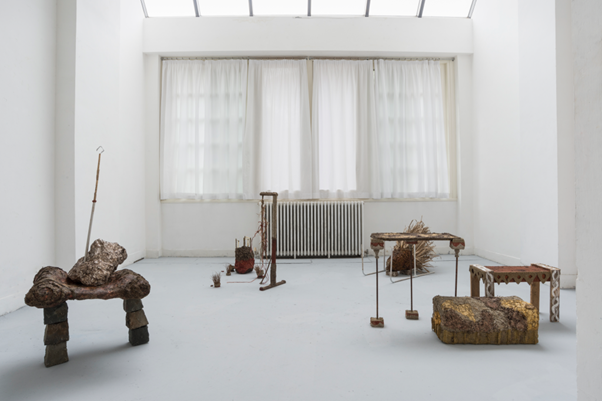
Photograph of artwork from the Open Studios event in March 2026.
You Never Know How the Past Will Turn Out, Timothy Morton, 2019.
The Carrier Bag Theory of Fiction, Ursula K. Le Guin, 1986.
One Hundred Years of Solitude, Gabriel García Márquez, 1967.
Lisa-Marie Harris, Sainsbury Scholar at the BSR from January to June 2026, shares in this blog her reflections on her residency experience and the research
In this blog, David Osbaldeston, Abbey Fellow from January to March 2026, reflects on his residency experience and the research he presented at the Spring
For over thirty years the BSR has run undergraduate (Summer School) and postgraduate (City of Rome) courses on the ancient history, archaeology, and topography of
Lisa-Marie Harris, Sainsbury Scholar at the BSR from January to June 2026, shares in this blog her reflections on her residency experience and the research
In this blog, David Osbaldeston, Abbey Fellow from January to March 2026, reflects on his residency experience and the research he presented at the Spring
For over thirty years the BSR has run undergraduate (Summer School) and postgraduate (City of Rome) courses on the ancient history, archaeology, and topography of
We use cookies on our website to give you the most relevant experience by remembering your preferences and repeat visits. By clicking “Accept All”, you consent to the use of ALL the cookies. However, you may visit "Cookie Settings" to provide a controlled consent.
This website uses cookies to improve your experience while you navigate through the website. Out of these, the cookies that are categorized as necessary are stored on your browser as they are essential for the working of basic functionalities of the website. We also use third-party cookies that help us analyze and understand how you use this website. These cookies will be stored in your browser only with your consent. You also have the option to opt-out of these cookies. But opting out of some of these cookies may affect your browsing experience.
Necessary cookies are absolutely essential for the website to function properly. These cookies ensure basic functionalities and security features of the website, anonymously.
Cookie
Duration
Description
cookielawinfo-checkbox-advertisement
1 year
Set by the GDPR Cookie Consent plugin, this cookie records the user consent for the cookies in the "Advertisement" category.
cookielawinfo-checkbox-analytics
11 months
This cookie is set by GDPR Cookie Consent plugin. The cookie is used to store the user consent for the cookies in the category "Analytics".
cookielawinfo-checkbox-functional
11 months
The cookie is set by GDPR cookie consent to record the user consent for the cookies in the category "Functional".
cookielawinfo-checkbox-necessary
11 months
This cookie is set by GDPR Cookie Consent plugin. The cookies is used to store the user consent for the cookies in the category "Necessary".
cookielawinfo-checkbox-others
11 months
This cookie is set by GDPR Cookie Consent plugin. The cookie is used to store the user consent for the cookies in the category "Other.
cookielawinfo-checkbox-performance
11 months
This cookie is set by GDPR Cookie Consent plugin. The cookie is used to store the user consent for the cookies in the category "Performance".
CookieLawInfoConsent
1 year
CookieYes sets this cookie to record the default button state of the corresponding category and the status of CCPA. It works only in coordination with the primary cookie.
elementor
never
The website's WordPress theme uses this cookie. It allows the website owner to implement or change the website's content in real-time.
viewed_cookie_policy
11 months
The cookie is set by the GDPR Cookie Consent plugin and is used to store whether or not user has consented to the use of cookies. It does not store any personal data.
Functional cookies help to perform certain functionalities like sharing the content of the website on social media platforms, collect feedbacks, and other third-party features.
Performance cookies are used to understand and analyze the key performance indexes of the website which helps in delivering a better user experience for the visitors.
Analytical cookies are used to understand how visitors interact with the website. These cookies help provide information on metrics the number of visitors, bounce rate, traffic source, etc.
Cookie
Duration
Description
_ga
1 year 1 month 4 days
Google Analytics sets this cookie to calculate visitor, session and campaign data and track site usage for the site's analytics report. The cookie stores information anonymously and assigns a randomly generated number to recognise unique visitors.
_ga_*
1 year 1 month 4 days
Google Analytics sets this cookie to store and count page views.
_gat_gtag_UA_*
1 minute
Google Analytics sets this cookie to store a unique user ID.
_gid
1 day
Google Analytics sets this cookie to store information on how visitors use a website while also creating an analytics report of the website's performance. Some of the collected data includes the number of visitors, their source, and the pages they visit anonymously.
CONSENT
2 years
YouTube sets this cookie via embedded YouTube videos and registers anonymous statistical data.
Advertisement cookies are used to provide visitors with relevant ads and marketing campaigns. These cookies track visitors across websites and collect information to provide customized ads.
Cookie
Duration
Description
VISITOR_INFO1_LIVE
5 months 27 days
YouTube sets this cookie to measure bandwidth, determining whether the user gets the new or old player interface.
YSC
session
Youtube sets this cookie to track the views of embedded videos on Youtube pages.