

This is the third in a series of lectures on Material Environments, hosted jointly by the American Academy in Rome and the British School at Rome over the academic year 2025-2026. Through several evening lectures, speakers will present new research on environments of ancient and post-Classical Rome and Italy. Changing technologies of research provide new answers to questions about the experience and effect of landscape and climate. These lectures showcase the ways in which environmental considerations recast our study of the past.
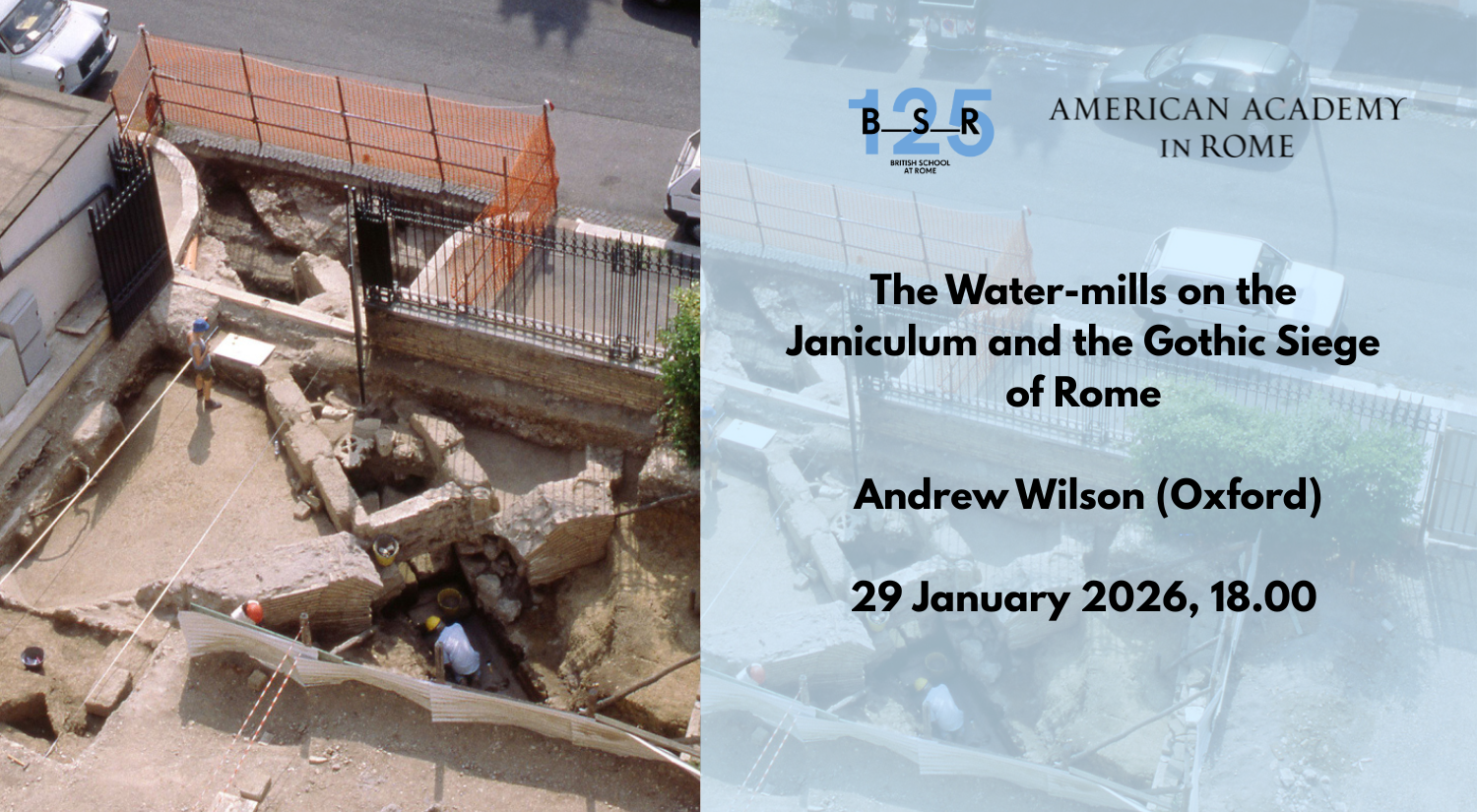
This talk draws together the results of several excavation campaigns in and around the parking lot of the American Academy on Via Medici in 1990–91 and 1998–99 and explores their significance for the changes to the material environment of the Janiculum hill and of Trastevere more generally before and after the Gothic siege of AD 537. Probably in the late third century AD, a multi-wheeled water-mill complex was built astride the Aqua Traiana in what is now Via Medici. This was burned, probably in Alaric’s sack of Rome, and the site was converted into a water-drawing point where a water-wheel lifted water out of the Aqua Traiana. In the Gothic siege of 537, the Byzantine defenders blocked the aqueduct to prevent the Goths entering through it. This had long-term consequences for the settlement topography of medieval and early modern Trastevere which are still visible in the urban landscape today.
Andrew Wilson is Professor of the Archaeology of the Roman Empire at the University of Oxford.
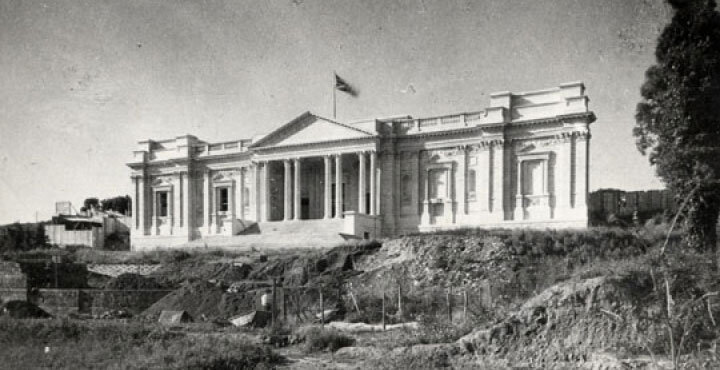
This event will take place at the American Academy in Rome, McKim, Mead & White BuildingVia Angelo Masina, 5. More info here.
Please note that this event has been postponed: the new date is 18 June 2026.