

‘… I have seen with my own eyes and measured with my own hands the fragments of many ancient buildings, these remaining standing in our times with marvellous spectacle …’.
Andrea Palladio
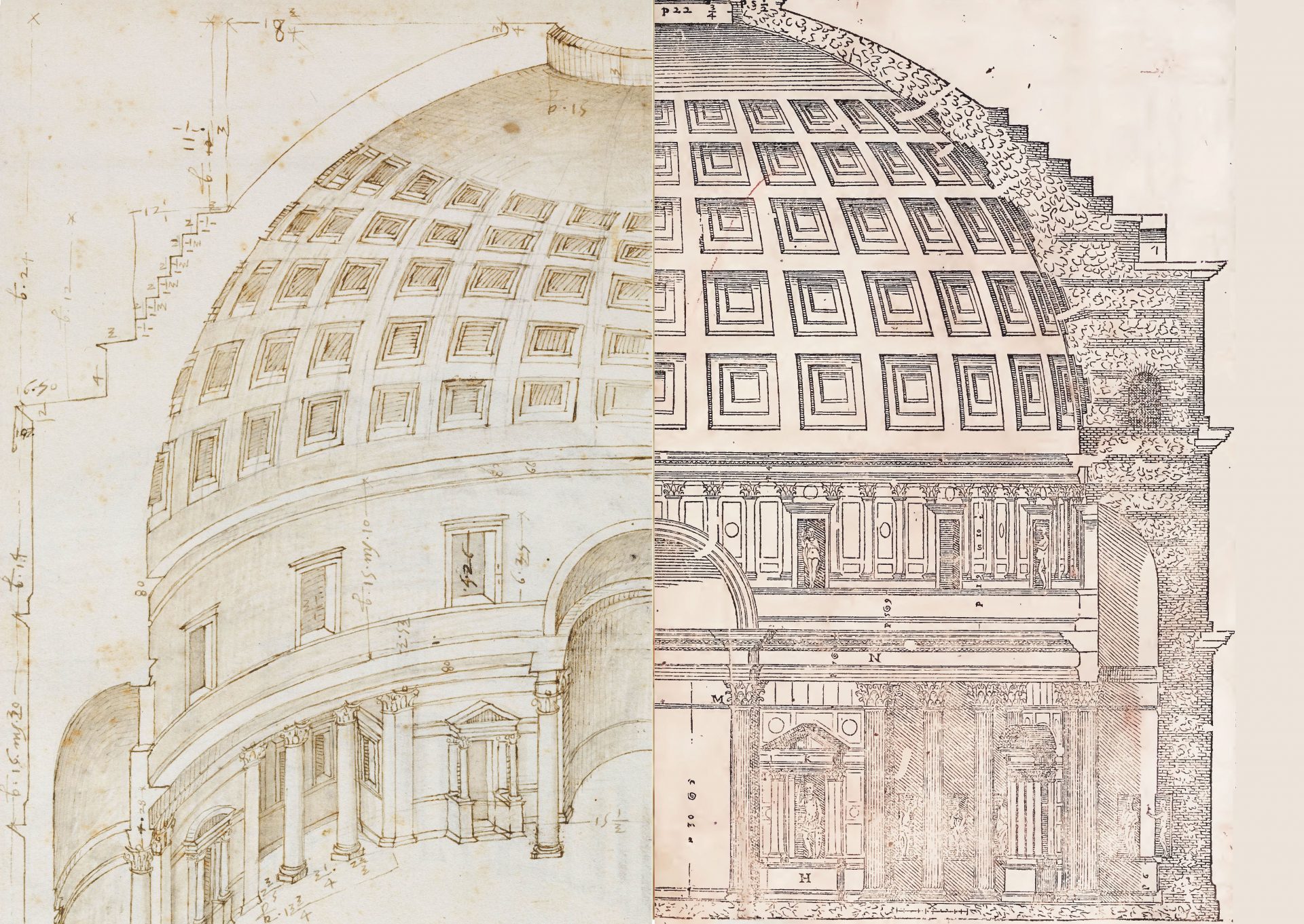
The buildings of antiquity, especially those in Rome, were of fundamental interest to Renaissance architects over the course of the first half of the sixteenth century. During a very few decades, numerous works were surveyed and recorded, often for the first time, and in ever more exacting detail and with ever greater sophistication, among them Rome’s Colosseum and Pantheon and very many other prominent monuments. This great achievement not only provided a touchstone for contemporary Renaissance architecture but would also lay the foundations for modern-day archaeology. Although the contributions of many illustrious architects and draughtsmen are now lost, enough material still survives to chart the extraordinarily rapid acquisition of knowledge during this remarkable time, which includes drawings from the early sixteenth century by Giuliano da Sangallo and members of the circles of Bramante and Raphael, and those later on by Antonio da Sangallo the Younger, Andrea Palladio and Pirro Ligorio.
The conference will re-evaluate the advances made in the depiction and surveying of antiquities over this fifty-year period. It will stress how the various steps taken can be justifiably understood as a common enterprise, which then fuelled the activities and accomplishments of numerous individuals, and it will explore how these figures also responded to the initiatives of their predecessors and contemporaries. It will emphasise, therefore, that such work was not conceived in seclusion, and was rarely conducted in isolation, but involved a great deal of sharing in expertise and resource; but it will also examine how, as time went by, the aims and methods of the principal exponents in the field, from Bramante to Palladio, gradually changed. Also considered will be how individual practitioners devised their own particular methods for recording antiquities, in what ways they utilised earlier drawings in the productions of their own, how and why new recording techniques were developed, and how drawn reconstructions were conceived.
In focusing on the subject of the surveying, depicting and reconstructing ancient buildings in the sixteenth century, the conference will be of major interest to historians both of Renaissance architecture and of ancient and Renaissance Rome and its topography. It will also be of relevance to curators and researchers in the fields of classics, history and art history more generally, as well as to non-academics with interests in the study of antiquity or archaeology, such as professionals involved with the documentation and preservation of Rome’s ancient heritage.
The event will be held both in-person and online. Registration is mandatory through the links at the top of this page.